
 Worksheets
Periodic Table Review
Total questions: 104
Worksheet time: 2hrs 18mins
Name
Class
Date
1.
In the modern periodic table elements are arranged by:
a)
atomic mass
b)
atomic number
c)
valence electrons
d)
number of isotopes
2.
Each column in the periodic table is called a
a)
period
b)
group
c)
cluster
d)
unit
3.
The atomic number tells you what?
a)
number of electrons
b)
number of protons
c)
number of neutrons
d)
both electrons and protons in an atom.
4.

What does the 1.00794 stand for?
a)
Hydrogen
b)
atomic number
c)
atomic mass
d)
atomic explosion
5.

How many protons are in Beryllium?
a)
4
b)
9
c)
5
d)
2
6.
Why is water NOT on the periodic table?
a)
It is naturally occuring
b)
It is a compound, not an element
c)
It exists as a solid, a liquid, and a gas
d)
Its chemical formula doesn't fit
7.
_______ are the ROWS on the periodic table.
a)
Families
b)
Groups
c)
Periods
d)
Elements
8.
which one can be found on the periodic table
a)
Compound
b)
Element
9.
Which of the following is not a compound?
a)
HCl
b)
Cl
c)
NaCl
d)
CO2
10.
Choose the answer which contains ONLY elements.
a)
carbon dioxide, carbon, boron
b)
water, calcium, bromine
c)
hydrogen, carbon dioxide, paper
d)
gold, silver, iron
11.
The chemical formula for table sugar (sucrose) is C12H22O11. Name all the elements found in this compound.
a)
Oxygen, carbon, hydrogen
b)
Calcium, helium, iodine
c)
Oxygen, calcium, hydrogen
d)
Helium, carbon, oxygen
12.
How many electrons should Magnesium have around its Lewis dot model?
a)
1
b)
2
c)
3
d)
4
13.

Which subatomic particle has no electric charge?
a)
the proton
b)
the neutron
c)
the electron
d)
the photon
14.
How many electrons should Neon have around its Lewis dot model?
a)
5
b)
6
c)
7
d)
8
15.
Where are valence electrons found in an atom?
a)
first electron shell
b)
second electron shell
c)
third electron shell
d)
outermost electron shell for most atoms
16.
The family in the periodic table that contains the most reactive metals is the_______
a)
Alkaline Earth Metals
b)
Transition Metals
c)
Alkali Metals
d)
Other Metals
17.
Which group of the periodic table is composed of inert (not reactive) gases?
a)
alkali metals
b)
alkaline earth metals
c)
halogens
d)
noble gases
18.
A negatively charged particle that moves around the nucleus is a(n)
a)
proton
b)
neutron
c)
electron
d)
quark
19.

The atomic number of this pictured element is
a)
28
b)
58.6934
c)
Ni
d)
Nickel
20.
How many electrons do atoms need to be stable?
a)
1
b)
2
c)
6
d)
8
21.
Elements which are shiny, conduct electricity and heat are called
a)
metal
b)
nonmetal
c)
metalloid
d)
nonexistent
22.

The yellow atoms are called
a)
metals
b)
nonmetals
c)
metalloids
d)
noble gases
23.

The atoms along the staircase are called
a)
metals
b)
nonmetals
c)
metalloids
d)
noble gases
24.
An isotope is the same element with a different number of...? (4.3)
a)
Protons
b)
Neutrons
c)
Electrons
25.
Which element is not in the Alkali metal family?
a)
Li
b)
H
c)
Fr
d)
Cs
26.
Which element is not a metal?
a)
H
b)
Re
c)
Al
d)
B
27.
Elements on the right side of the of the zigzag line are normally?
a)
non metals
b)
metals
c)
metalloids
d)
rare earth metals
28.
Group Name and Number for Neon
a)
Alkaline Earth Metals 2 or 2A
b)
Noble Gases 18 or 8A
c)
Halogens 17 or 7A
d)
Alkali Metals 1 or 1A
29.
Group Name and Number for Flourine
a)
Transition Metals 3-12
b)
Noble Gases 18 or 8A
c)
Halogens 17 or 7A
d)
Alkali Metals 1 or 1A
30.
Group Name and Number for Magnesium
a)
Alkaline Earth Metals 2 or 2A
b)
Noble Gases 18 or 8A
c)
Halogens 17 or 7A
d)
Alkali Metals 1 or 1A
31.

In what section would Transition Metals be found?
a)
orange
b)
light blue
c)
blue
d)
white
32.

What section is the least reactive?
a)
yellow
b)
red
c)
dark blue
d)
orange
33.
Sodium (Na) and potassium (K) are in the same group on the periodic table. Based on their locations, which statement about sodium and potassium is true?
a)
Sodium is less electronegative than potassium.
b)
Sodium has fewer energy levels than potassium.
c)
Sodium has a larger ionic radius than potassium.
d)
Sodium has lower ionization energy than potassium.
34.
Which of these elements has the greatest atomic radius?
a)
H
b)
N
c)
Cl
d)
Cs
35.
The Periodic Table of the Elements is useful for revealing patterns and trends in the elements. Which statement accurately describes a pattern in the size of atomic radii in the Periodic Table of the Elements?
a)
Atomic radii decrease from left to right across a period and decrease from top to bottom in a group.
b)
Atomic radii increase from left to right across a period and increase from top to bottom in a group.
c)
Atomic radii decrease from left to right across a period and increase from top to bottom in a group.
d)
Atomic radii increase from left to right across a period and decrease from top to bottom in a group.
36.

The symbols W, X, Y, and Z represent four elements shown on the outline of a periodic table.
Which element has the highest electronegativity?
Which element has the highest electronegativity?
a)
W
b)
X
c)
Y
d)
Z
37.
All elements found on the left side of the Periodic Table of the Elements have what properties in common?
a)
They conduct heat and electricity
b)
They are all gases
c)
They are brittle and dull
d)
They are radioactive
38.

Which of these elements has an electron structure most similar to that of element X?
a)
1
b)
2
c)
3
d)
4
39.
The number of valence electrons in an element affects the reactivity of that element. Which element listed has the fewest valence electrons?
a)
beryllium (Be)
b)
sodium (Na)
c)
oxygen (O)
d)
neon (Ne)
40.
Which element has 2 valence electrons?
a)
cesium (Cs)
b)
magnesium (Mg)
c)
boron (B)
d)
argon (Ar)
41.
Which of the following will have a lower ionization energy than Scandium (Sc)?
a)
Helium (He)
b)
Titanium (Ti)
c)
Calcium (Ca)
d)
Magnesium (Mg)
42.
Which atom has the largest atomic radius?
a)
potassium
b)
rubidium
c)
francium
d)
cesium
43.
Electronegativity is...
a)
how good an atom is at attracting electrons
b)
the ability of an atom to lose electrons
c)
the energy required to remove an electron from a specific atom
d)
how easy it is to make friends.
44.
Metals have the largest -
a)
atomic radius and electronegativity
b)
electronegativity and ionization energy
c)
atomic radius only
d)
ionization energy and atomic radius
45.
Which of the following will have a larger radius than Zinc?
a)
Gallium
b)
Aluminum
c)
Magnesium
d)
Strontium
46.
As you move down the periodic table atoms get bigger. This is because ____________.
a)
The atoms have more mass.
b)
The atoms have more protons.
c)
The atoms have more energy levels
d)
The atoms have more neutrons
47.

Beryllium is in group number______.
a)
Group 2
b)
Group 3
c)
Group 4
d)
Group 7
48.

The period for Bromine is ___________.
a)
3
b)
2
c)
4
49.
As you move down the periodic table atoms get bigger. This is because ____________.
a)
The atoms have more mass.
b)
The atoms have more protons.
c)
The atoms have more energy levels
d)
The atoms have more neutrons
50.
As atoms of elements in group 16 are considered in order from top to bottom, the electronegativity of each successive element....
a)
decreases
b)
increases
c)
remains the same
d)
none of the above
51.
Ionization energy is...
a)
the energy required to add an electron to a specific atom
b)
how much energy it takes to remove an electron from an atom
c)
the energy required to shield the outer electrons from the nucleus
d)
a measure of the ability of an atom to attract electrons
52.
Electronegativity __________ from left to right within a period and __________ from top to bottom within a group.
a)
decreases, increases
b)
increases, increases
c)
increases, decreases
d)
stays the same, increases
53.
Which of the following is not a property of metals?
a)
brittle
b)
malleable
c)
lustrous
d)
conductive
54.
Which is a halogen?
a)
Helium
b)
Chlorine
c)
Oxygen
d)
Neptune
55.
According to the Periodic Table of the Elements, which set of elements has similar properties?
a)
H, C, I
b)
He, H, Al
c)
He, Ne, Ar
d)
Na, Ca, Al
56.
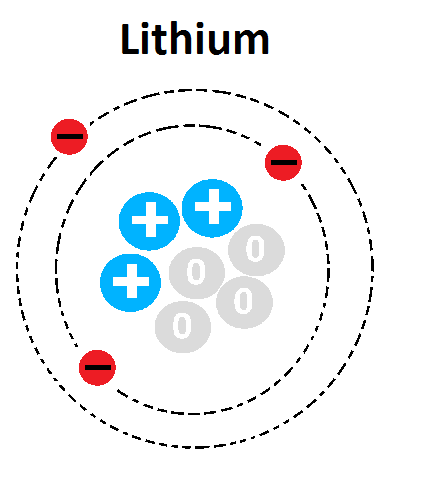
What is the atomic number of this atom?
a)
1
b)
3
c)
4
d)
7
57.
Most of the atom is made of...
a)
Protons and Neutron
b)
Electrons
c)
Empty space
d)
Aliens from outer space
58.
Which particle(s) are not found in the nucleus?
a)
Electrons only
b)
Protons only
c)
Protons and Neutrons
d)
Protons and Electrons
59.
Which particle(s) can be found inside the nucleus?
a)
Protons only
b)
Electrons only
c)
Protons and Electrons
d)
Protons and Neutrons
60.
the central region of an atom where its neutrons and protons are is its
a)
nucleus
b)
electron cloud
c)
core
d)
center
61.
A particle that moves around the nucleus is a(n)...
a)
Proton
b)
Neutron
c)
Electron
d)
Quark
62.
What atom matches this electron configuration?
1s22s22p63s23p64s23d10
1s22s22p63s23p64s23d10
a)
Zinc
b)
Copper
c)
Nickel
d)
Germanium
63.
Which of the following is true for d-block elements
a)
to identify d-block elements the number d is the group number
b)
to identify d-block elements add a one to the d number and that is the group number
c)
to identify d-block elements you add the number d with the number s to figure group number
d)
to identify d-block elements you take the number d and subtract the number s
64.
How many electrons can the f sublevel contain?
a)
6
b)
10
c)
14
d)
2
65.

How many electrons does Si contain? (click to see image)
a)
14
b)
28
c)
2
d)
4
66.
How many electrons can the first energy level hold?
a)
1
b)
2
c)
8
d)
0
67.
The electron configuration of an atom is 1s22s22p6. The number of electrons in the atom is
a)
3
b)
5
c)
8
d)
10
68.
Which electron configuration belongs to Chlorine (Cl)?
a)
1s2 2s2 2p6 3s2 3p5
b)
1s2 2s2 2p6 3s2 3p6
c)
1s2 2s2 2p6 3s2 3p7
69.
What is the electron configuration of Ag?
a)
1s2 2s2 2p6 3s2 3p6 4s2 3d10 4p6 5s24d9
b)
[Kr] 5s2 4d9
c)
1s2 2s2 2p6 3s2 3p6 4s2 4p6 5s2 4d9
d)
1s2 2s2 2p6 3s2 3p6 3d10 4s2 4d10 4p6 5d10 5s2 4d9
70.
There are 4 different types of subshells s,p,d,f
a)
true
b)
false
71.
How many electrons can the d sublevel hold?
a)
8
b)
10
c)
2
d)
4
72.
What atom matches this electron configuration?
[Xe] 6s2 4f14 5d9
[Xe] 6s2 4f14 5d9
a)
Mercury
b)
Gold
c)
Platinum
d)
Thallium
73.
Identify the Electron Configuration for Aluminum (Al)
a)
1s2 2s2 2p6 3s2 3p1
b)
1s2 2s2 2p6 3s2 3p3
c)
1s2 2s2 2p6 3s2 4p1
74.
How many electrons can the second energy level hold?
a)
1
b)
2
c)
8
d)
18
75.
which of the following is not true about periodic table
a)
there are 18 groups
b)
there are 7 periods
c)
there are 7 groups
d)
the groups are the vertical columns
76.
What is the noble gas configuration for phosphorus?
a)
[Ar] 3p5
b)
[He] 3s2 3p5
c)
[Ne] 3s2 3p3
d)
[Na] 3s2 3p5
77.
[Ne]3s1 is the noble gas configuration for which element?
a)
sodium
b)
lithium
c)
fluorine
d)
aluminum
78.
What is the noble gas configuration for boron?
a)
[He]1s22s2
b)
[He]2s22p2
c)
[He]2s22p1
d)
[Li]2s22p1
79.
What is the noble gas configuration for beryllium?
a)
[He]1s2
b)
[He]2s2
c)
[Li]2s1
d)
[Li]2s2
80.
What is the noble gas configuration for phosphorus?
a)
[Ar] 3p5
b)
[He] 3s2 3p5
c)
[Ne] 3s2 3p3
d)
[Na] 3s2 3p5
81.
What is the noble gas configuration for Neon?
a)
[Ne]
b)
[He]2s22p6
c)
[F]2p1
d)
[Ne]2s21p6
82.
[Ne]3s1 is the noble gas configuration for which element?
a)
sodium
b)
lithium
c)
fluorine
d)
aluminum
83.
[Ne]3s23p1 is the noble gas configuration for which element?
a)
scandium
b)
boron
c)
nitrogen
d)
aluminum
84.
[Ne]3s23p5 is the noble gas configuration for which element?
a)
chlorine
b)
fluorine
c)
sulfur
d)
aluminum
85.
What is the noble gas configuration for Argon?
a)
[Ne]2s22p6
b)
[He]2s22p6
c)
[He]3s23p6
d)
[Ne]3s23p6
86.
[He]2s22p4 is the noble gas configuration for which element?
a)
oxygen
b)
sulfur
c)
phosphorus
d)
fluorine
87.
Chlorine, bromine, and iodine were grouped together in the earliest forms of the periodic table, including the table developed by Mendeleev. What was an organizing principle in this grouping at that time?
a)
Atoms of the three elements had approximately the same mass.
b)
The three elements react the same way with other elements.
c)
The elements have the same number of valence electrons.
d)
These three elements are all gases at room temperature
88.
Which of these elements has an electron structure most similar to that of element X?
a)
1
b)
2
c)
3
d)
4
89.
Based on their locations in the periodic table, which element has chemical properties most similar to those of calcium, Ca?
a)
beryllium, Be
b)
potassium, K
c)
titanium, Ti
d)
yttrium, Y
90.

What is the family name of this group of elements?
a)
Alkali metals
b)
Halogens
c)
Noble Gases
d)
Alkali Earth Metals
91.
Which element has 2 valence electrons?
a)
cesium (Cs)
b)
magnesium (Mg)
c)
boron (B)
d)
argon (Ar)
92.
Which of these elements has the greatest atomic radius?
a)
H
b)
N
c)
Cl
d)
Cs
93.
Going from left to right in the periodic table, the atomic radius decreases. Which of the following explains the atomic radii trend of elements going down a period?
a)
There is an increase in the number of electron shells
b)
There is a decrease in the number of electron shells
c)
The attraction increases between the protons and the valence electrons because there is no shielding effect.
d)
The attraction decreases between the neutrons and the valence electrons because of the shielding effect
94.
The Periodic Table of the Elements is useful for revealing patterns and trends in the elements. Which statement accurately describes a pattern in the size of atomic radii in the Periodic Table of the Elements?
a)
Atomic radii decrease from left to right across a period and decrease from top to bottom in a group.
b)
Atomic radii increase from left to right across a period and increase from top to bottom in a group.
c)
Atomic radii decrease from left to right across a period and increase from top to bottom in a group.
d)
Atomic radii increase from left to right across a period and decrease from top to bottom in a group.
95.
The symbols W, X, Y, and Z represent four elements shown on the outline of a periodic table.
Which element has the highest electronegativity?
Which element has the highest electronegativity?
a)
W
b)
X
c)
Y
d)
Z
96.
Which statement best describes the electronegativity of the elements?
a)
Electronegativity decreases with increasing atomic number within a period
b)
Electronegativity decreases with increasing atomic number within a group
c)
Electronegativity tends to be higher in the metals than in the nonmetals.
d)
Electronegativity tends to be lower in the gases than in the solids.
97.
Fluorine, chlorine, bromine, and iodine all have the same number of valence electrons and have a tendency to gain electrons. Which element has the greatest ionization energy and electronegativity?
a)
fluorine
b)
chlorine
c)
bromine
d)
iodine
98.
Which of the following will have a larger radius than Zinc?
a)
Gallium
b)
Aluminum
c)
Magnesium
d)
Strontium
99.
Which of the following will have a higher electronegativity than arsenic (As)?
a)
Carbon (C)
b)
Neon (Ne)
c)
Antimony (Sb)
d)
Germanium (Ge)
100.
Which of the following will have a lower ionization energy than Scandium (Sc)?
a)
Helium (He)
b)
Titanium (Ti)
c)
Calcium (Ca)
d)
Magnesium (Mg)
101.
As you move down the periodic table atoms get bigger. This is because ____________.
a)
The atoms have more mass.
b)
The atoms have more protons.
c)
The atoms have more energy levels
d)
The atoms have more neutrons
102.
Ionization energy is...
a)
the energy required to add an electron to a specific atom
b)
how much energy it takes to remove an electron from an atom
c)
the energy required to shield the outer electrons from the nucleus
d)
a measure of the ability of an atom to attract electrons
103.
The atom with the largest atomic radius in Group 18 is -
a)
Ar
b)
He
c)
Kr
d)
Rn
104.
Electronegativity __________ from left to right within a period and __________ from top to bottom within a group.
a)
decreases, increases
b)
increases, increases
c)
increases, decreases
d)
stays the same, increases
100 %

