
 Worksheets
04a - Introduction to Chemical Bonds
Total questions: 25
Worksheet time: 21mins
Name
Class
Date
1.
What usually forms the positive ion?
a)
Metal
b)
Non Metals
c)
None
2.
What happens when the sodium atom loses an electron?
a)
It become negatively charged
b)
It become positively charged
c)
none
3.
What usually forms the negative ion?
a)
nonmetals
b)
metal
c)
none
4.
Covalent compounds
a)
Share electrons
b)
transfer electrons
c)
contain a sea of electrons
d)
conduct electricity
5.
What happens when an atom loses an electron?
a)
Neutral (no charge)
b)
Positive charge
c)
Negative charge
6.
What charges attract?
a)
Opposite
b)
Same
7.
What charges repel?
a)
Same
b)
Opposite
8.

What elements generally make an ionic bond?
a)
metal and nonmetal
b)
2 or more nonmetals
c)
metal
d)
none of the above
9.

What elements generally make a covalent bond?
a)
metal and nonmetal
b)
2 or more nonmetals
c)
metal
d)
none of the above
10.
What is a valence electron?
a)
an electron that is found in the outermost shell of an atom.
b)
an electron found in the innermost shell of an atom.
c)
an electron found in the middle shell.
11.
What is the number of valence electrons for Oxygen?
a)
8
b)
6
c)
2
d)
1
12.
What is the number of valence electrons for Beryillum?
a)
1
b)
4
c)
2
d)
7
13.
What is the number of valence electrons for Silicon?
a)
1
b)
2
c)
6
d)
4
14.
What is the number of valence electrons for Neon?
a)
6
b)
7
c)
8
d)
9
15.

How many valence electrons in this structure?
a)
6
b)
5
c)
4
d)
7
16.
What group would Ca like to join with
a)
5
b)
6
c)
7
d)
8
17.
Is Hydrogen considered a metal or a non-metal?
a)
Metal
b)
Non-metal
18.
If an atom has no charge, which of the following must be true?
a)
It has more neutrons than protons or electrons.
b)
There are only neutrons inside the atom.
c)
Its number of protons is equal to its number of electrons.
d)
The neutrons in the atom outnumber the electrons and protons.
19.
Based on what you know about atomic structure, what can you infer about the word "nuclear?"
a)
It relates to protons and neutrons.
b)
It relates to electrons.
c)
It relates to neutrons only.
d)
It relates to ions only.
20.
Which of the following atoms is most likely to bond with another atom?
a)
b)
c)
d)
21.
Ionic bonds are between...
a)
nonmetals and nonmetals
b)
carbon and oxygen
c)
metals and nonmentals
d)
hydrogen and chlorine
22.
Covalent bonds are between...
a)
two or more nonmetals
b)
sodium and chlorine
c)
metals and metals
d)
metals and nonmetals
23.
Ionic Bonding involves...
a)
The transfer of protons
b)
The transfer of nuetrons
c)
The transfer of electrons
24.
Why do elements bond?
a)
To be friends
b)
To create a new element
c)
To become stable
25.
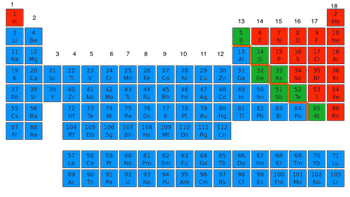
Where are metals located on the periodic table?
a)
Blue
b)
Green
c)
Red
100 %

