Worksheets
IAT PSCI Unit 1 Chapter 2
Total questions: 35
Worksheet time: 39mins
The path followed by an electric current from a power source through devices that use electricity and back to the source.
Electric circuit
Ammeter
Conductor
Insulator
A material that allows electric current to exist in it.
Conductor
Insulator
Convector
Vector
A material that does not allow electric current to exist in it.
Conductor
Insulator
Convector
Vector
A circuit that has all its parts connected in a single loop.
Series Circuit
Parallel Circuit
Perpendicular Circuit
Lateral Circuit
A circuit in which two or more single loops connect to the same cells.
Series Circuit
Parallel Circuit
Perpendicular Circuit
Lateral Circuit
A machine or computer program that models a given environment or situation for the purpose of training or research.
Simulator
Ammeter
Conductor
Digital Multi Meter (DMM)
A device that measures the amount of electric current in a circuit
Ammeter
Voltmeter
Spectrometer
Thermometer
A flow of negative charges around a circuit.
Electric Current
Insulation
Magnicity
Convection
The characteristics that are specific to a given type of interaction.
Defining Characteristics
Evidence
Magnetic Materials
Electric Circuit
Metals that interact with magnets.
Magnetic Materials
Simulators
Insulators
Aluminum and Copper

A coil of wire connected to a source of electricity. The coil is occasionally wrapped around a magnetic material.
Electromagnet
Simulator
Ammeter
Parallel Circuit
All of the following are magnetic materials except for
Iron
Copper
Nickel
Cobalt
As the number of cells in an electric circuit increases, the brightness of a single light-bulb in the circuit will
Increase
Decrease
Stay the same
As the number of cells in an electric circuit decreases, the brightness of a single light-bulb in the circuit will
Increase
Decrease
Stay the same
As the number of cells in an electric circuit decreases, the current through a single light-bulb in the circuit will
Increase
Decrease
Stay the same
As the number of cells in an electric circuit increase, the current through a single light-bulb in the circuit will
Increase
Decrease
Stay the same

In Activity 4, you increased the number of cells in an electrical circuit with a single light-bulb and measured the resulting electric current with an ammeter.
What was the manipulated variable in this experiment?
the number of cells
the number of wires
the value of the electric current
the number of bulbs
The batteries in this image are hooked up in _____.
series
parallel
In Activity 4, you increased the number of cells in an electrical circuit with a single light-bulb and measured the resulting electric current with an ammeter.
What was the responding variable in this experiment?
the number of cells
the number of wires
the value of the electric current
the number of bulbs

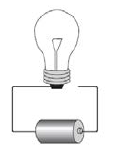
What type of circuit is the image above?
Series Circuit
Parallel Circuit
Perpendicular Circuit
Lateral Circuit
Which of the following statements about magnets is true?
For magnets made of the same material, the larger the magnet, the stronger the interaction with magnetic materials
Magnets attract all metals.
Magnets can either attract or repel other magnetic materials that are not themselves magnets.
A magnetic interaction only occurs if the interacting objects are touching.
None of the above statements is true.
The ends of a battery are connected to a coil of wire that is wrapped around a steel nail. What type of interaction is occurring between the battery and the coil of wire?
Mechanical
Magnetic
Electric-Charge
Electric-Circuit
Electromagnetic
The ends of a battery are connected to a coil of wire that is wrapped around a steel nail. What type of interaction is occurring between the coil and the nail?
Mechanical
Magnetic
Electric-Charge
Electric-Circuit
Electromagnetic
A balloon is rubbed with a piece of fur until it accumulates a static charge. When the charged balloon is brought near an uncharged object, what will happen to the object?
It will be repelled
It will be attracted
Nothing will happen
Two balloons are charged by rubbing a piece of fur against them. When one balloon is brought near the second balloon, what will happen to the second balloon?
It will be repelled
It will be attracted
Nothing will happen
TRUE or FALSE
Evidence for the magnet-magnetic material interaction is a change in motion of the magnet and magnetic material towards each other, regardless of which side of the magnet faces the magnetic material.
True
False
TRUE or FALSE
Evidence for the magnet-magnetic material interaction is a change in motion of the magnet and magnetic material away from each other, regardless of which side of the magnet faces the magnetic material.
True
False
TRUE or FALSE
Scientists believe that only the positive charges (electrons) inside conductors move.
True
False
TRUE or FALSE
In a parallel (multi-loop or separate-loop) circuit each device makes its own separate loop with the source. Unscrewing a bulb (or other device) from one loop will cause the electric-circuit interaction to cease (the other bulb will go out).
True
False
TRUE or FALSE
In order for the magnetic interaction to occur, the objects involved need to come into contact (touch) each other.
True
False
Two charged objects brought near each other will
Always repel
Always attract
Either attract or repel depending on their charge
Do nothing at all