wayground logo

Free Printable Worksheets

Font size

S
M
L
XL
Worksheets

Properties of Ocean Water

Total questions: 41

Worksheet time: 1hrs 20mins
Name
Class
Date
1.
What two elements make up water?
a)
Helium and oxygen
b)
Hydrogen and oxygen
c)
helium and carbon
d)
oxygen and carbon
2.
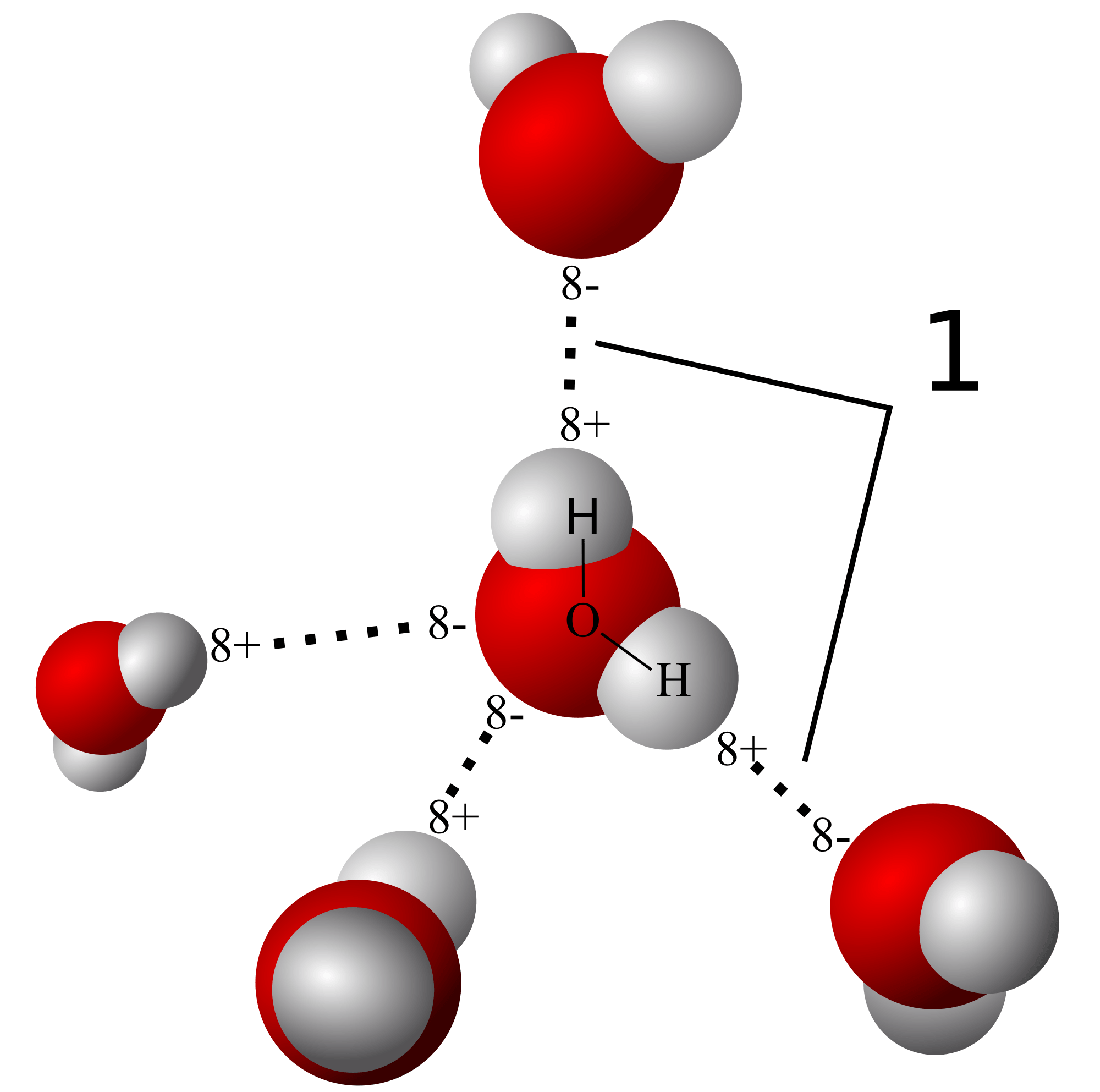
Attractions between water molecules are called
a)
Covalent bonds
b)
Ionic bonds
c)
Polar bonds
d)
Hydrogen bonds
3.
Why does ice float?
a)
As water freezes, it expands and its density decreases.
b)
As water freezes, it takes up more hydrogen from the atmosphere, causing it to have a greater buoyancy.
c)
As water freezes, air becomes trapped between the hydrogen bonds of water molecules.
d)
As water freezes, it takes up more oxygen from the atmosphere, causing it to have a greater buoyancy.
4.
Which end of the water molecule has a slightly positive charge?
a)
the oxygen end
b)
the hydrogen end
c)
both ends are slightly positive
d)
neither end is positive
5.
Which process does NOT lead to a decrease in the salinity of water?
a)
runoff from land
b)
precipitation
c)
sea ice melting
d)
evaporation
6.
Which term refers to a rapid change of temperature with increasing depth of the ocean?
a)
pycnocline
b)
thermocline
c)
abyssalocline
d)
isothermal cline
7.
In addition to salinity, what factor affects the density of seawater?
a)
depth
b)
latitude
c)
temperature
d)
salt content
8.
What happens to pressure as you go deeper into the ocean? 
a)
increases
b)
decreases
c)
stays the same
d)
doubles
9.
Which of the following is not a process that decreases the salinity of seawater?
a)
runoff from land
b)
icebergs melting
c)
precipitation
d)
evaporation
10.
The highest salinity would be found in which of the following areas?
a)
an area with high rates of precipitation
b)
an area with high rates of evaporation
c)
an area with plenty of runoff
d)
all of the above
11.
Which process increases the salinity of water?
a)
runoff from land
b)
formation of sea ice
c)
precipitation
d)
melting of sea ice
12.
The high salinity of the Mediterranean Sea is due primarily to —
a)
Precipitation
b)
Deposition
c)
Volcanoes
d)
Evaporation
13.

Seawater is typically denser than freshwater due to seawater’s —

a)

Greater depth

b)

Lower freezing point

c)

Smaller mass

d)

Higher salinity

14.
The main cause of the salinity of the ocean is
a)
Runoff from land
b)
Metamorphism
c)
Underwater volcanism
d)
CO2 emissions
15.

What term is the measure of dissolved salts in water?

a)

Thermocline

b)

Salinity

c)

Saltiness

d)

Tides

16.
The higher the salt content in the ocean the ________ dense the water will be.
a)
less
b)
more
c)
nothing happens
17.

If I have freshwater that is less dense, what will it do in comparison to salt water that is more dense?

a)

The more dense water will float and the less dense water will sink.

b)

The more dense water will sink and the less dense water will float

c)

Nothing they will mix evenly.

18.
What is density?
a)
mass-per-unit volume
b)
mass-per-unit area
c)
weight-per-unit mass
d)
weight-per-unit volume
19.
True or False Salinity increases as ocean depth increases.
a)
True
b)
False
20.
Jack has a rock. The rock has a mass of 14g and a volume of 2cm3. What is the density of the rock?
a)
7 mL
b)
7 g/cm3
c)
28 g/cm3
d)
1/7 g/cm3
21.
Which units of measurement are used for volume?
a)
grams
b)
centimeters
c)
grams/milliliter
d)
milliliter
22.
Which lab tool might you use to measure the volume of a liquid?
a)
electric scale
b)
bunsen burner
c)
test tube
d)
graduated cylinder
23.
What is the volume of Object X?
a)
10.0 cm3
b)
15.0 cm3
c)
20.0 cm3
d)
25.0 cm3
24.
True or False:  The density of a specific type of material never changes.  
a)
True
b)
False
25.

What is the formula for density?

a)

density = mass x volume

b)

density = mass / volume

c)

density = mass + volume

d)

density = mass - volume

26.
Frank has an eraser. It has a mass of 4g, and a volume of 2cm3. What is its density?
a)
8 g/cm3
b)
2 g/cm3
c)
1/2 g/cm3
d)
24 g/cm3
27.
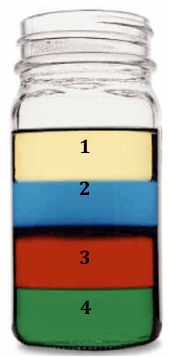
Put the liquids in order from most dense to least dense?
a)
4, 3, 2, 1
b)
1, 2, 3, 4
c)
3, 4, 2, 1, 
d)
4, 3, 1, 2
28.
Why do some substances float on water?
a)
they are warmer than water
b)
they are cooler than water
c)
they are more dense than water
d)
they are less dense than water
29.

Which term means how clear water is

a)

Acidity

b)

pH

c)

Turbidity

d)

Hardness

30.

At a depth of 80 meters, the pressure would be

a)

4 atm

b)

8 atm

c)

9 atm

d)

16 atm

31.

If an object weighs more than the buoyancy force, it will

a)

sink

b)

float

c)

be neutral

32.

A covalent bond

a)

is the attraction between two water molecules

b)

is the sharing of electrons between atoms

33.

The density of water is

a)

1 g/ml

b)

1 ml/g

c)

0 g/ml

d)

35 ml/g

34.

The density of seawater is

a)

slightly higher than that of freshwater

b)

slightly lower than that of freshwater

c)

double that of freshwater

d)

half that of freshwater

35.
Marine organisms help maintain the chemical balance of ocean water by removing nutrients and 
a)
returning other nutrients and gases to the water
b)
producing bacteria that destroy pollutants
c)
adding no new elements to the water
d)
introducing minerals and trace elements to the water
36.

Where would you find the lowest levels of nutrients in the water?

a)

in the estuary / along the coastline

b)

1 miles offshore

c)

5 miles offshore

d)

100 miles offshore

37.

What portion of the ocean has the highest levels of oxygen?

a)

the bottom - because the oxygen sinks

b)

the bottom - because of high levels of photosynthesis

c)

the surface - because of high levels of photosynthesis

d)

the surface - because of high rates of decomposition

38.

Why is there more carbon dioxide in deeper water?

a)

because less photosynthesis occurs there

b)

because more photosynthesis occurs there

39.

If you needed to make 1L of 40 ppt seawater, how many grams of salt would you add?

a)

10

b)

20

c)

40

d)

80

40.

If you needed to make 35 ppt seawater in 500 mL of water (same as a 1/2 liter), how much salt would you need?

a)

35 grams

b)

17.5 grams

c)

70 grams

41.

What would you use this thing for?

a)

to measure the turbidity

b)

to measure the temperature

c)

to measure the density

d)

to measure the salinity