
Font size
 Worksheets
Star Test Review
Total questions: 40
Worksheet time: 44mins



Which of the following is the most abundant element in the Sun?
Hydrogen
Helium
Carbon
Oxygen
Which of the following is the apparent change in the position of an object due to a change in position of an observer?
triangulation
par sec
parallax
light year

When comparing sunspots to the other areas of the Sun’s surface, one can say that sunspots are:
tiny nuclear explosions.
lighter in color.
higher in altitude.
cooler in temperature.
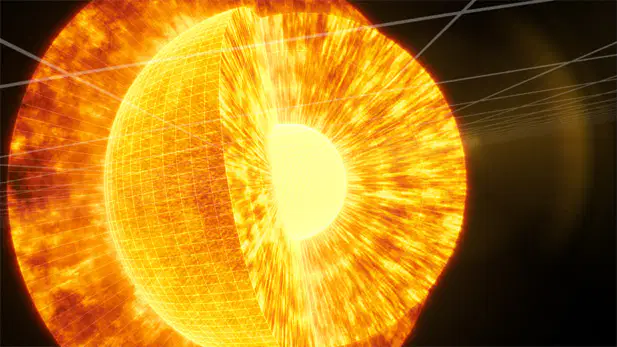
What is the interior or center part of the Sun called?
the radiative zone
the core
the convective zone
the photosphere
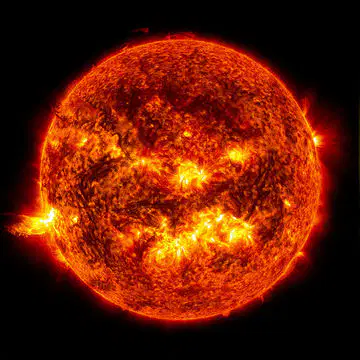
The Sun creates energy through a series of steps known as:
electron-neutron chain reaction.
proton-proton chain reaction.
nuclear fission.
proton-electron chain reaction.
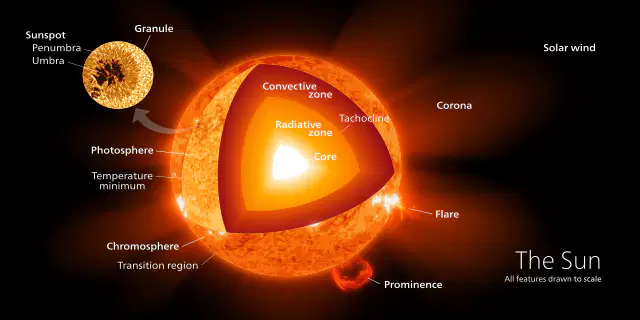
This region of the Sun is located near the radiative zone and extends down over 124,000 miles (200,000 kms) from the surface. Once hot materials travel from the radiative zone to the photosphere and cool, they drop back into the base of this region. What region is being described here?
the chromosphere
the corona
the core
the convective zone


Sunspots tend to occur in cycles which occur ever ______ years.
2
5
11
65

What is solar wind?
A type of wind on Earth
A continuous stream of charged particles from the Sun
A type of storm on the Sun
A calm breeze in space

____ binaries orbit far enough from each other that they can be viewed individually.
Spectroscopic
Independent
Visual
Parallax
A star moving away from us will show spectral lines that are ______ due to the doppler effect
thicker
brighter
blueshifted
redshifted

The image shows a light curve for what type of binary star sytem?
Spectroscopic
Eclipsing
Visual
Double
Astrometric
A star moving toward us will show spectral lines that are ______ due to the doppler effect
thicker
brighter
blueshifted
redshifted


Is the surface temperature of White Dwarf stars higher or lower than Red Supergiants?
Higher
Lower

What does the Y-axis of the HR diagram measures?
Luminosity
Temperature
What does the X-axis of the HR diagram measures?
Luminosity
Temperature

Most of the stars on the HR diagram are classified as what type of star?
White Dwarfs
Blue Giants
Red Giants
Main Sequence

What type of star has a high temperature and a high luminosity?
White Dwarfs
Blue Giants
Red Supergiants
Smaller Main Sequence stars
What type of star has a high temperature and a low luminosity?
White Dwarfs
Blue Giants
Red Supergiants
Smaller Main Sequence stars
What type of star has a low temperature and a high luminosity?
White Dwarfs
Blue Giants
Red Supergiants
Smaller Main Sequence stars
Is the luminosity of Red Giant stars higher or lower than Red Supergiants?
Higher
Lower

A scientist has a sample of an unknown gas. In order to identify the gas, they look at the spectrum of visible light emitted from it when it is heated. This is shown in the figure. Also shown in the figure are the emission spectra of three pure, gaseous elements. Which of the three elements is the unknown gas?
helium
hydrogen
oxygen

The absorption spectrum of a star is shown at the top of the image. When compared with the spectra of the pure gases below, which elements are present in the star?
hydrogen
helium
sodium
lithium

The absorption lines in the spectrum for Galaxy B are shifted toward the _____ end of the spectrum when compared to the lines for the Milky Way.
red
blue

The absorption lines in the spectrum for Galaxy A are shifted toward the _____ end of the spectrum when compared to the lines for the Milky Way.
red
blue
Is the sun hot
Yes
No
Its queso

