
 Worksheets
History of the periodic table and atomic theory
Total questions: 11
Worksheet time: 8mins
Name
Class
Date
1.
What was Dmitri Mendeleev's greatest contribution to the history of the periodic table?
a)
He arranged all of the known elements by their atomic number
b)
He realised that there was a pattern of reactivity which repeated every 8 elements
c)
He predicted the existence (and properties) of new elements
d)
He identified the "law of triads" which became the groups
2.
Why were there blank spaces left in Mendeleev's periodic table?
a)
He didn't know what to put there.
b)
Undiscovered elements not yet known.
c)
Multiple elements could have fit
d)
He forgot to add the elements in.
3.
Which of these was not proposed by John Dalton in 1805?
a)
All matter is made of atoms
b)
Atoms are made of protons, neutrons and electrons
c)
During chemical reactions, atoms rearrange themselves
d)
The atoms of a particular element are all identical
4.
Which of the following models of an atom is most widely accepted as correct?
a)
Bohr model
b)
Quantum-mechanical model
c)
Atomic model
d)
Radioactive model
5.
Why did scientists need/want to organize the elements?
a)
Scientists like things organized
b)
make it easier to understand the elements
c)
have one list of the known elements.
d)
none of the above
6.
What were the scientists looking for among the element properties to help them organize?
a)
boiling points
b)
chemical reactivity
c)
patterns among properties
d)
naming similarities
7.
Mendeleev classified elements based on not only atomic mass but what else?
a)
reactivity
b)
boiling points
c)
physical properties only
d)
chemical & physical properties
8.

Place the following scientists in order, from earliest to latest:
A) Ernest Rutherford
B) J.J. Thomson
C) John Dalton
A) Ernest Rutherford
B) J.J. Thomson
C) John Dalton
a)
B,C,A
b)
C,A,B
c)
A,C,B
d)
C,B,A
9.
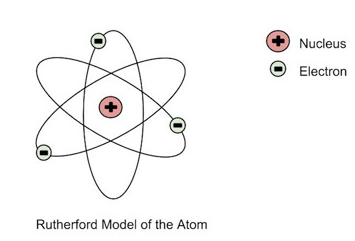
Rutherford's gold foil experiment provided evidence that...
a)
negative and positive charges are spread evenly throughout the atom.
b)
alpha particles have a positive charge.
c)
gold is not a dense as previously thought.
d)
there is a dense positively charged nucleus at the center of an atom.
10.
Bohr's model of the atom proposed that ___.
a)
electrons move around the nucleus in fixed orbits
b)
neutrons move around the nucleus
c)
neutrons do not exist, but are just paired protons and electrons
d)
the nucleus spins
11.
Which of the following correctly describes the electron cloud model?
a)
Electrons do not follow fixed orbits, but are found more frequently in areas around the nucleus.
b)
Electrons are found in fixed orbitals around a positive nucleus.
c)
All of an atom's mass is concentrated in the electron cloud around the nucleus.
d)
Electrons are evenly embedded throughout a positively charged sphere.
100 %

