wayground logo

Free Printable Worksheets

NEW

Font size

S
M
L
XL
Worksheets

Atomic Structure- History, Periodic Table, Electron Config

Total questions: 61

Worksheet time: 44mins

Name
Class
Date
1.
The _____________ determines the identity of an object.
a)
# of Protons
b)
# of Electrons
c)
# of Neutrons
d)
Atomic Mass
2.
Who believed that electrons were scattered amongst positively charged material.
a)
JJ Thomson
b)
Ernest Rutherford
c)
John Dalton
d)
Niels Bohr
3.
How many protons does an atom with an atomic number of 28 and a mass number of 40 have?
a)
28
b)
68
c)
12
d)
40
4.

Developed the "plum pudding" model of the atom

a)

JJ Thomson

b)

Ernest Rutherford

c)

John Dalton

d)

Niels Bohr

5.

Proposed electrons orbit the nucleus in specific layers, called energy shells.

a)

John Dalton

b)

JJ Thomson

c)

Ernest Rutherford

d)

Niels Bohr

6.
Gold Foil
a)
Dalton
b)
Rutherford
c)
Thompson
d)
Bohr
7.
Discovered that the atom has a small, dense, positively charged nucleus.
a)
Ernest Rutherford
b)
Heisenberg
c)
Democritus
d)
JJ Thomson
8.

Who discovered the electron?

a)

Bohr

b)

Dalton

c)

Rutherford

d)

Thomson

9.
Which particle has a positive charge?
a)
electron
b)
orbital
c)
proton
d)
neutron
10.
Choose the particle that has no charge.
a)
nucleus
b)
neutron
c)
proton
d)
electron
11.

This particle determines what element you have.

a)

electron

b)

proton

c)

neutron

d)

valence shell

12.
What are the maximum number of electrons that go on the first 3 energy levels?
a)
2,4,16
b)
2,8,18
c)
4,8,12
d)
3,4,6
13.
What are valence electrons?
a)
electrons on the first orbital always
b)
nucleus
c)
the outermost shell
d)
the number of electrons on the outermost orbital
14.
Which particles make up the nucleus of an atom?
a)
protons and neutrons
b)
electrons and protons
c)
electrons, protons, and neutrons
d)
electrons and neutrons
15.
What charge does the nucleus have and why?
a)
positive - the neutrons do not have a charge
b)
positive - the neutrons and protons are positively charged particles
c)
neutral - the neutral charge dominates the positive charge
d)
neutral - electrons cancel out the positive charge of the atom
16.

What is the mass number and name of an element with 8 protons and 8 neutrons?

a)

Carbon-16

b)

Oxygen-16

c)

Oxygen-24

d)

Neon-8

17.
An atom has 10 protons, 15 neutrons and 10 electrons what is its mass number.
a)
20
b)
10
c)
5
d)
25
18.
Most of the mass of an atom is contained here.
a)
electron orbitals 
b)
nucleus
c)
shells
d)
atomic #
19.
What is the difference between the atomic mass and the mass number?
a)
the atomic mass is always a whole number
b)
the atomic mass equals the atomic #
c)
mass number is the rounded atomic mass - always a whole number
d)
electrons
20.
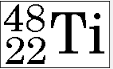
How many protons does this isotope of titanium have?
a)
48
b)
22
c)
26
d)
70
21.
How many neutrons does the isotope of lithium have?
a)
8
b)
3
c)
4
d)
5
22.
What is an ion?
a)
A Charged Atom
b)
A Large Atom
c)
A Small Atom
d)
A Cute Atom
23.
Maximum number of electrons that can be placed in an s orbital.  
a)
2
b)
6
c)
10
d)
14
24.
The maximum number of electrons that can be placed in an p orbital.  
a)
2
b)
6
c)
10
d)
14
25.
The maximum number of electrons that can be placed in an d  orbital.  
a)
2
b)
6
c)
10
d)
14
26.
In an orbital diagram,  an arrow represents: 
a)
an electron
b)
an orbital
c)
an element
27.
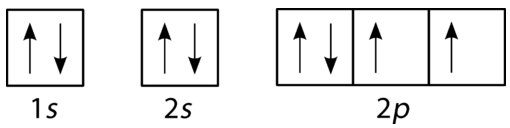
This orbital diagram represents:  
a)
C
b)
B
c)
N
d)
O
28.
This orbital diagram represents:  
a)
C
b)
B
c)
N
d)
O
29.
What is incorrect about this orbital diagram?
a)
Both arrows in the 2p box should be pointing up
b)
There is nothing incorrect with this diagram
c)
In the there should only be 1 orbital in the first 2p box and one in the 2nd 2p box
d)
All the arrows should be pointing up.
30.
The electron configuration of an atom is 1s22s22p6.  The number of electrons in the atom is 
a)
3
b)
6
c)
8
d)
10
31.
What atom matches this electron configuration?
1s22s22p63s23p64s23d10
a)
Zinc
b)
Copper
c)
Nickel
d)
Germanium
32.

What is the noble gas shorthand (core)electron configuration Sulfur atom?

a)

[Ar] 3p4

b)

[He] 3s23p4

c)

[Ne] 3s23p4

d)

[Na] 3s23p4

33.
What electron configuration matches an oxygen atom?
a)
1s22s22p63s2, 3p64s23d104p5
b)
1s22s22p4
c)
1s22s22p6
d)
1s22s22p63s23p64s23d1
34.
How many electrons does Si contain? (click to see image)
a)
14
b)
28
c)
2
d)
4
35.
How many valence electrons does Si contain? (click to see image)
a)
14
b)
28
c)
2
d)
4
36.
The electron configuration of an atom is 1s22s22p6.  The number of valence electrons in the atom is 
a)
3
b)
6
c)
8
d)
10
37.
Which of these is a property of metals?
a)
It's malleable
b)
It can't conduct electricity
c)
They are used in food
d)
It's very brittle
38.
Where are the non-metallic elements found in the periodic table?
a)
In the middle
b)
In the top rows
c)
On the left-hand side
d)
On the right-hand side
39.
Which elements are found on the left to middle of The Periodic Table? 
a)
Metals
b)
Nonmetals
c)
Metalloids
d)
Candles
40.
The elements argon, krypton, and xenon are all non-metals. What property would these elements have in common?
a)
Good conductor of thermal energy
b)
Poor conductor of electricity
c)
Shiny, lustrous surface
d)
Soft and malleable
41.
Which of the following is a good conductor of heat?
a)
Metal
b)
Nonmetal
c)
Metalloid
42.
Silicon is a semiconductor and has properties of both metals and nonmetals. What type of element is Silicon? 
a)
Metal
b)
Nonmetal
c)
Metalloid
d)
Pretty
43.

Which of these elements has the largest atomic radius

a)

Cs (cesium)

b)

Ba (barium)

c)

At (astatine)

d)

Rn radon

44.

Which of these elements is a noble gas?

a)

Cd (cadmium)

b)

Sb (antimony)

c)

Ar (argon)

d)

Na (sodium)

45.

Which of these elements has the SMALLEST atomic radius?

a)

H (hydrogen)

b)

Rb (rubidium)

c)

Li (lithium)

d)

Fr (francium)

46.

Which of these elements is a alkali metal?

a)

W tungsten

b)

Sc scandium

c)

Be beryllium

d)

Li lithium

47.
Sodium (Na) and potassium (K) are in the same group on the periodic table. Based on their locations, which statement about sodium and potassium is true?
a)
Sodium is less electronegative than potassium. 
b)
Sodium has fewer energy levels than potassium. 
c)
Sodium has a larger ionic radius than potassium. 
d)
Sodium has lower ionization energy than potassium. 
48.

Fluorine, chlorine, bromine, and iodine all have the same number of valence electrons and have a tendency to gain electrons. Which element has the greatest ionization energy?

a)

fluorine

b)

chlorine

c)

bromine

d)

iodine

49.
The ionization potential of an element is the amount of energy required to remove an electron from an isolated atom or molecule. According to the periodic table, which of the following indicates the correct decreasing order of ionization energy?
a)
Li > Na > K > Cs
b)
Na > K > Li > Cs
c)
Li > K > Na > Cs 
d)
Cs > K > Na > Li 
50.
Based on their locations in the periodic table, which element has chemical properties most similar to those of calcium, Ca?
a)
beryllium, Be
b)
potassium, K
c)
titanium, Ti
d)
yttrium, Y
51.
The number of valence electrons in an element affects the reactivity of that element. Which element listed has the fewest valence electrons?
a)
beryllium (Be)
b)
sodium (Na) 
c)
oxygen (O) 
d)
neon (Ne)
52.
Which of the following will have a lower ionization energy than Scandium (Sc)?
a)
Helium (He)
b)
Titanium (Ti)
c)
Calcium (Ca)
d)
Magnesium (Mg)
53.

24.1% of all the isotopes of a an element have a mass of 75.23 amu, 48.7% have a mass of 74.61 amu, and 27.2% have a mass of 75.20 amu.

What is the average mass of this element?

a)

74.92 amu

b)

24.97 amu

c)

75.01 amu

d)

74.51 amu

54.
An isotope has three forms.  30% have a mass of 4 amu, 20% have a mass of 5 amu and 50% have a mass of 3 amu.  Average atomic mass will be closest to
a)
2 amu
b)
3 amu
c)
4 amu
d)
5 amu
55.
Atom 1 has Mass=12  Protons=6
Atom 2 has Mass= 14 Electrons=6
Are these atoms isotopes of each other or different elements?
a)
Different Elements - Mg & Si
b)
Different Elements - Ar & Ca
c)
Isotopes of Carbon
d)
Isotopes of Magnesium
56.

What is the atomic number?

a)

the number of protons

b)

the number of protons and neutrons

c)

the number of neutrons

d)

the number of protons and electrons

57.

What is the mass number?

a)

the number of protons

b)

the number of protons and neutrons

c)

the number of neutrons

d)

the number of protons and electrons

58.

What is the atomic number of this nucleus?

a)

1

b)

3

c)

4

d)

7

59.

What is the mass number of this nucleus?

a)

1

b)

3

c)

4

d)

7

60.
A phosphorus atom has 15 protons and 16 neutrons. What is the mass number?
a)
15
b)
16
c)
31
d)
1
61.

Mass Number =

a)

Protons + Neutrons

b)

Protons - Neutrons