
 Worksheets
Big Review for Unit 1 Test : Advanced Science
Total questions: 36
Worksheet time: 27mins
Name
Class
Date
1.
Marcos wants to know: Does the type of gasoline put in a car effect how fast the car can drive? What is the independent variable?
a)
Type of gasoline
b)
which car the gas is put into
c)
how fast the car can drive
d)
how much gas is put into the car
2.
An experiment is performed on plants to see how different liquids affect plant growth. Each plant in the experiment is given a different liquid; water, apple juice, or milk. Each plant has the same amount of soil, sunlight, and listens to the same music. In this investigation, the independent variable is ...
a)
The type of plant
b)
The amount of sunlight
c)
The type of music
d)
The type of liquid
3.
Kreedence wants to know if birds prefer to eat in one place over another. She makes three feeders out of 2-liter bottles and paints all of them red. She fills each of the feeders with the same amount of mixed birdseed, and plans to keep the feeders out for 10 days before measuring how much seed is eaten from each feeder. She puts each of the feeders in her back yard: one feeder in a large dead tree, another feeder she sits on the dog house, and the last she sits in a small bushy tree.
What is the dependent variable?
What is the dependent variable?
a)
Length of the birdfeeders
b)
Amount of time feeders are outside
c)
Amount of seed eaten
d)
Location the feeders are put in.
4.
Mr. McNiece wanted to see how different types of music affected students' pulse rates. She played different types of music: heavy metal, rap, R&B, alternative, pop, country, and classical music. Identify the independent variable.
a)
classical music resulted in the highest pulse rate
b)
high pulse rate
c)
pulse rate
d)
types of music
5.
Mr. McNiece wanted to see how different types of music affected students' pulse rates. She played different types of music: heavy metal, rap, R&B, alternative, pop, country, and classical music. What constant should be considered when doing this experiment?
a)
types of music
b)
use all dead people
c)
using a different student for each music type
d)
amount of time the music was played
6.
A new company wants to test out a pill that will unlock all of your brain to make you 50% smarter and much more efficient.
Which answer choice shows what the control group would be?
Which answer choice shows what the control group would be?
a)
The group that receives the pill
b)
The group that receives the fake pill
c)
The new company
d)
The brain that gets smarter
7.
Gerald wants to find out how quickly he can melt a stick of butter. He plans to use a hair dryer with 4 different heat settings. What would be the control group in his experiment?
a)
Hottest Setting
b)
Lowest Setting
c)
No Heat
d)
Middle Setting
8.
Jack has a rock. The rock has a mass of 14g and a volume of 2cm3. What is the density of the rock?
a)
7 mL
b)
7 g/cm3
c)
28 g/cm3
d)
1/7 g/cm3
9.
Which units of measurement are used for volume?
a)
grams
b)
centimeters
c)
grams/milliliter
d)
milliliter
10.

What is the volume of Object X?
a)
10.0 cm3
b)
15.0 cm3
c)
20.0 cm3
d)
25.0 cm3
11.
True or False: The density of a specific type of material never changes.
a)
True
b)
False
12.
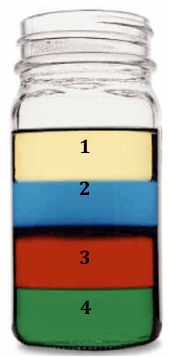
Put the liquids in order from most dense to least dense.
a)
4, 3, 2, 1
b)
1, 2, 3, 4
c)
3, 4, 2, 1,
d)
4, 3, 1, 2
13.
If an object has a density of 3.6 g/mL and you put it into water, will it sink or float?
a)
sink
b)
float
14.
Can an element be broken down into a simpler substance
a)
yes
b)
No
15.
Humans absorb oxygen from the air they breathe in and exhale carbon dioxide gas, CO2. Carbon dioxide gas is
a)
an element made of carbon and oxygen atoms.
b)
a solution made of carbon and oxygen atoms.
c)
a compound of carbon and oxygen atoms.
d)
a mixture of carbon and oxygen atoms.
16.

Classify the picture with the correct label.
a)
Element
b)
Compound
c)
Mixture of Elements
d)
Mixture of Compounds
17.

Classify the picture with the correct label.
a)
Element
b)
Compound
c)
Mixture of Elements & Compounds
d)
Mixture of Elements
18.
Which of the following tells you that a chemical change may have occurred?
a)
Change Shape
b)
Melting
c)
Vaporizing
d)
Change in color
19.
What happens in ALL chemical changes?
a)
Change in state of matter
b)
A new substance is formed
c)
Bubbles are produced
d)
An explosion
20.
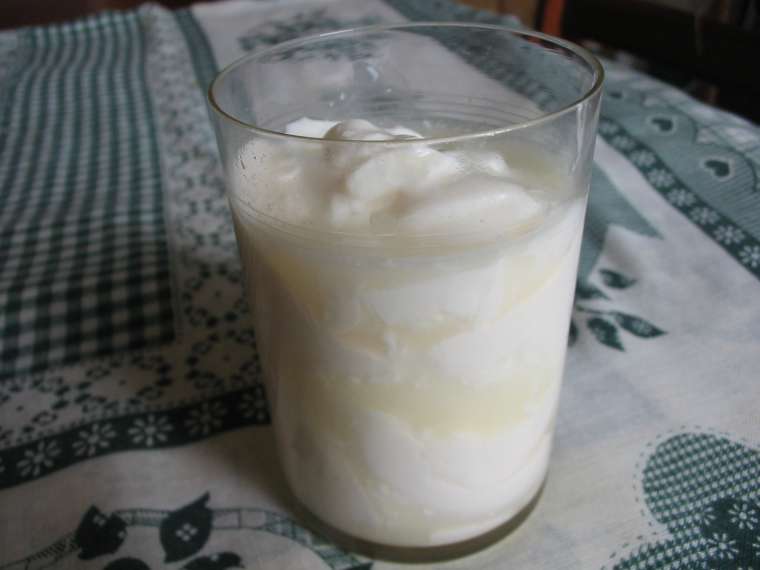
Is milk going sour a physical or chemical change?
a)
Physical
b)
Chemical
21.

Is Gatorade powder dissolving in water physical or chemical change?
a)
Physical
b)
Chemical
22.
Density: Chemical or Physical Property
a)
Chemical Property
b)
Physical Property
23.
Flammability (burns): Chemical or Physical Property
a)
Chemical Property
b)
Physical Property
24.
Solubility (dissolves): Chemical or Physical Property
a)
Chemical Property
b)
Physical Property
25.
Reacts with Acid: Chemical or Physical Property
a)
Chemical Property
b)
Physical Property
26.
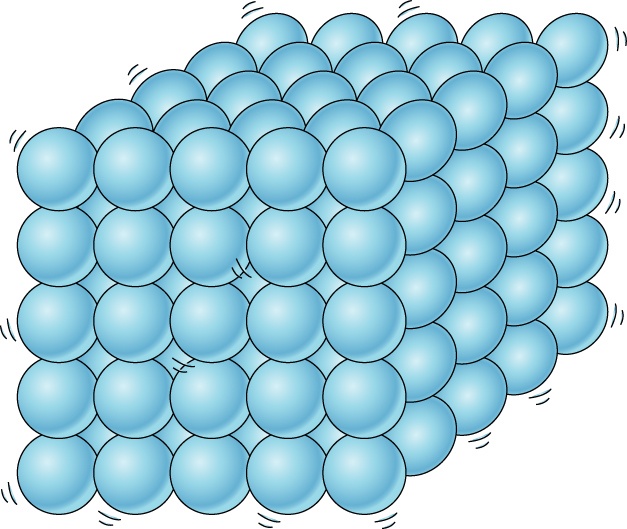
Which description best matches this particle model?
a)
Closely packed and can't move a lot.
b)
Particles are close together but can move a little.
c)
Particles have lots of energy and can move around.
27.

Number 2 represents a ________
a)
solid
b)
liquid
c)
gas
d)
plasma
28.
As particles are exposed to warmer temperatures they __________
a)
speed up
b)
slow down
c)
stay the same
d)
vibrate
29.

What does the particle diagram show?
a)
solid
b)
liquid
c)
gas
d)
plasma
30.

What does the particle diagram show?
a)
solid
b)
liquid
c)
gas
d)
plasma
31.

Which state of matter has molecules that slide past each other but stay close together? They do not form a regular pattern.
a)
solid
b)
liquid
c)
gas
32.
Which of the following is a compound?
a)
Co
b)
O2
c)
C
d)
CO2
33.
The smallest unbreakable unit of a compound is called
a)
subscript
b)
proton
c)
formula
d)
molecule
34.

A 5 kg bowling ball, a 0.25 kg baseball, and a 0.05 kg golf ball are dropped from a 100-meter high building. A camera catches the motion of the balls as they pass specific markers (in meters, m) on the building. The times (in seconds, s) that each object passes the markers are listed in the table below. Which of the following conclusions is true?
a)
Light objects fall faster than heavy ones.
b)
All objects fall at the same rate regardless of mass.
c)
Heavy objects fall faster than light ones.
d)
Objects of different shapes fall at the same rate
35.

A scientist collected the following data on algal growth during an experiment:
Which of the following conclusions could be drawn from the data?
Which of the following conclusions could be drawn from the data?
a)
Algae multiply most rapidly at 35°C.
b)
Algae multiply most slowly at 20°C.
c)
Algae multiply most slowly at 10°C.
d)
Algae multiply most rapidly at 20°C.
36.

Sean enjoys studying the stars. He used a photometry tool to calculate several stars' apparent magnitudes (how bright a star looks in the sky). He then researched the stars' distances from Earth. He recorded his results in the table below.
What conclusions can Sean draw from his chart?
What conclusions can Sean draw from his chart?
a)
A star's apparent magnitude increases as its distance from Earth increases.
b)
A star's apparent magnitude decreases as its distance from Earth increases.
c)
A star's apparent magnitude decreases if it is very close to another star.
d)
A star's apparent magnitude is not directly related to its distance from Earth.
100 %

