wayground logo

Free Printable Worksheets

NEW

Font size

S
M
L
XL
Worksheets

Various 4th grade Science Skills/Concepts

Total questions: 80

Worksheet time: 1hrs 1mins

Name
Class
Date
1.
________________ are bodies, natural satellites, that orbit the Sun, a star. 
a)
Earths
b)
Meteorites
c)
Stars
d)
Planets
2.
In the picture, the sun appears to have a rough texture with light and dark colors. What is this showing?
a)
that the sun has a sandy surface
b)
that the sun has a rocky surface
c)
that the sun has an icy surface
d)
that the sun has a fiery surface
3.
Three of the following pairs have only rocky planets, but one of them does not. Which has a planet that does not have a rocky surface?
a)
Mercury, Mars
b)
Mercury, Venus
c)
Earth, Venus
d)
Earth, Saturn
4.

Three of the following pairs have only gas planets, but one does not. Which group does NOT have a gas surface?

a)

Mercury, Jupiter

b)

Uranus, Neptune

c)

Uranus, Jupiter

d)

Jupiter, Saturn

5.
Which of the following best describes the moon?
a)
It is warmer than Earth
b)
It is rockier and drier than Earth
c)
It has more oxygen in its atmosphere than Earth
d)
It is closer to the Sun than to Earth
6.
What do Earth and the moon have in common?
a)
They are the same size
b)
They both move around other objects
c)
They both give off their own light
d)
They are both the same temperature
7.
Which of the following is the best description of a year?
a)
Sun makes one complete rotation on its axis
b)
Moon makes one complete revolution around the Earth
c)
Earth makes one complete rotation on its axis
d)
Earth makes one complete revolution around the sun
8.
The __________ is the natural satellite that orbits the Earth
a)
Moon
b)
Sun
c)
Jupiter
d)
Comet
9.
A telescope would be the best instrument to study which of the following?
a)
the parts of a cell
b)
the surface of other planets
c)
the bottom of the ocean
d)
the speed of an airplane
10.
Which of the following is a result of the tilt of Earth on its axis?
a)
winter occurs all over Earth at one time
b)
during summer on Earth, there is more rain
c)
seasons occur at different times on different places
d)
we always experience day and night on Earth
11.
We experience day and night on Earth because...
a)
the Earth revolves around the sun
b)
the Earth tilts on its axis
c)
the moon revolves around the Earth
d)
the Earth rotates on its axis
12.
The Earth rotates on its axis once each...
a)
Day
b)
Week
c)
Month
d)
Year
13.
The Sun appears to rise in the __________ and set in the _________. 
a)
East, West
b)
North, South
c)
West, East
d)
South, North
14.
If the Sun appears to be in the east, where would your shadow be?
a)
north
b)
south
c)
east
d)
west
15.
The Moon produces no light, and yet shines at night. This is because the Moon...
a)
Has many craters
b)
Reflects light from the Earth
c)
Reflects light from the Sun
d)
Rotates at a very high speed
16.

Which of the following gives the names of the planets in the correct order starting near the Sun and moving farther away from the Sun?

a)

Mercury, Venus, Earth, Mars, Jupiter, Saturn, Uranus, Neptune

b)

Mercury, Earth, Venus, Jupiter, Mars, Saturn, Neptune, Uranus

c)

Mars, Saturn, Neptune, Venus, Earth, Mercury, Jupiter, Uranus

d)

Mercury, Earth, Mars, Jupiter, Venus, Uranus, Saturn, Neptune

17.

The diagram above is a model to show how the Sun, Earth, and Moon behave in our solar system. What is this diagram showing?

a)

The Earth revolves around the Sun and the Earth revolves around the Moon.

b)

The Sun revolves around the Earth and the Earth revolves around the Moon.

c)

The Sun revolves around the Earth and the Moon revolves around the Earth.

d)

The Earth revolves around the Sun and the Moon revolves around the Earth.

18.

Which season does the following illustration (diagram) show for the northern hemisphere?

a)

winter

b)

spring

c)

summer

d)

fall

19.

Why can you not see the Moon in the sky when it is a "New Moon"?

a)

The Moon is not in the same line as the Sun and Earth, so no sunlight reflects off of it.

b)

The Moon is directly between the Sun and Earth, so no sunlight reflects off of it.

c)

The Moon is behind the Sun, so it cannot be seen from Earth.

d)

The Moon is at its furthest point away from the Earth, so it cannot be seen.

20.

Which phase of the moon is shown in the diagram above?

a)

full moon

b)

quarter moon

c)

crescent moon

d)

gibbous moon

21.

A __________________ is a group of stars that form a pattern or image.

a)

Moon

b)

planet

c)

constellation

d)

sun

22.
Which of these describes rotation?
a)
The Moon goes around Earth every 28 days.
b)
Earth orbits the Sun about every 365 days
c)
Earth makes one turn on its axis every 24 hours
d)
Mercury goes around the Sun every 88 days.
23.
How many planets are in our solar system? 
a)
9
b)
6
c)
7
d)
8
24.
What two planets are in between the Sun and Earth?
a)
Mars and Jupiter
b)
Mercury and Venus 
c)
Neptune and Mercury
d)
Saturn and Uranus
25.
What is a dwarf planet? 
a)
A dwarf planet is the setting of the fairy tale of Snow White and the Seven Dwarfs
b)
 A dwarf planet is the largest planet in the solar system. 
c)
A dwarf planet is a planet surrounded by moons.
d)
A dwarf planet is smaller than regular planets and shares orbital space with other bodies similar  in size.
26.
If the days are cold and short —
a)
the Sun is probably not tilted 
b)
the Sun is colder than usual
c)
 Earth is tilted toward the Sun
d)
Earth is tilted away from the Sun
27.
When the Moon has completed one quarter of its orbit around the Earth, the Moon  appears to be a half circle. This phase is called the 
a)
full moon 
b)
 quarter moon
c)
crescent moon
d)
gibbous moon
28.
People see different phases of the moon, because —
a)
 the Moon is a flat surface 
b)
the Moon is sometimes behind clouds 
c)
the Moon revolves around the Earth
d)
the Moon changes its shape 
29.
To turn or spin on an axis means to —
a)
 phase
b)
eclipse
c)
rotate
d)
revolve
30.
What shape of the moon is when you can see more than half on the lit side, but not all of it?
a)
full moon
b)
gibbous
c)
crescent
d)
new moon
31.
The path on object takes as it moves around another object is called
a)
revolution
b)
rotation
c)
orbit
d)
mare
32.
Where does the moon get its light?
a)
sun
b)
planets
c)
other stars
d)
itself
33.
Which phase of the moon shows an entire circle reflected by the sun?
a)
New
b)
Full Moon
c)
Waxing Crescent
d)
Waning Crescent
34.
This is the largest planet in the solar system.
a)
Saturn
b)
Jupiter
c)
Uranus
d)
Venus
35.
This is the smallest planet in the solar system
a)
Mercury
b)
Venus
c)
Earth
d)
Mars
36.
Only planet known to have life
a)
Earth
b)
Mars
c)
Venus
d)
Mercury
37.
About how many days does it take to moon to go through a complete cycle?
a)
7 days
b)
365 days
c)
29 days
d)
20 days
38.
Which phase of the moon can you see less than half of the lit side, but not all is gone?
a)
crescent
b)
new moon
c)
full moon
d)
gibbous
39.
The part of the earth receiving the sun's most direct rays is having
a)
spring
b)
fall
c)
winter
d)
summer
40.
The sun is an averaged sized star?
a)
True
b)
False
41.
Changes in the moon's appearance are
a)
phases
b)
eclipses
c)
stages
d)
cycle
42.
Define New Moon
a)
None of moon is visible from Earth
b)
All of moon visible from Earth
c)
Moon is 1/2 visible from Earth
d)
Moon is more than Half Visible from Earth
43.
Define Quarter Moon
a)
None of moon visible
b)
Less than Half the moon is visible
c)
More than half of moon is visible
d)
Half of the moon is visible
44.
Name the moon phase
a)
Waning Crescent
b)
Waxing Crescent
c)
Waning Gibbous
d)
Waxing Gibbous
45.
The 1st Quarter moon is lit on the:
a)
Left Side
b)
Right Side
46.
T/F When the moon is waxing,the part that is lit by the sun is getting larger on the right side
a)
TRUE
b)
FALSE
47.
Stuff that everything is made of-
a)
Wood
b)
Matter
c)
Water
48.
The three states of matter are?
a)
solid, liquid, plasma
b)
mass, temperature, liquid
c)
solid, liquid, gas
49.
The amount of matter in an object-
a)
density
b)
mass
c)
solubility 
50.
Matter is everywhere.
a)
True
b)
False
51.
A solid
a)
floats away
b)
puddles when pourded
c)
maintains its shape
52.
What causes a change in the state of matter?
a)
physical properties
b)
chemical energy
c)
temperature
53.
Adding HEAT to matter causes its particles to:
a)
move faster and farther apart
b)
Move slower and farther apart
c)
Move faster and closer together
d)
Move slower and closer together
54.
A state of matter that has a definite volume and shape.
a)
solid
b)
liquid
c)
gas
d)
matter
55.
Liquid matter takes the shape of _______.
a)
a gas
b)
water
c)
a pet
d)
Its container
56.
Water in its solid form is _____________.
a)
a vapor
b)
ice
c)
a liquid
d)
boiling
57.
______________ does not have a definite shape or volume.
a)
liquid
b)
solid
c)
gas
58.
When you see steam, fog or clouds, which state of matter is it?
a)
solid
b)
liquid
c)
gas
59.
Which state of matter has particles that are tightly packed?
a)
liquid
b)
gas
c)
solid
60.
How can you describe this picture?
a)
liquid
b)
solid
c)
gas
61.
Where is most water found on Earth?
a)
glaciers
b)
lakes
c)
rivers
d)
oceans
62.
What is water doing when it is changed to water vapor?
a)
evaporating
b)
condensing
c)
transpiring
d)
freezing
63.
What is water vapor doing when it changes to water?
a)
evaporating
b)
condensing
c)
precipitating
d)
freezing
64.
On which kind of day would you expect the most evaporation from the surface of a  pond?
a)
sunny and hot
b)
sunny and cold
c)
rainy and hot
d)
rainy and cold
65.
What is the source of energy that makes the water cycle work?
a)
electricity
b)
the sun
c)
wind
d)
thunder
66.
Phase changes such as evaporation and condensation are most directly related to  ________________
a)
wind speed
b)
humidity
c)
temperature
d)
air pressure
67.
Snow, sleet, hail, and rain are all examples of  ________________. 
a)
evaporation
b)
condensation
c)
accumulation
d)
precipitation
68.
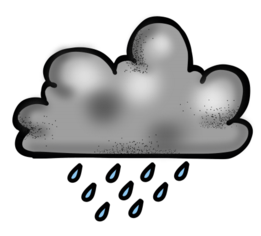
What part of the water cycle does this picture show?
a)
condensation
b)
precipitation
c)
evaporation
69.
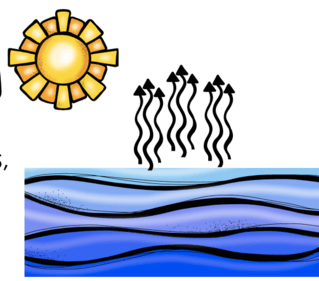
What part of the water cycle does this picture show?
a)
condensation
b)
precipitation
c)
evaporation
70.
Evaporation happens when the sun ___________ water and turns it into vapor.
a)
cools
b)
heats up
c)
freezes
d)
lights up
71.
Which of these is an example of precipitation?
a)
snow
b)
air
c)
clouds
d)
vapor
72.
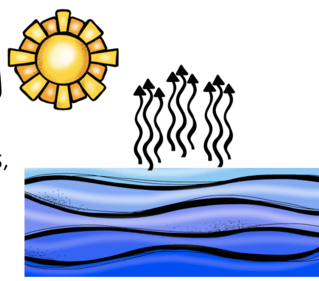
What part of the water cycle does this picture show?
a)
condensation
b)
precipitation
c)
evaporation
73.
What is the water cycle?
a)
the 3 forms of water
b)
the movement of water on, above, or below the surface of the Earth
c)
when water melts
d)
when clouds form
74.
Which of these is not an example of precipitation?
a)
rain
b)
clouds
c)
sleet
d)
snow
75.
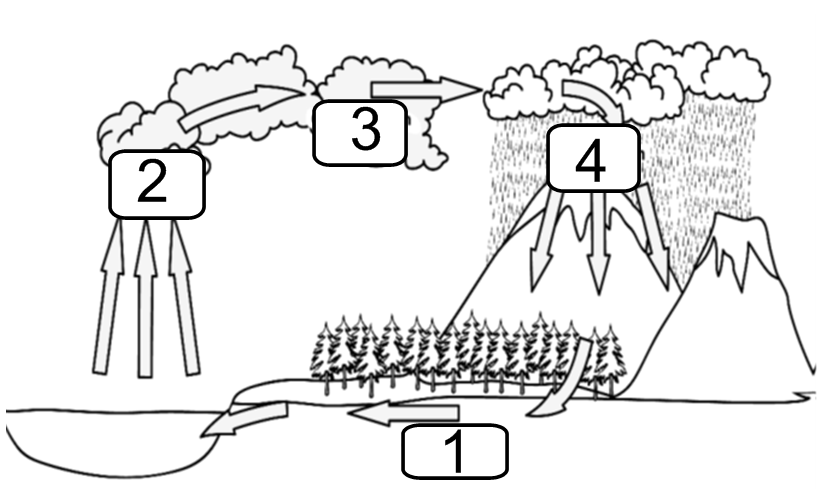
Which stage does the #2 show in the diagram?
a)
condensation
b)
evaporation
c)
precipitation
d)
run off
76.
Which stage does the #3 show in the diagram?
a)
condensation
b)
evaporation
c)
precipitation
d)
run off
77.
what does the #4 show in the diagram?
a)
condensation
b)
evaporation
c)
precipitation
d)
run off
78.
What is evaporation?
a)
change from liquid to gas
b)
change from gas to liquid
79.
What is condensation?
a)
change from gas to liquid
b)
change from liquid to gas
80.
What is precipitation?
a)
Any form of water that falls from clouds
b)
change from gas to liquid