
 Worksheets
Common Assessment #4 Mega Quiz
Total questions: 40
Worksheet time: 33mins
Name
Class
Date
1.
In a strand of DNA, if it contains 20% of Thymine, then how much Guanine would be present?
a)
30%
b)
20%
c)
80%
d)
10%
2.
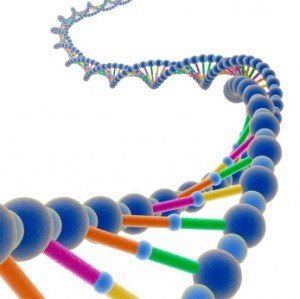
Which of the following best describes a DNA molecule?
a)
double helix
b)
contains ribose
c)
made of amino acids
d)
contains Uracil
3.
Which of the following units are repeatedly joined together to form a strand of DNA?
a)
amino acids
b)
nucleotides
c)
fatty acids
d)
polysaccharides
4.
Guanine bonds with ______________.
a)
Adenine
b)
Guanine
c)
Cytosine
d)
Thymine
5.

In a molecule of double-stranded DNA, the amount of Adenine present is always equal to the amount of
a)
cytosine
b)
guanine
c)
thymine
d)
uracil
6.
Why is DNA important?
a)
it is very small and very complicated
b)
it's in everything
c)
it serves as the blueprint for traits of all living things
d)
because we eat it every day for energy
7.
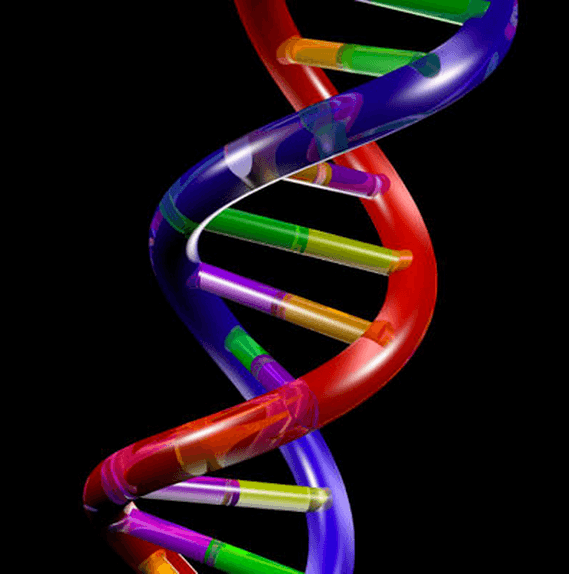
What determines the code, or information, of a DNA molecule?
a)
the shape (structure) of the nitrogen bases
b)
the order (sequence) of the nitrogen bases
c)
the color of the nitrogen bases
d)
the frequency (number) of nitrogen bases
8.
Which 2 molecules form the sides (backbone) of the DNA ladder?
a)
deoxyribose sugar and adenine
b)
deoxyribose sugar and a hydrogen bond
c)
deoxyribose sugar and the nucleus
d)
deoxyribose sugar and phosphate
9.
What are the three components of a nucleotide?
a)
sugar, hydrogen, nitrogen base
b)
sugar, oxygen, nitrogen base
c)
sugar, phosphate, nitrogen base
d)
sugar, phosphate, protein
10.
A process in which DNA has the unique ability to make an exact copy of itself.
a)
Replication
b)
Translation
c)
Transcription
11.
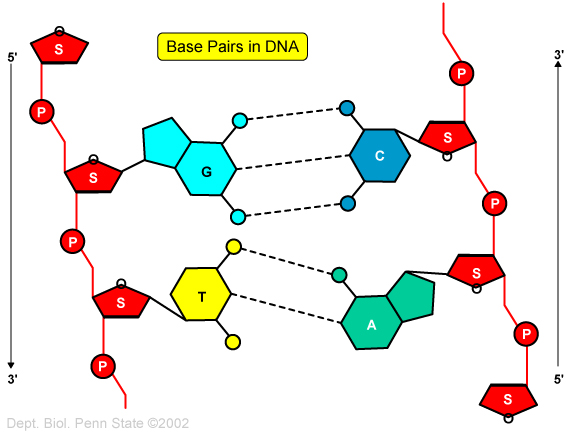
Nitrogenous bases are joined by which type of bond?
a)
polar bonds
b)
ionic bonds
c)
covalent bonds
d)
hydrogen bonds
12.

The following picture must be
a)
DNA because it's double stranded
b)
RNA because it's single stranded
c)
DNA because it's single stranded
d)
RNA because it's double stranded
13.

What does this picture represent?
a)
amino acid
b)
base pairing
c)
nucleotide
d)
the DNA molecule
14.
RNA contains the sugar
a)
ribose
b)
deoxyribose
c)
glucose
d)
lactose
15.
Which of the following is a base that is NOT contained in DNA?
a)
Adenine
b)
Thymine
c)
Uracil
d)
Guanine
16.
Which of the following statements is true?
a)
DNA is single-stranded
b)
RNA is single-stranded
c)
DNA contains uracil
d)
RNA contains deoxyribose
17.
Reasons that viruses are considered to be nonliving is because
a)
They are not cellular
b)
They cannot reproduce on their own
c)
They cannot make proteins
d)
all of the above
18.
What do viruses need to reproduce?
a)
they need genetic material
b)
They need a host cell
c)
They need bacteria
d)
They need insulin
19.
When a virus invades a living cell, its _______
takes over the cell's functions.
takes over the cell's functions.
a)
outer coat
b)
genetic material
c)
core
d)
cytoplasm
20.
What provides direct energy for the virus?
a)
food
b)
its host
c)
the sun
d)
a parasite
21.
Viruses are cells.
a)
True
b)
False
22.
Which of the following occurs after a virus attaches to a host cell in the viral reproduction process?
a)
The host cell dies
b)
The virus dies
c)
The virus inserts its genetic information into the host cell
d)
copies of the virus are immediately released from the host
23.
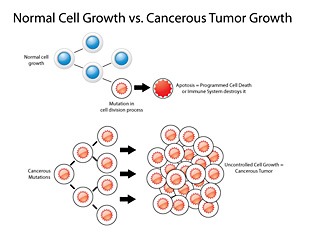
Cancer is best and fully described by ...
a)
Uncontrolled cell growth
b)
Cells which grow abnormally and no longer function correctly
c)
Cells which have lost the ability to reproduce
d)
Cells which create abnormal tissues
24.

During the cell cycle, the resting phase is ...
a)
G0
b)
G1
c)
G2
d)
S
25.
Cancer creates abnormal cells by disrupting
a)
the cell cycle
b)
red blood cell formation
c)
DNA replication
d)
ATP synthesis
26.
An abnormal mass of cancer cells is called a
a)
tumor
b)
cyst
c)
lesion
d)
polyp
27.

What is cancer?
a)
The heart does not receive enough blood.
b)
Sudden disruption of blood flow to part of the brain.
c)
Blood filled weak spot.
d)
Uncontrolled growth and spread of abnormal cells.
28.
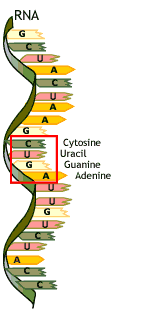
In RNA, Uracil pairs with ______.
a)
cytosine
b)
adenine
c)
guanine
d)
thymine
29.
The process to go from DNA to mRNA is _______
a)
translation
b)
transcription
c)
replication
30.
The process to go from mRNA to a protein is called ____
a)
transcription
b)
rRNA
c)
replication
d)
translation
31.
DNA holds the code for
a)
lipids
b)
carbohydrates
c)
protein
d)
sugar
32.
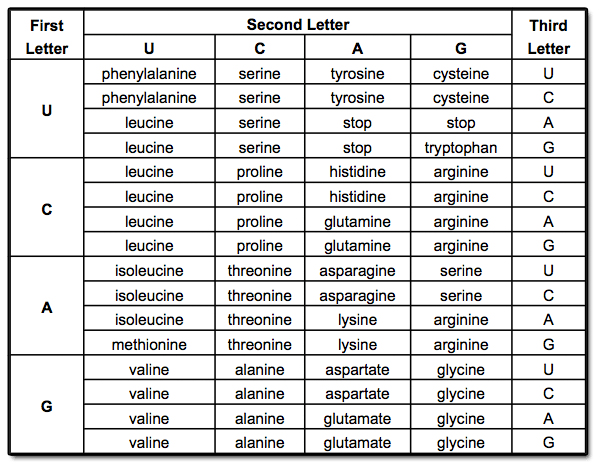
What amino acid is represented by the codon UUA?
a)
Phenylalanine
b)
Tyrosine
c)
Leucine
d)
Stop codon
33.
Which component of DNA determines the traits of an organism?
a)
Nitrogen Bases
b)
Sugar-Phosphate Backbone
c)
Hydrogen bonds
34.
What is the location in the cell for translation?
a)
nucleus
b)
mitochondria
c)
ribosome
d)
chloroplast
35.
What is the three base sequence of mRNA that codes for a single amino acid?
a)
Anticodon
b)
Codon
c)
Protein
36.
What is the location in the cell for transcription?
a)
nucleus
b)
cytoplasm
c)
ribosome
d)
mitochondria
37.
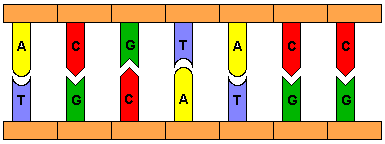
In DNA, Adenine pairs with ___________.
a)
Guanine
b)
Cytosine
c)
Thymine
d)
Uracil
38.
Translation is the process where
a)
mRNA is created in the Nucleus
b)
mRNA is decoded to form a protein
c)
glucose molecules are made
d)
is where lipids are synthesised
39.
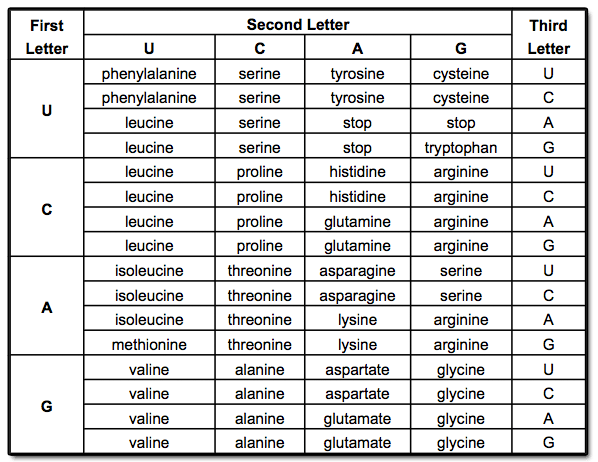
What is the correct amino acid sequence for the mRNA code AUGCCAGUAUGA
a)
Met-Pro-Ala-Val
b)
Met-Pro-Val
c)
Tyr-Gly-His
d)
Tyr-Gly-Arg-His
40.
What is the correct amino acid sequence for the mRNA code AUG GUA UGG
a)
Met-Pro-Ala
b)
Met-Val-Trp
c)
Tyr-Gly-His
d)
Tyr-Gly-Arg
100 %

