

wayground logo

Free Printable Worksheets

Font size

S
M
L
XL
Worksheets

Midterm Review

Total questions: 41

Worksheet time: 33mins

Name
Class
Date
1.
A major function of skin is protection from:
a)
Abrasion
b)
UV light 
c)
Entry of microorganisms
d)
All of the above 
2.
The waterproofing protein that fills the cells in the upper layers of the epidermis.
a)
Keratin
b)
Melatonin
c)
Melanin
d)
Actin
3.
This gland releases an oil known as sebum.
a)
Sebacious gland
b)
Apocrine Gland
c)
Eccrine Gland
d)
All of the above
4.
What is the top layer of the skin called?
a)
Dermis
b)
Hypodermis
c)
Epidermis
d)
Subcutaneous
5.
What is the function of the arrector pili muscle?
a)
To secrete sebum
b)
To produce keratin
c)
To make hairs stand on end
d)
None of these
6.
This is a general term for sweat glands.
a)
cerumen
b)
sebaceous
c)
apocrine
d)
sudoriferous
7.

Which type of cell is found in the hypodermis?

a)

adipose tissue

b)

keratinocytes

c)

Langerhans (dendritic) cells

d)

melanocytes

e)

Merkel cells

8.
Which of the following is not one of the four tissue types? 
a)
Blood
b)
Connective
c)
Epithelial
d)
Nervous 
9.
What type of connective tissue is found at the ends of bones to reduce friction?
a)
Cartilage
b)
Dense Connective Tissue
c)
Adipose Tissue
d)
Loose Connective Tissue
10.
What type of connective tissue has a hard matrix of calcium and salts?
a)
Bone
b)
Adipose
c)
Blood
d)
Dense Connective
11.
Which type of tissue helps in body movement?
a)
Epithelial
b)
Connective
c)
Muscle
d)
Neural
12.

Which type of tissue is avascular (no blood vessels) and tightly packed?

a)

Epithelial

b)

Connective

c)

Areolar

d)

Adipose

13.

What are the four types of tissues in the human body? (Select all that apply)

a)

Epithelial

b)

Connective

c)

Muscle

d)

Nervous

14.

What is histology?

a)

Study of organs

b)

Study of different types of tissue

c)

Study of histamines

d)

Study of skin

15.

What does pseudostratified mean?

a)

Many layers of cells

b)

Single layer that looks like many layers of cells

c)

Single layer of cells

d)

No layer of cells

16.

What is the protein that makes your hair, nails, and skin tough and adds protection to your body?

a)

glycoprotein

b)

actin

c)

keratin

d)

elastin

17.

What are the two main cells that make up nervous tissue?

a)

neurons

b)

myelin

c)

axon

d)

neuroglia

18.

Nervous tissue is found in the brain, spinal cord, and nerves and is responsible for communication.

a)

true

b)

false

19.

The main function of the nervous system

a)

send messages to and from the brain and spinal cord to and from the body

b)

break down food to be used by the body

c)

remove wastes from the body

d)

all of these

20.

The part of the body that integrates the information it receives from all over the body in order to make decisions is called the __________________

a)

peripheral nervous system

b)

sympathetic nervous system

c)

central nervous system

d)

parasympathetic nervous system

21.
What is the purpose of the myelin sheath on the axon?
a)
To maintain temperature
b)
To improve conductivity
c)
To protect the axon
d)
To release neurotransmitters
22.
a signal molecule that transmits nerve impulses across synapses
a)
neuron
b)
neurotransmitter
c)
nerve
d)
action potential
23.
Location at which a neuron can transfer an impulse to another cell with the use of neurotransmitters is called __________.
a)
myelin sheath
b)
axon
c)
threshold
d)
synapse
24.
These carry signals from tissues and organs to the brain and spinal cord
a)
Sensory Neurons
b)
Motor Neurons
c)
Efferent Neurons
d)
Glial Cells
25.
This part of the nervous system regulates involuntary actions such as heart function, blood pressure, breathing, digestion.
a)
Autonomic Nervous System
b)
Sensory Nervous System
c)
Motor Nervous System
d)
Peripheral Nervous System
26.

The brain is covered in a membrane called:

a)

choroid plexus.

b)

meninges.

c)

ventricles.

d)

cerebral aqueduct.

27.

What part of the nervous system is responsible for slowing down breathing and pulse?

a)

Spinal Nerves

b)

Sympathetic

c)

Parasympathetic

d)

Spinal Nerves

28.

Which best describes myelin?

a)

it is a neurotransmitter that triggers muscle contraction

b)

it is a protein that builds the axon

c)

it is a fat that speeds the message along the axon

d)

it is a fat that helps the neuron "hear" messages
29.
What are the 2 major divisions of the peripheral nervous system (PNS)?
a)
Sensory & Motor
b)
Peripheral & Central
c)
Somatic & Autonomic
d)
Brain & Spinal Cord
30.
nerve impulse
a)
action potential
b)
resting potential
c)
membrane potential
d)
synapse
31.
This releases neurotransmitters which are sent into the synaptic cleft for receptors on the dendrite
a)
axon
b)
axon terminal
c)
gene
d)
neuron
32.
Location of the adrenal glands.
a)
Within the thoracic cavity.
b)
Within the pancreas
c)
Posterior to the kidneys
d)
Superior to the kidneys
33.

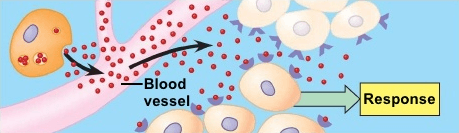
What kind of hormones travel in the blood stream?

a)

autocrine

b)

paracrine

c)

endocrine

d)

exocrine

34.

What type of hormones can pass through the lipid membrane of a cell?

a)

Steroid hormones

b)

Nonsteroid hormones

c)

both

d)

neither

35.

Which category of hormone binds to a receptor on a cell membrane and needs the help of a second messanger?

a)

Steroid

b)

Nonsteroid

c)

both

d)

neither

36.

Which category of hormone is released from an axon terminal and crosses a synapse?

a)

Steroid

b)

Nonsteroid

c)

both

d)

neither

37.

Chemicals produced by endocrine glands are called ____________

a)

glands

b)

hormones

c)

neurons

d)

stimuli

38.

Which system in humans helps maintain homeostasis?

a)

negative feedback mechanism

b)

positive feedback mechanism

c)

both A and B

d)

None of these

39.

What is the main function of the endocrine system?

a)

It creates chemicals, or hormones, that are sent around the body to maintain homeostasis.

b)

It creates electrical messages that are sent around the body to maintain homeostasis.

c)

It maintains the correct level of oxygen in the body to maintain homeostasis.

d)

It releases waste from the body to maintain homeostasis.

40.

The process by which an organism’s internal environment is kept stable in spite of changes in the external environment.

a)

Positive Feedback

b)

Negative Feedback

c)

Homeostasis

d)

Targeted Cells

41.
The "cause" for something to happen is the
a)
response
b)
effect
c)
stimulus
d)
homeostasis
