
 Worksheets
Ecology Unit #2
Total questions: 42
Worksheet time: 28mins


Plants that convert energy from the sun are called what?
decomposer
primary consumer
secondary consumer
producer


What is the greenhouse effect?
It is a phenomenon where the sun’s rays are absorbed by clouds.
It is a phenomenon that occurs when heat escapes into space.
It is when heat is trapped by gases, then sent back to earth’s surface.
It describes the atmosphere’s composition.

In the woods, there are ducks and mice. They both compete for grasshoppers as the only source of food in that area at that time. The ducks outcompete the mice, and the mice die out in that area. This is an example of:
Neutralism
Commensalism
The competitive exclusion principle
Mutualism

Barnacles are animals that cannot move. In order to get food, they attach to whales and catch any floating plankton in the water. The whale is neither helped nor harmed in the interaction. What type of symbiosis is this?
Mutualism
Commensalism
Parasitism
Neutralism

In the wild, some alligators gets their teeth cleaned by birds. The birds gets their food from the alligators' teeth.
What type of symbiosis is this?
Mutualism
Commensalism
Parasitism
Neutralism

In an ecosystem, there are populations of moose, rabbits, grass, and pine trees. Suddenly, a fire blazes through the area, which kills all of the populations. As the months go on, new species of grass begin to take root. This attracts animals, and eventually the ecosystem is restored.
What type of ecological succession happened?
Primary succession
Secondary succession
Tertiary succession
None of the above

An example of symbiosis where a tick receives nutrients from a host but the host is harmed in the process is called what?
parasitism
mutualism
commensalism
nonalism

What is this called: a relationship between two in which one species, the predator, feeds on the other species, the prey?
chemosynthesis
predation
cellular respiration
commensalism
A species like a raccoon that can eat a large variety of food for its diet would be called what?
Generalist
Specialist
Producer
Detritivore
A species that influences the survival of many other species in an ecosystem is called a (an)?
Endangered species
Niche species
Extinct species
Keystone species
Bees and butterflies compete for the same type of flowers (habitat) in this type of competition. What is it?
Interspecific competition
Competitive exclusion
Intraspecific competition
Random dispersion

What is the carrying capacity of the graph?
1000
8000
800
600

What type of growth is demonstrated in the graph?
Exponential
Carrying capacity
Linear
Logistic

When Yellowstone National Park was created in the late 1800s, wolves were on the decline. The last wolves in Yellowstone were killed in 1926, but in the 1800s, there were between 100-160 wolves in the park. In 1995, gray wolves were reintroduced to the park.
Which graph (drawn in red) below shows a prediction of how the population would change if there was less water available in the ecosystem?


There would be no change to carrying capacity.
The reason that organisms cannot produce populations of unlimited size is that
Populations always stay exactly the same.
The resources of Earth are limited.
There is no carrying capacity for the whole Earth.
Species rarely compete with each other for food.
Which of the following are density dependent factors?
competition for resources
predation
disease
natural disasters
Which of the following are examples of a density independent factors?
forest fire
seasonal cycles
storms
disease
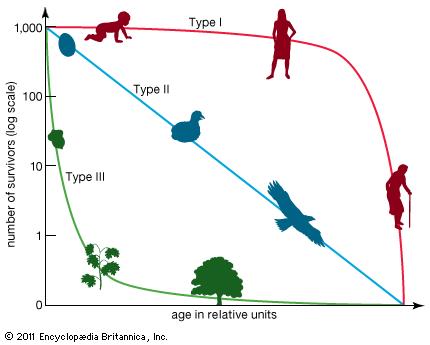
The mortality rate of organisms following a type I survivorship curve is __________.
fairly constant throughout life
higher in post-reproductive years
lower after the organisms become established
unrelated to age


What does the yellow line represent?
exponential growth
logistic growth
carrying capacity
none of the above
Vultures eat the soft, dead tissue of animals. What word would describe them as consumers?
Carnivore
Omnivore
Scavenger
Saprotroph

