
 Worksheets
Interim Review- Energy and Waves (AKS 7 and 9)
Total questions: 45
Worksheet time: 43mins
Name
Class
Date
1.
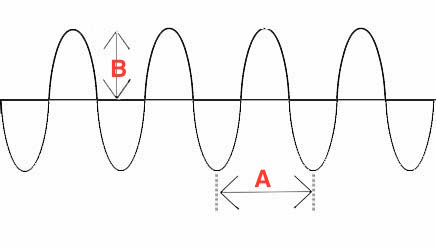
What property of this wave is represented by the letter "A"
a)
amplitude
b)
crest
c)
trough
d)
wavelength
2.
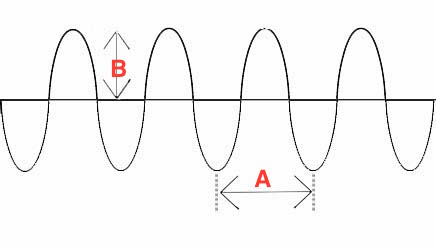
What property of the wave is represented by the letter "B"?
a)
amplitude
b)
crest
c)
trough
d)
wavelength
3.
The highest point on a wave is:
a)
the crest
b)
the trough
c)
the top
d)
the coast
4.
The lowest point on a wave is the:
a)
Amplitude
b)
Crest
c)
Trough
d)
Wavelength
5.
The number of wavelengths that pass a point each per second is:
a)
frequency
b)
period
c)
longitudinal
d)
transverse wave
6.
A mechanical wave cannot travel through...
a)
a vacuum(empty space).
b)
water.
c)
air.
d)
glass.
7.
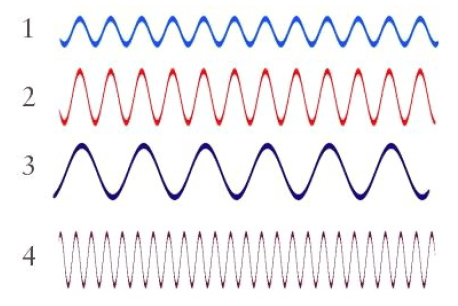
Which wave in the diagram has the greatest frequency?
a)
1
b)
2
c)
3
d)
4
8.
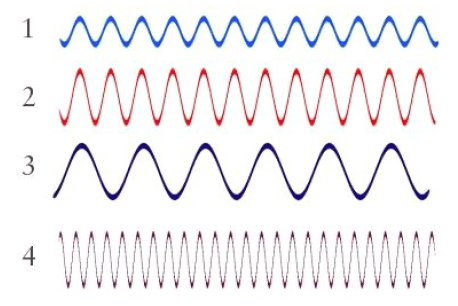
Which wave in the diagram has the greatest wavelength?
a)
1
b)
2
c)
3
d)
4
9.
Which of the following can sound travel through?
a)
solid
b)
liquid
c)
gas
d)
all of the above
10.
regular disturbances that carry energy through matter or space
a)
crest
b)
energy
c)
wave
d)
trough
11.
which material does sound travel the fastest?
a)
solid
b)
liquid
c)
gases
12.
Which statement about the length and energy of gamma-ray waves compared to other electromagnetic waves is true?
a)
Gamma-ray waves have the shortest wavelengths and carry the least amount of energy.
b)
Gamma-ray waves have the shortest wavelengths and carry the most amount of energy.
c)
Gamma-ray waves have the longest wavelengths and carry the least amount of energy.
d)
Gamma-ray waves have the longest wavelengths and carry the most amount of energy.
13.

Which statements correctly compare the sound waves experienced by observer A and observer B?
a)
Observer A experiences a wave with fewer crests.
b)
Observer A experiences a wave with lower energy.
c)
Observer A experiences a wave with a higher pitch.
d)
Observer A experiences a wave with a slower speed.
14.
How would the energy carried by an electromagnetic wave change if the wavelength were lengthened?
a)
The energy would increase
b)
the energy would fluctuate
c)
the energy would decrease
d)
the energy would stay the same
15.
A sound wave transfers energy by
a)
causing the air particles to vibrate.
b)
creating a vacuum between areas of air particles.
c)
creating high and low pressure areas that push and pull the air around them.
d)
filling the space left when a vibrating object moves in a direction opposite to the wave’s motion.
16.
When the particles of a medium are vibrating at right angles to the direction of energy transfer, then the wave is a
a)
Longitudinal wave
b)
Transverse wave
c)
sound wave
d)
Standing wave
17.
What happens to the amplitude of a sound wave when energy transfer is increased?
a)
As the transfer of energy is increased, the amplitude stops and no sound is made.
b)
As the transfer of energy is increased, the amplitude decreases causing the sound to get quieter.
c)
As the transfer of energy is increased, the amplitude increases causing the sound to get louder.
d)
As the transfer of energy is increased, the amplitude remains the same keeping the sound constant.
18.
What is one difference between an electromagnetic wave and a mechanical wave?
a)
A mechanical wave can travel through a vacuum. An electromagnetic wave must have a medium to travel through.
b)
An electromagnetic wave can travel through a vacuum. A mechanical wave must have a medium to travel through.
c)
An electromagnetic wave moves parallel to the direction of the wave's travel. A mechanical wave can move only perpendicular to the direction of the wave's travel.
d)
An electromagnetic wave moves perpendicular to the direction of the wave's travel. A mechanical wave can move only parallel to the direction of the wave's travel.
19.
Which of the following correctly describes sound waves?
a)
They are transverse waves.
b)
They are a part of the electromagnetic spectrum.
c)
They are longitudinal waves.
d)
They do not require a medium for transmission
20.
Which of the following best describes refraction?
a)
The bending of a wave as it reflects at an angle from a surface.
b)
The bending of a wave as it passes at an angle from one material to another.
c)
The bending of a wave it goes around, or passes through, openings in a barrier.
d)
The bending of one wave as two or more waves try to occupy the same space at the same time.
21.
Light travels fastest through which of the following?
a)
Air
b)
Gas
c)
Vacuum
d)
Water
22.
Why do we see lightning before we hear thunder?
a)
Sound travels slower than light can travel.
b)
Sound needs a medium to travel through.
c)
Sound cannot reflect off surfaces as easily as light.
d)
Sound is not processed by the brain as fast as light.
23.

When a sound wave hits a wall and echoes back, this is an example of what?
a)
Refraction
b)
Diffraction
c)
Reflection
d)
Interference
24.

When 2 waves meet and there amplitude increases it is known as what?
a)
Constructive Interference
b)
Amplitude Addition
c)
Positive Interference
d)
Destructive Interference
25.

This image is representing what wave interaction?
a)
Refraction
b)
Diffraction
c)
Reflection
d)
Interference
26.

a)
Constructive Interference
b)
Destructive Interference
27.

What is happening in this picture?
a)
Reflection
b)
Refraction
c)
Diffraction
d)
Absorption
28.
Heat is the movement of ______.
a)
radiation
b)
thermal energy
c)
cold
d)
fire
29.
Thermal energy ALWAYS moves from _____ to _____.
a)
solid to liquid
b)
ice to water
c)
hot to cold
d)
solid to gas
30.
Heat from the sun travels to Earth by _____.
a)
conduction
b)
convection
c)
insulation
d)
radiation
31.

The heat from a hot burner to a pot is transferred by ______.
a)
convection
b)
insulation
c)
radiation
d)
conduction
32.

What line segment represents only the solid state?
a)
A-B
b)
B-C
c)
C-D
d)
D-E
33.

In which segment is the kinetic energy remaining constant?
a)
A-B
b)
B-C
c)
C-D
d)
E-F
34.

What state(s) of matter are present at D-E?
a)
Solid-liquid
b)
Liquid
c)
Liquid-gas
d)
Gas-Solid
35.
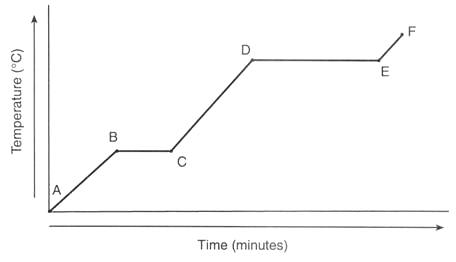
Between which points is the temperature of the substance remaining constant?
a)
A-B only.
b)
A-B, C-D, E-F
c)
B-C only.
d)
B-C, D-E
36.

Between which points is the temperature of the substance increasing?
a)
A-B only.
b)
A-B, C-D, E-F
c)
B-C only.
d)
B-C, D-E
37.

What state of matter is segment 5?
a)
Solid
b)
Liquid
c)
Gas
d)
Plasma
38.

A substance's heating curve is shown in the graph. What is its boiling point?
a)
100 C
b)
60 C
c)
80 C
d)
20 C
39.
When the temperature of matter increases the particles...
a)
speed up and move closer
b)
speed up and move farther apart
c)
slow down and move closer together
d)
slow down and move farther apart
40.
What does temperature measure?
a)
Heat
b)
ºC
c)
Kinetic Energy
d)
Thermal Energy
41.

What would be the effect on the particles if more heat is supplied to the system?
a)
They would slow down
b)
They would stop moving
c)
They would speed up
d)
There would be no effect
42.

Copper, Stainless Steel, Carbon Steel, and Zinc were all heated using the same thermal energy. What material would be the coolest after being heated?
a)
Copper
b)
Carbon Steel
c)
Zinc
d)
Stainless Steel
43.
When plants convert the sun's energy into food, which type of energy is it?
a)
kinetic
b)
chemical
c)
thermal
d)
radiant
44.

A battery converts what type of energy to another?
a)
sound to kinetic
b)
light to heat
c)
mechanical to electrical
d)
chemical to electrical
45.
According to which law of energy, energy can't be created or destroyed?
a)
First law of motion
b)
The law of tacos
c)
Laws of Energy
d)
law of conservation of energy
100 %

