
 Worksheets
8.5AB Atomic Structrue
Total questions: 39
Worksheet time: 1hrs 18mins
Name
Class
Date
1.
Which subatomic particles contribute the most to the mass of an atom?
a)
Protons, Neutrons, Electrons
b)
Protons only
c)
Protons and Electrons
d)
Protons and Neutrons
2.

What is the number of protons that the element in this image contain?
a)
14
b)
7
c)
15
d)
18
3.
If an atom has 12 positively charged subatomic particles, which of the following must it also have to be considered a neutral atom?
a)
12 neutrons
b)
12 electrons
c)
12 protons
d)
24 protons and neutrons
4.
An atom has 10 protons, 15 neutrons and 10 electrons what is its mass number.
a)
20
b)
10
c)
5
d)
25
5.
The particles of the atom you can find by knowing the atomic number.
a)
neutrons
b)
protons and electrons
c)
protons and neutrons
d)
atomic mass
6.
An element with a mass number of 11 and an atomic number of 5 has how many neutrons?
a)
11
b)
5
c)
6
d)
16
7.

The mass of one proton is greater than the mass of one...
a)
neutron
b)
electron
8.

What is the atomic mass of the atom pictured?
a)
9
b)
10
c)
18
d)
19
9.
This particle determines what element you have - the elements identity.
a)
electron
b)
proton
c)
neutron
d)
valence shell
10.
This causes the mass of the nucleus to increase.
a)
adding an electron
b)
adding a neutron
c)
more orbitals
d)
adding negatively charged particles
11.
Which particles make up the nucleus of an atom?
a)
protons and neutrons
b)
electrons and protons
c)
electrons, protons, and neutrons
d)
electrons and neutrons
12.
What charge does the nucleus have and why?
a)
positive - the neutrons do not have a charge
b)
positive - the neutrons and protons are positively charged particles
c)
neutral - the neutral charge dominates the positive charge
d)
neutral - electrons cancel out the positive charge of the atom
13.
What is the mass number and name of an element with 8 protons and 8 neutrons?
a)
16 - Carbon
b)
16 - Oxygen
c)
24 - Oxygen
d)
8 - Neon
14.
Which parts of the atom move around the nucleus?
a)
electrons
b)
protons
c)
electrode particles
d)
neutrons
15.
Found orbiting outside the nucleus, this subatomic particle has a negative charge.
a)
Neutron
b)
Proton
c)
Electron
d)
Idontknowatron
16.
The atomic number will always be the same as
a)
Mass number and number of protons
b)
Number of neutrons and protons
c)
number of electrons and protons
d)
Number of electrons and neutrons
17.

How many electrons does Oxygen need to fill its outer shell?
a)
3
b)
4
c)
1
d)
2
18.

How many protons does an Aluminum atom have? (use the picture to help you)
a)
27
b)
13
c)
14
d)
40
19.
What characteristic of an element's atoms ALWAYS determines the element's identity?
a)
the number of neutrons
b)
the number of protons
c)
the atomic mass
d)
the number of valence electrons
20.
How many valence electrons does Hydrogen have?
a)
1
b)
2
c)
3
d)
4
21.
Valence electrons are the...
a)
Innermost electrons
b)
Middle electrons
c)
Outermost electrons
d)
Any electrons
22.

a)
2
b)
3
c)
5
23.

a)
1
b)
2
c)
3
d)
4
24.
Valence electrons are:
a)
Electrons farthest away from the nucleus
b)
Electrons closest to the nucleus
c)
Electrons that just come and go - they don't stay with the atom
d)
Electrons in the second shell
25.

What does the nucleus of an atom contain?
a)
Electrons and neutrons
b)
Protons and neutrons
c)
Neutrinos and positrons
d)
Electrons and megatrons
26.
This element has 20 neutrons and 19 negatively charged particles
a)
Kr
b)
K
c)
Rb
d)
Xe
27.
How many electrons can the first energy level hold?
a)
1
b)
2
c)
8
d)
0
28.
All atoms with more than one energy level are most stable with (or would "prefer") how many electrons in their valence shell?
a)
1
b)
2
c)
8
d)
16
29.

True or False - Protons and Neutrons have about the same mass.
a)
True - They have about the same mass
b)
False - They do not have about the same mass
30.

The subatomic particles in green are...
a)
Protons
b)
Neutrons
c)
Electrons
31.
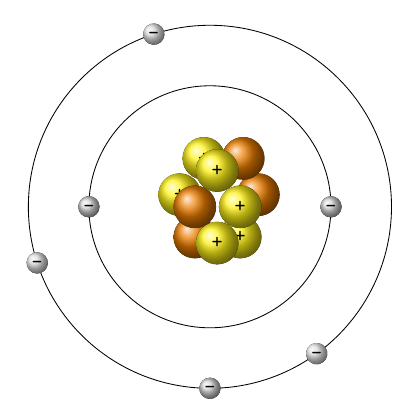
How many protons does this atom have?
a)
3
b)
6
c)
4
d)
2
32.
What subatomic particle is electrically neutral (no charge)?
a)
Proton
b)
Ion
c)
Neutron
d)
Electron
33.

Number of protons in an atom.
a)
Atomic Number
b)
Mass Number
c)
Isotope
d)
Valence electrons
34.

What parts of the atom make up most of its mass?
a)
protons and electrons
b)
protons and neutrons
c)
neutrons and electrons
d)
electrons
35.
Most of the atom is filled with
a)
electrons
b)
empty space
c)
the nucleus
d)
protons
36.

How many protons (+p) does this atom have?
a)
2
b)
7
c)
8
d)
16
37.
The subatomic particles of an atom include all of the following EXCEPT
a)
protons
b)
elements
c)
neutrons
d)
electrons
38.

How many neutrons does a sodium atom have?
a)
23
b)
11
c)
12
d)
34
39.
all matter is made of what
a)
energy
b)
atoms
c)
electrons
d)
compounds
100 %

