
NEW
Font size
S
M
L
XL
 Worksheets
Quarter 1 Exam Review
Total questions: 25
Worksheet time: 1hrs 11mins
Name
Class
Date
1.
This variable in an experiment is the one being deliberately changed by the scientist.
a)
dependent variable
b)
independent variable
c)
data
d)
control group
2.
Mr. S. sets up an experiment to see how the mass of a ball affects the distance it rolls off a ramp. Identify the dependent variable.
a)
height of the ramp
b)
distance traveled by the ball
c)
mass of the ball
d)
weight of the ball
3.
Once a theory has been tested and confirmed it cannot be changed.
a)
True
b)
False
4.
Laws tells us that it happens but doesn’t describe how or why.
a)
True
b)
False
5.
Einstein’s famous equation E=mc^2 describes the action of energy being converted to mass. What is this?
a)
Fact
b)
Theory
c)
Law
d)
Hypothesis
6.
People have 206 bones.
The tiniest bone is inside the ear. It is 3 millimeters long. It is called the stapes, or stirrup.
The tiniest bone is inside the ear. It is 3 millimeters long. It is called the stapes, or stirrup.
a)
Fact
b)
Theory
c)
Law
7.
Evolution is the widely held notion that all life is related and has descended from a common ancestor: the birds and the bananas, the fishes and the flowers
-- all related That is, complex creatures evolve from more simplistic ancestors naturally over time.
-- all related That is, complex creatures evolve from more simplistic ancestors naturally over time.
a)
Fact
b)
Theory
c)
Law
8.
A set of data are all close to each other, but they are not close to the actual value. This set of data can be described as...
a)
accurate
b)
precise
c)
both precise and accurate
9.
How close a measurement is to the true value is called..
a)
Accuracy
b)
Precision
c)
Significant
d)
Estimate
10.

This bullseye demonstrates...
a)
High Accuracy & High Precision
b)
High Accuracy & Low Precision
c)
Low Accuracy & High Precision
d)
Low Accuracy & Low Precision
11.
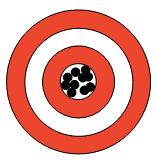
This bullseye demonstrates...
a)
High Accuracy & High Precision
b)
High Accuracy & Low Precision
c)
Low Accuracy & High Precision
d)
Low Accuracy & Low Precision
12.

How many total people took the survey?
a)
50
b)
150
c)
100
d)
200
13.

In which year did exactly 60 students have scholarships?
a)
2010
b)
2011
c)
2012
d)
2013
14.

There are 200 vegetable plants in a garden. How many of the vegetable plants are green beans?
a)
16
b)
24
c)
28
d)
32
15.
A substance that contains only one type of atom is a(n)
a)
compound
b)
element
c)
heterogeneous mixture
d)
homogeneous mixture
16.
Which of these is an example of a molecule?
a)
a small nugget of pure gold
b)
the smallest grain of salt in a salt shaker
c)
a small drop of sugar water
d)
two oxygen atoms joined to a carbon atom
17.
Which of these is a mixture?
a)
Uncooked chocolate chips and cookie dough blended together with a spoon.
b)
Distilled water
c)
A nugget of gold
d)
A molecule of Oxygen
18.
all matter is made of what
a)
energy
b)
atoms
c)
electrons
d)
compounds
19.
the central region of an atom where its neutrons and protons are is its
a)
nucleus
b)
electron cloud
c)
core
d)
center
20.
The positive particles of an atom are
a)
electrons
b)
positrons
c)
neutrons
d)
protons
21.
Particles in an atom that are neutral and have no charge are
a)
negatrons
b)
electrons
c)
neutrons
d)
protons
22.
A particle that moves around the nucleus is a(n)...
a)
Proton
b)
Neutron
c)
Electron
d)
Quark
23.
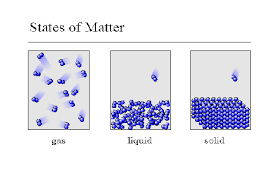
At higher temperatures
a)
particles in an object have less energy
b)
particles in an object move faster
c)
a gas contracts
24.
The state of matter that has no definite size or shape is
a)
Solid
b)
Liquid
c)
Gas
25.
Particles of a liquid
a)
are tightly packed together and stay in a fixed position.
b)
have no viscosity.
c)
decrease in volume with increasing temperature.
d)
are free to move around one another but still touch.
Reset

