
 Worksheets
Waves
Total questions: 16
Worksheet time: 11mins
Name
Class
Date
1.
When the frequency of a wave increases, what happens to the wavelength?
a)
The wavelength is not directly affected by the frequency of a wave.
b)
The wavelength increases.
c)
The wavelength decreases.
d)
More specific information is needed to form a conclusion about the wavelength.
2.
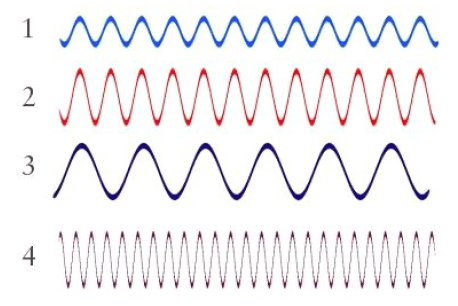
Which wave in the diagram has the greatest wavelength?
a)
1
b)
2
c)
3
d)
4
3.
Which of the following can sound travel through?
a)
solid
b)
liquid
c)
gas
d)
all of the above
4.
When a wave bends as it passes through at an angle from one medium to another.(example: pencil in a glass of water-)
a)
medium
b)
refraction
c)
reflection
d)
interference
5.
What types of waves carry energy at a right angle or perpendicular to the direction of the energy flow?
a)
Longitudinal waves
b)
Transverse waves
c)
Sound waves
d)
P-waves
6.
What do waves carry from place to place?
a)
Energy, but not matter or particles
b)
Energy and matter or particles
c)
Matter or particles but not energy
d)
Neither energy nor matter or particles
7.
Which wave travels parallel in relation to a medium?
a)
Transverse
b)
Longitudinal
c)
Both
d)
Neither
8.
When a wave hits an object that it cannot pass through, it will _________.
a)
diffract, or bend around the object
b)
continue traveling in a straight line
c)
refract, or change direction
d)
be absorbed by the object
9.
Seismic waves contain which type of waves?
a)
transverse
b)
compressional
c)
both transverse and compressional
d)
neither transverse or compressional
10.
When a wave bends around an object, this is called _______.
a)
diffraction
b)
reflection
c)
Law of Reflection
d)
refraction
11.
When a wave travels from air to water, ________.
a)
the wave changes direction
b)
a new wave forms
c)
some of the wave's energy can be transferred to the matter
12.
The distance between one point on a wave and the nearest point that is moving with the same speed and directions is called (a) __________.
a)
wavelength
b)
compression
c)
amplitude
d)
diffraction
13.
A wave has wavelength of 10 m and a speed of 340 m/s. What is the frequency of the wave?
a)
34 m/s
b)
3400 Hz
c)
3.4 Hz
d)
34 Hz
14.
1. A wave has frequency of 5 Hz and a speed of 25 m/s. What is the wavelength of the wave?
a)
25 m
b)
125 m
c)
5 m
d)
25 m/s
15.
What is a medium?
a)
something between a small and a large?
b)
the substance through which a wave can travel
c)
a pattern of vibration that simulates when a wave is standing still
d)
the distance from any point on a wave to an identical point on the next wave
16.
What is frequency?
a)
any disturbance that transmits energy through a medium
b)
the distance from any point on a wave to an identical point on the next wave
c)
the number of waves produced in a given amount of time
d)
when the particles in a longitudinal wave are spread apart
100 %

