wayground logo

Free Printable Worksheets

NEW

Font size

S
M
L
XL
Worksheets

Chapter 4 American Revolution

Total questions: 56

Worksheet time: 35mins

Name
Class
Date
1.
This was a tax on molasses and sugar to reduce smuggling.
a)
Stamp Act
b)
Sugar Act
c)
Townshend Act
d)
Tea Act
2.
This was a tax on all printed materials in the 13 Colonies.
a)
Stamp Act
b)
Sugar Act
c)
Tea Act
d)
Townshend Act
3.
Finish this American Colonist Motto, "No Taxation without..."
a)
Transportation
b)
Relaxation
c)
Representation
d)
Sensation
4.
Why were the American Colonist taxed after the French and Indian War?
a)
Britain was in debt and needed money
b)
That was the agreement with the Native Americans
c)
They made too much money
d)
Townshend Acts
5.
What was this poster's meaning?
a)
The Colonies needed to be united
b)
Serpents can grow back together
c)
Colonies need to be independent
d)
Ben Franklin didn't know why he made this
6.
This event broke tensions between the colonist and the British troops where shots were fired. Crispus Attucks was the first to be killed.
a)
Lexington and Concord
b)
Boston Tea Party
c)
Boston Massacre
d)
Bloody Valentine
7.
How did the colonist protest against the tea tax?
a)
Dressed up like Native Americans
b)
Boston Massacre
c)
Dumped tea into Boston harbor
d)
Didn't pay the tax on the East India Tea
8.
Which was the punishment for the Boston Tea Party?
a)
Intolerable Acts
b)
Sugar Acts
c)
Quartering Acts
d)
Stamp Acts
9.
Early revolutionary battle where 1,000 British troops died and realized the American Colonists were tougher than they though.
a)
Battle of Bunker Hill
b)
Lexington and Concord
c)
Battle of Saratoga
d)
Battle of Yorktown
10.
This type of American Colonist was in support of the British parliament.
a)
Patriot
b)
Loyalist
c)
Yes man
d)
Neutral
11.
The Second Continental Congress addressed the steps to the colonies governing themselves and the creation of what military group?
a)
Colonial militias
b)
Marines
c)
Continental Army
d)
Navy
12.
Who was the first choice to command the Continental Army?
a)
Thomas Jefferson
b)
Benjamin Franklin
c)
Thomas Paine
d)
George Washington
13.
This type of colonist was ready for rebellion and the fight for independence.
a)
Loyalist
b)
Patriot
c)
Neutral
d)
British 
14.
Colonists were forbidden to settle west of the Appalachian Mountains.
a)
Proclamation line of 1763
b)
Proclamation boundary
c)
Manifest Destiny
d)
Borderlands
15.
Which act was passed as a result of the Boston Tea Party?
a)
Stamp Act
b)
Quartering Act
c)
Intolerable Acts
d)
Outrageous Acts
16.
Which phrase became popular after passage of the Stamp Act?
a)
“The rights of Englishmen”
b)
“Give me liberty or give me death”
c)
“Life, liberty, and the pursuit of happiness”
d)
“No taxation without representation“
17.
What does Quartering mean?
a)
To allow troops to stay in your home
b)
Hitting someone with a quarter
c)
To give someone a quarter
d)
Giving a quarter of your earnings to Britain
18.
Given that only 5 people died in the Boston Massacre, why was it labeled a massacre?
a)
 British commanders ordered troops to shoot into a rioting crowd in effort to restore order
b)
the victims were innocent bystanders who were caught in the barrage of gunfire
c)
 the victims had done little to provoke the confrontational and hostile British troops
d)
Boston radicals used it as propaganda to take advantage of the heightened tensions 
19.
To refuse to buy goods from someone as a form of protest . . .
a)
occupy
b)
boycott
c)
damage
d)
repeal
20.
What group was created as a response to the Stamp Act?
a)
Sons of Liberty
b)
The Patriots
c)
The Red Coats
d)
The Loyalists
21.
Why did King George III tax the colonists so heavily?
a)
He hated the colonist
b)
He wanted more money for himself
c)
The national debt increase from the French and Indian War
d)
To make money for the colonies
22.
The Olive Branch Petition was written as a last attempt at …
a)
Freedom 
b)
Peace 
c)
Loyalty 
d)
Rebellion 
23.
Arguably the first "battle" of the Revolutionary War occurred when the Massachusetts Minutemen fired on British troops at -
a)
Boston
b)
Philidelphia
c)
Saratoga
d)
Lexington and Concord
24.
Who was the major author of the Declaration of Independence?
a)
Benjamin Franklin
b)
John Adams
c)
Thomas Jefferson
d)
Patrick Henry
25.
Surrounded by French and Continental armies, a large British army surrendered here.
a)
Saratoga
b)
Yorktown
c)
Bunker Hill
d)
Lexington and Concord
26.
This member of the Continental Congress helped gain French support for American independence.
a)
Thomas Jefferson
b)
Benjamin Franklin
c)
Patrick Henry
d)
John Adams
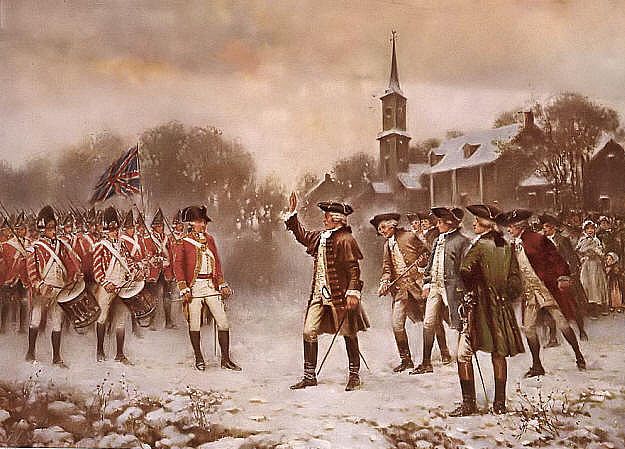
27.
What event is depicted in this image?
a)
Boston Massacre
b)
Boston Tea Party
c)
Battle of Bunker Hill
d)
Lexington and Concord
28.
This patriot made a daring ride to warn colonists that British soldiers were approaching.
a)
Patrick Henry
b)
Paul Revere
c)
Phillis Wheatley
d)
Samuel Adams
29.
Of the following events, which happened first? 
a)
Saratoga
b)
Yorktown
c)
Declaration of Independence
d)
Treaty of Paris of 1783
30.
Which one of these is not an advantage that helped the American patriots defeat Great Britain.
a)
defense of their own land, principles and beliefs
b)
support from France
c)
superior numbers of soldiers and greater experience
d)
strong leadership from men like George Washington
31.
The U.S. was founded on July 4, 1776, by the approval of this document.
a)
the Treaty of Paris
b)
the Constitution
c)
the Declaration of Independence
d)
the Virginia Charter
32.
The Sons of Liberty were:
a)
the children of our Founding Fathers.
b)
a professional dance team.
c)
Patriots who protested taxes.
d)
the writers of the Declaration of the Independence.
33.
What is another name for British soldiers?
a)
Redcoats
b)
Patriots
c)
Minutemen
d)
Continental Soldiers
34.
Who won the American Revolution?
a)
The British
b)
The American Colonists
35.
The British Navy used this to keep goods from reaching the Patriots by sea.
a)
Blockade
b)
Stamp Act
c)
Tuna Water
d)
Minutement
36.
What roles did women have during the war?
a)
They ran farms.
b)
They ran businesses.
c)
They followed their soldiers and helped in the camps.
d)
All of the above
37.
The British sent troops to Concord to
a)
capture weapons stored there
b)
attack George Washington’s troops
c)
take Fort Ticonderoga
d)
try to capture John Paul Jones
38.
During the war African Americans
a)
stayed on plantations and kept out of the war
b)
ran away and joined both sides
c)
only fought for the Americans
d)
only fought for the British
39.
Colonists protested taxes by doing all of the following EXCEPT
a)
Boycotting British goods
b)
Throwing tea into the Boston harbor
c)
Petitioning King George
d)
Holding protest rallies in London
40.
Trenton
a)
Kept the British from splitting New England from the other colonies
b)
Winter encampment where soldiers suffered from cold, hunger, and disease
c)
George Washington led his troops across the Delaware river to attack
d)
A.  Was the final major battle of the Revolution
41.
Valley Forge
a)
Was the final major battle of the Revolution
b)
Kept the British from splitting New England from the other colonies
c)
Winter encampment where soldiers suffered from cold, hunger, and disease
d)
Patriots held off the British until they ran out of ammunition
42.
Treaty of Paris
a)
said kings were nonsense
b)
Was the final major battle of the Revolution
c)
Decided the outcome of the fight between Khan and Pippin
d)
The agreement ending the Revolution
43.
Common Sense
a)
Thomas Paine said kings were nonsense
b)
The agreement ending the Revolution
c)
Kept the British from splitting New England from the other colonies
44.
The _____________ required colonists to pay extra taxes on the paper goods such as newspapers, legal documents, and playing cards. 
a)
Sugar Act
b)
Stamp Act 
c)
Intolerable Acts 
d)
Quartering Acts 
45.
In 1774 delegates from all the colonies except Georgia met to discuss the problems the colonies were having with England. This was called ____________. 
a)
Boston Tea Party
b)
First Continental Congress
c)
Parliament
d)
None of the answers 
46.
Who wrote "Common Sense" that challenged the colonists to fight for independence? 
a)
Patrick Henry
b)
Thomas Paine 
c)
John Adams
d)
Thomas Jefferson 
47.
Who was the Commander in Chief of the Continental Army? He led 2400 men across the Delaware River. 
a)
George Washington 
b)
Patrick Henry
c)
Lord Cornwallis
d)
George Jones 
48.
The first armed conflict of the Revolutionary War took place at_______________. This is known as the shot heard around the world. 
a)
Philadelphia
b)
Lexington
c)
Washington D.C. 
d)
None of the answers 
49.
The American Troops defeated the British in New York during the  _____________ in the fall of 1777. 
a)
Boston Massacre
b)
Battle of Lexington
c)
Battle of Saratoga
d)
None of the answers 
50.

John Locke supported the right of the people to do this if government failed to protect natural rights.

a)

revolution

b)

continue to obey

c)

petition

d)

emigration

51.

According to John Locke, these are given by God and cannot be taken by the government. The protection of these is the purpose of the government.

a)

divine rights

b)

systemic rights

c)

natural rights

d)

preternatural rights

52.

He was influenced by the ideas of John Locke.

a)

Thomas Hobbes

b)

Thomas Jefferson

c)

Machiavelli

d)

Plato

53.

Who drilled Patriots at Valley Forge

a)

Friedrich von Steuben

b)

guerilla warfare

c)

Continental Army

d)

privateers

54.

French general who support the American during the war for Independence.Helped trained colonial troops and persuaded France to aid the colonies

a)

Marquis de Lafaytte

b)

Samuel Adams

c)

Abigail Adams

d)

John Adams

55.

rapid rise in prices

a)

boycott

b)

tributary

c)

inflation

d)

profiteering

56.
An economic condition which results in an increase in the price of goods.
a)
neutral
b)
inflation
c)
profiteering
d)
veteran