wayground logo

Free Printable Worksheets

Font size

S
M
L
XL
Worksheets

Rebellion & Revolution

Total questions: 91

Worksheet time: 1hrs 5mins

Name
Class
Date
1.

The Sugar Act was a tax on sugar and _______

a)

molasses

b)

tea

c)

clothes

2.

The French and Indian War was very _______________ for the British.

a)

cheap

b)

expensive

c)

long

3.

Who did the King feel should pay for the war?

a)

British

b)

colonists

c)

Spain

4.

The Colonists were happy about paying the tax.

a)

TRUE

b)

FALSE

5.

The Stamp Act taxed all ________ goods.

a)

paper

b)

plastic

c)

pollution

6.

Which of the following would NOT be taxed under the Stamp Act?

a)

paper

b)

magazines

c)

pens

d)

birth certificate

7.

The colonists hope that the tax would be taken away, or ____________

a)

repealed

b)

lost

c)

given

d)

refocused

8.
1. What is an official statement of a complaint over something believed to be wrong or unfair. 
a)
grievance
b)
revolution
c)
boycott
9.
2. To forcible overthrow the government in favor of a new system. 
a)
boycott
b)
grievance
c)
revolution
10.
3. To refuse to buy or handle goods as a a punishment or protest
a)
grievance
b)
 boycott
c)
revolution
11.
What act was the cause of the Boston Tea party?
a)
The Townshend act
b)
Tea Act
c)
Sugar Act
12.
Who was the King during the American Revolution?
a)
King Arthur
b)
Martin Luther King Jr.
c)
King George III
13.
Define boycott.
a)
An organized campaign to refuse to buy certain products
b)
import tax
c)
Citizen soldiers who could be ready to fight at a minute's notice
d)
to surrender
14.
The Townshend Acts put taxes on  _________.
a)
cloth
b)
 salt and sugar 
c)
glass, tea, paint, paper
15.
British colonists making fun of the British soldiers started the ______________.
a)
Seven Years War
b)
Boston Massacre
c)
Boston Tea Party
16.
Parliament gave the East India Tea Company a _______________ on tea.
a)
boycott
b)
monopoly
c)
tax
d)
sale
17.
What did the Quartering Act Do?
a)
Taxed Colonists on glass and paint
b)
Made Colonists house soldiers
c)
Forced colonists west of the Appalachian Mountains
d)
Raised the tax on sugar
18.
What was one of the intolerable acts?
a)
closed Boston Port
b)
closed New York Harbor
c)
closed Norfolk Harbor
d)
closed Massachusetts Port
19.
Who organized the Boston Tea Party?
a)
Daughters of Liberty
b)
Sons of Liberty
c)
The British
d)
The Illuminati
20.
What was The other name for the Intolerable Act?
a)
Stamp act
b)
Coercive Act
c)
Sugar Act 
d)
Military Act
21.
Which of the following best describes the events of the Boston Massacre?
a)
Boston townspeople attacked and killed five British soldiers
b)
Boston soldiers attacked and killed five Boston townspeople.
c)
British soldiers attacked Boston townspeople, who shot five soldiers.
d)
Boston townspeople attacked British soldiers, who shot five colonists.
22.
Which of the following is a true statement about the Boston Massacre?
a)
It became a rallying point for anti-French feeling.
b)
It became a rallying point for anti-British feeling.
c)
It had no impact on the colonies.
d)
It led to the repeal of the Stamp Act.
23.
A result of the colonists’ angry reaction to the Tea Act of 1773 was that the British Parliament...
a)
repealed the Tea Act.
b)
raised the tea tax.
c)
banned the sale of tea.
d)
passed the Intolerable Acts.
24.
Which of the following best describes the First Continental Congress of 1774?
a)
The First Continental Congress was a meeting in Boston to discuss how to handle an unwanted shipment of tea.
b)
The First Continental Congress was a meeting in Charleston to discuss the practice of smuggling goods into the colonies.
c)
The First Continental Congress was a meeting of twelve of the thirteen colonies called in response to the Boston Massacre.
d)
The First Continental Congress was a meeting of twelve of the thirteen colonies called in response to the Intolerable Acts.
25.
Why did Parliament eventually repeal the Stamp Act?
a)
the colonists established a blockade 
b)
The colonists started buying British goods.
c)
The colonists were able to produce their own goods
d)
The colonists began boycotting (refusing to buy) British goods
26.
What does “taxation without representation” mean?
a)
taxing someone without giving them a voice in government
b)
not taxing a certain group of people
c)
taxing someone who does not live in the country
d)
taxing everyone the same amount
27.
What was the name of the British lawmaking body whose votes affected the colonists?
a)
Parliament
b)
Congress
c)
King George III
d)
Lobster backs
28.
What was the main reason that colonists gave for being upset with Parliament?
a)
No women were allowed.
b)
Members wanted to punish the colonists.
c)
They were forced to drink coffee.
d)
The colonists had no representatives in Parliament.
29.
Why did England impose taxes on the colonies?
a)
Pay for the cost of a new navy.
b)
Build roads to the Ohio River Valley.
c)
Show colonists who was in charge.
d)
Pay off debts owed from the French and Indian War.
30.
Who was the main author of the Declaration of Independence?
a)
Benjamin Franklin
b)
Samuel Adams
c)
Thomas Jefferson
d)
Paul Revere
31.
The Preamble is...
a)
in the beginning of the Declaration...
b)
the conclusion.
c)
in the middle.
d)
not in the Declaration.
32.
According to the Declaration of Independence, what truth was "self-evident"?
a)
All men are created equal
b)
Rights are given by good kings
c)
Government exists to protect us from ourselves
d)
Only a democracy can protect our rights
33.
The words self-evident means what?
a)
confusing
b)
obvious
c)
wrong
d)
self-aware
34.
What are our natural rights according to Jefferson?  (He got the idea from John Locke, but he changed the last right.)
a)
Freedom of speech, religion, and press
b)
Life, liberty, and property
c)
Life, liberty, and the pursuit of happiness
d)
Voting, rebelling, and health
35.
Why was the Declaration of Independence written?
a)
To stop taxes from the British Empire.
b)
To make a United States army.
c)
To gain independence from the British Empire
d)
To install their own king in America
36.
To Great Britain, the signing of the Declaration of Independence was
a)
an act of loyalty.
b)
an act of treason.
c)
an act of bravery.
d)
an act of insanity.
37.
Which statement best describes the role of government according to the Declaration of Independence?
a)
“The main purpose of government is to expand and glorify the state”
b)
“The main purpose of government is to protect the unalienable rights of individuals”
c)
“The main purpose of government is to protect the rights and privileges of His Majesty, the King”
d)
“The main purpose of government is to promote the general welfare of the community by taking steps toward social equality”
38.
When Thomas Jefferson copied John Locke's ideas about the social contract, what did he say the people had the right to do to a government who was not protecting the people's rights?
a)
Write a letter
b)
Suggest how it could be better
c)
Wait until they started to respect the people's rights
d)
Abolish it
39.
The Declaration of Independence states, “That whenever any form of government becomes destructive of these ends, it is the Right of the People to alter or abolish it.” Which Enlightened idea do these words describe?
a)
need to ensure a representative government.
b)
social contract between government and the people.
c)
revolutionary intent to overthrow the current government.
d)
return to a society that has no central authority.
40.
According to the Declaration of Independence who gives us our rights? 
a)
given by God at birth 
b)
given by our government 
c)
given by our president 
d)
given by our parents 
41.
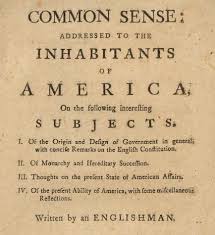
Who wrote a pamphlet called "Common Sense"?
a)
George Washington
b)
Thomas Paine
c)
Thomas Jefferson
d)
Patrick Henry
42.

Which the meaning of Grievances?

a)

Virtues

b)

Complaints

c)

Petitions

d)

Answers

43.
Why is July 4th a significant date to the Declaration of Independence?
a)
The Continental Congress approved the document
b)
It was when they started writing the document
c)
It was Jefferson's birthday
d)
It was the day they sent it to the King
44.
What was the purpose of the Olive Branch Petition?
a)
to ask King George to make peace with the colonies.
b)
to persuade British troops to leave Boston.
c)
to encourage colonists to join the army.
d)
to convince Parliament to repeal the Stamp Act.
45.
One grievance colonists had against the King was that he dissolved their local governments in which Act?
a)
Intolerable Acts
b)
Navigation Acts
c)
Stamp Act
d)
Tea Act
46.
What is the meaning of taxation without representation?
a)
When people are taxed, but they have no say in the government
b)
When people are taxed twice on the same item
c)
When some people get taxed and others don't
d)
When people in the Colonies are taxed, but no one in England is
47.
Who were the colonial leaders making decisions during the Revolutionary War?
a)
George Washington, Thomas Jefferson, John Adams, Ben Franklin
b)
Thomas Edison, John Deere, Abe Lincoln, George Washington
c)
Daniel Boone, Barach Obama, Abe Lincoln, Thomas Jefferson
d)
George Washington, Abe Lincoln, Eleanor Roosevelt, Betsy Ross
48.
What was the most significant result for our country's history because the Colonies won the Revolutionary War?
a)
It resulted in our freedom and ability to govern ourselves
b)
We won a war
c)
Other counties were impressed by our winning a war
d)
George Washington would always be our President
49.
What was the name of the war where the Native Americans worked together with the French to fight against the British?
a)
American Revolution
b)
Battle of Bunker Hill
c)
French and Indian War
d)
Revolutionary War
50.
Colonists who wanted independence from Britain were called...
a)
Yankees
b)
Rebels
c)
Loyalists
d)
Patriots
51.
Why were the colonists so upset about the new taxes from the British?
a)
The merchants wanted to live in Britain.
b)
What are you talking about...the colonists were not mad.
c)
The colonists believed that they should have representatives in the British government.
d)
The tax money went to the French people.
52.
Why did the British need to tax the colonists?
a)
The British wanted to give money to the Native Americans.
b)
The French and Indian War cost them a lot of money and they had a debt to pay.
c)
The British government was poor.
d)
The Revolutionary War was expensive.
53.
The Declaration of Independence stated that all people have the right to Life, Liberty, and the Pursuit of __________________.
a)
food and shelter
b)
happiness
c)
an education
d)
freedom
54.
What event does this picture represent?
a)
The Boston Massacre
b)
The Boston Tea Party
55.
This person was the Commander-in-Chief of the Continental Army.
a)
Patrick Henry
b)
George Washington
c)
Benjamin Franklin
d)
Thomas Jefferson
56.
Money that people are forced to pay to the government for services
a)
Debt
b)
Tax
c)
Savings
d)
Piggy Bank
57.
The Sons and Daughters of Liberty were protest groups formed by Patriots to protest the Stamp Act.
a)
True
b)
False
58.
The Continental Congress met in Philadelphia, PA to write a letter of protest to the King of England.
a)
True
b)
False
59.
People who were loyal to the King of England during the Revolutionary War.
a)
Patriots
b)
Loyalists
c)
Redcoats
60.
Why did fighting break out at Lexington and Concord in April 1775?
a)
Minutemen attacked a British fort.
b)
Colonists refused to let British troops stay in their homes.
c)
British troops tried to seize colonists' arms and ammunition.
d)
British troops tried to break up a meeting in the Old North Church.
61.
What was the historical significance of the Battles of Lexington and Concord?
a)
The fighting ended colonists' resistance to British authority.
b)
The outcome proved that militias were no match for British troops.
c)
Britain gave up on any attempt to keep its North American colonies.
d)
The fighting signaled the start of the American Revolution.
62.
"give me liberty or give me death!"
"A government of our own in our natural right..."
"We must indeed all hang together or, most assuredly, we shall all hang separately."
These statements were made by...
a)
Redcoats
b)
Patriots
c)
Tories
d)
Native American Indians
63.
The Battle of Saratoga was significant in the Revolutionary War because it...
a)
ended the British threat to the South
b)
guaranteed Canadian help for the colonists
c)
convinced the French to support the Americans
d)
forced the British to withdraw from North America
64.
During the war, Native Americans generally supported the...
a)
British because the British promised to free enslaved African Americans
b)
British because the British seemed less of a threat to their way of life
c)
Patriots because the Patriots seemed less of a threat to their way of life
d)
Patriots because the Patriots promised to return Native American lands
65.
The Proclamation of 1763 created an imaginary line along which geographic feature of America?
a)
Atlantic Ocean
b)
Great Lakes
c)
Appalachian Mountains
d)
Rocky Mountains
66.
Who was the patriot who warned colonists in Lexington, MA that "the British are coming"?
a)
Paul Revere
b)
George Washington
c)
John Hancock
d)
Sam Adams
67.
Which founding father traveled to France during the war to gain French support for the American's cause?
a)
George Washington
b)
Thomas Jefferson
c)
John Adams
d)
Benjamin Franklin
68.
Which founding father was a Boston lawyer who defended the British troops accused of murder in the Boston Massacre?
a)
George Washington
b)
Thomas Jefferson
c)
John Adams
d)
Benjamin Franklin
69.
Which event marked the beginning of the Revolutionary War, the "shot heard 'round the world"?
a)
Battle of Saratoga
b)
Battles of Lexington and Concord
c)
Surrender at Yorktown
d)
Treaty of Paris
70.
Which event marked the "turning point" of the war, when the French decide to help the Americans?
a)
Battle of Saratoga
b)
Battles of Lexington and Concord
c)
Surrender at Yorktown
d)
Treaty of Paris
71.
Which event marked Great Britain officially recognizing American independence?
a)
Battle of Saratoga
b)
Declaration of Independence
c)
Surrender at Yorktown
d)
Treaty of Paris
72.
Who helps America fight the British; a major factor in America winning the war?
a)
France
b)
China
c)
Italy
d)
Canada
73.
Which of the following was a reason America is able to defeat the British?
a)
better trained soldiers
b)
more military experience
c)
innovative (new) tactics and strategies
d)
a larger army
74.
Which of the following was NOT a reason the Americans are able to defeat the British?
a)
more motivation (fighting on and for their own land)
b)
good leadership (Washington and French generals)
c)
new/innovative tactics and strategies
d)
a larger army
75.
What effect did Common Sense have in the colonies?
a)
It persuaded many colonists that America should be independent.
b)
It instilled fear of war in the colonies.
c)
It convinced the colonies to remain loyal to Great Britain.
d)
It petitioned the king to end the quarrel between the colonies and Great Britain.
76.
Did the American Colonies have anyone to represent them in parliament where laws were made for Great Britain?
a)
No
b)
Yes
77.
"No taxation without __________________!"
a)
representation
b)
approval
c)
Parliament
d)
boycotts
78.
Where did the Second Continental Congress meet?
a)
New York City
b)
Philadelphia
c)
Boston
d)
Washington D.C.
79.
What were the strengths of the American forces in the American Revolutionary War?
a)
dedication of ordinary people
b)
inspiring leaders
c)
daring captains on land and sea
d)
all of these
80.
What were the British strengths during the war?
a)
a well-trained army.
b)
a navy that ruled the sea.
c)
the help of mercenaries.
d)
all of these
81.
What were the problems the British had in the American Revolutionary War?
a)
They had to break the opponents' will to fight.
b)
The great distance between Britain and America.
c)
their overconfident leadership
d)
All of these
82.
What were the American problems to overcome in the Revolutionary War?
a)
inexperienced soldiers
b)
shortages of food, clothing, and weapons
c)
lack of money
d)
all of these
83.
Where did Washington and his troops spend a brutal winter that could have easily led to American surrender?
a)
Valley Forge
b)
Saratoga
c)
Monmouth
d)
Canada
84.

Why did many African Americans fight in the war?

a)

They were offered freedom

b)

They were forced to

c)

They didn't have anything else to do

85.

Choose two strengths of the Patriots.

a)

Had a great leader!

b)

Dedicated!

c)

Had great skills!

d)

Had better weapons!

86.

Choose two weaknesses of the Patriots.

a)

Had fewer people

b)

Didn't know the land

c)

Had no money

d)

No cause to fight.

87.

What was George Washington's winning strategy at the Battle of Trenton?

a)

Surround the British and block them from getting resupplied

b)

make a surprise attack the morning after Christmas

c)

make the British chase the Patriots until they wear out

d)

hide in trenches and sneak up on soldiers

88.
Which battle was the final battle of the Revolutionary War?
a)
the Battle of Trenton
b)
the battle of Bunker Hill
c)
Valley Forge
d)
the Battle of Yorktown
89.
Two challenges the Americans faced after winning the war were...
a)
Native Americans and land ownership
b)
slavery and how to govern themselves 
c)
how to govern themselves and build a navy
d)
slavery and choosing a leader
90.
The Declaration of Independence included the following parts: an explanation as to why the colonists needed to break free from Britain, the rights of people that cannot be taken away and...
a)
a list of demands
b)
a list of wishes and wants
c)
a list of crimes
d)
a list of complaints against King George
91.
Why was it dangerous to sign the Declaration of Independence?
a)
those who signed it would be forced to fight in the war
b)
those who signed it would be kicked out of the colonies
c)
those who signed it would be put in jail
d)
those who signed it would be charged with treason and hanged