
 Worksheets
Unit 3 SOM & Gas Laws Review
Total questions: 50
Worksheet time: 40mins
A vacuum cleaner works by creating a space of _______ within the canister.
low pressure
high pressure
low temperature
high temperature
There are fewer molecules as you climb a mountain.
The pressure should increase as you go up
The pressure should decrease as you go up.
The temperature should increase as you go up.
Nothing changes as you climb the mountain.
Air pressure occurs ______.
mainly down
mainly up
mainly to the side
in all directions
Air can cause objects to move from _____ to _____ .
high to low pressure
high to low temperature
low to high pressure
low to high temperature
Which particles are easiest to press together (compress)?
Gases
Liquids
Solids
All are equally the same.
Pressure in a container _______ if the number of collisions ________.
increases; increases
decreases; increases
increases; remains the same
remains the same; decreases
What best describes why the two cans rolled towards each other? Blowing between them _____.
increased pressure between them.
decreased pressure between them
increased pressure outside of them
decreased pressure outside of them
What kept the water from falling out of the inverted cup?
Magic
Gravity pulls it up
Air applied a force upward
Water is sticky
If water did not shoot out of the hole of the bottle then air pressure _____
was greater than water.
was less than water.
was equal to water.
is weak
What best explains why the tissue in the beaker does not get wet even though the beaker goes underwater?
The beaker was empty space.
The tissue was small.
Water was pulled down by gravity
Air pushed the water particles away from the tissue.
Temperature best describes ________.
the space an object occupies
the average energy of the particles' motion
the force of the particles
the number of particles
If a student wants to draw higher pressure then they should draw _____
more particle dots
longer particle arrows
more arrows striking the surface
All of the above
The lowest temperature for the _________ scale is zero.
Kelvin
Celsius
Fahrenheit
All of them
What is the relationship between pressure and temperature?
Positive; both increase together
Negative; as Temp increases pressure decreases
Positive; as Temp increases pressure decreases
Negative; both increase together
As a substance becomes warmer, the density tends to ______.
remain the same
decrease
increase
How is water's behavior different than the other substances in the SIM lab (Oxygen, Neon, Argon)?
The density of the liquid is less than the solid.
The density of the solid is less than the liquid.
The density of the liquid is greater than a gas.
The density of the liquid is less than a gas.
Why does a hot air balloon rise?
Hot air spreads out more and is denser than cold air.
Hot air spreads out more and is less dense than cold air
Hot air has less particles and is less dense.
Hot air has less particles and is denser.
If you remove air particles from inside the balloon then it will _______.
Shrivel up; less particles = less pressure
Pop; less particles = less pressure
Shrivel up; less particles = more pressure
Pop; less particles = more pressure
A vacuum is _______.
something that cleans your house
a space containing little to no particles
a space of very high pressure
a space of very high temperature
Pressure is
defined as the mass that an object exerts when at rest.
not a measurable in gases.
defined as the number of moles of substance divided by the mass of the substance.
created by the force of the gas particles impacting the walls of the container.

The data table below shows that as the pressure of a gas sample was changed, the volume of the gas changed. The pressure was measured in atmospheres (atm) and the volume was measured in milliliters (mL).
According to the data table, as the pressure of the gas increases, the volume of the gas:
decreases
increases
remains the same
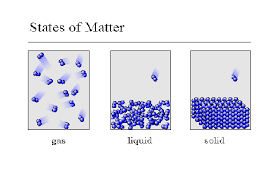

Which is a quality that only gases display?
Spread out to fill all available space
Can be compressed
Take the shape of their container
All of these

WHAT STATE OF MATTER IS C?
SOLID
LIQUID
GAS
SUPER FLUID
WHAT STATE OF MATTER IS B?
SOLID
LIQUID
GAS
SUPER FLUID
WHAT STATE OF MATTER IS A?
SOLID
LIQUID
GAS
SUPER FLUID
WHAT IS THE PHASE CHANGE FROM C TO B?
MELTING
FREEZING
VAPORIZATION
CONDENSATION
WHAT IS THE PHASE CHANGE FROM B TO A?
MELTING
FREEZING
VAPORIZATION
CONDENSATION
WHAT IS THE PHASE CHANGE FROM C TO A?
MELTING
SUBLIMATION
DEPOSITION
CONDENSATION
WHAT IS THE PHASE CHANGE FROM A TO C?
MELTING
SUBLIMATION
DEPOSITION
CONDENSATION

In region A, identify the state(s) of matter
gas
liquid
solid

At what TIME does the material enter the phase change from liquid to gas
~5min
~15 min
~25min
~35min

What is the boiling temperature of the material?
0oC
100oC
-25oC
225oC

What line segment represents only the solid state? (Diagram F)
A-B
B-C
C-D
D-E


According to Charles Law, the relationship between Temperature and Volume can best be described as....
Inverse Relationship
No Relationship
Direct Relationship

Which graph shows the pressure-temperature relationship expected for an ideal gas?
1
2
3
4
(Charles Law) There are 65 liters of helium in a balloon at 35 K. If the temperature of the balloon is increased to 40 K, what will the new volume of the balloon be?
40 L
70 L
74.3 L
75.9 L
What happened during the Can Crush station when the can was inverted into a beaker of ice water?
The temperature increased, causing the inside pressure to drop, which crushed the can.
The temperature decreased, causing the inside pressure to drop, which crushed the can.
The temperature increased, causing the inside pressure to rise, which crushed the can.
The temperature decreased, causing the inside pressure to rise, which crushed the can.
During the Gas Law lab, what happened during the Cartesian Diver when you squeezed the 2 L bottle?
The diver sank because the volume of air inside decreased, due to an increase in pressure.
The diver sank because the temperature dropped.
The diver sank because it became less dense due to a change in pressure.
The diver sank because more air particles were added after squeezing the bottle.

