wayground logo

Free Printable Worksheets

NEW

Font size

S
M
L
XL
Worksheets

Matter and The Periodic Table

Total questions: 31

Worksheet time: 19mins

Name
Class
Date
1.
Which element has an atomic number of 6?
a)
Carbon
b)
Nitrogen
c)
Xenon
d)
Sodium
2.

Which of the following elements is a Noble Gas with a complete outer energy level?

a)

Lithium (Li)

b)

Argon (Ar)

c)

Boron (B)

d)

Bromine (Br)

3.
Fluorine has an atomic number of 9. How many protons does it have?
a)
4
b)
9
c)
12
d)
0
4.
Carbon has 6 protons. Carbon has an atomic mass of 12. How many neutrons does Carbon have?
a)
12
b)
0
c)
2
d)
6
5.
Calcium has an atomic mass of 40 amu. Calcium has 20 protons. How many neutrons does Calcium have?
a)
40
b)
20
c)
0
d)
15
6.
These determine the reactivity of an element...
a)
Valence electrons
b)
Valence Protons
c)
Valence Neutrons
d)
Valence Quark
7.

What is one difference between aluminum (Group 13) and magnesium's (Group 2) structure?

a)

Aluminum has more protons and fewer neutrons than magnesium.

b)

Magnesium has one more proton than aluminum.

c)

Magnesium's atomic mass is larger than aluminum's atomic mass.

d)

Magnesium has one less proton than aluminum.

8.

The blue elements are called

a)

metals

b)

nonmetals

c)

metalloids

d)

noble gases

9.
How many Valance electrons does Iodine Have?
a)
6
b)
16
c)
7
d)
17
10.
Atoms with similar properties are most likely located...
a)
in the same period.
b)
in the same group.
c)
in different periods.
d)
to the right and left of each other.
11.
How many electrons can the second electron shell hold?
a)
2
b)
8
c)
16
d)
18
12.

Flammability is an example of what type of property?

a)

Chemical property

b)

Physical property

13.

Density : Chemical or Physical Property

a)

Chemical Property

b)

Physical Property

14.
What is the mass number?
a)
the number of protons
b)
the sum of the number of protons and the number of neutrons in the nucleus of an atom 
15.
This is a Bohr Model of what element?
a)
Beryllium
b)
Boron
c)
Barium
d)
Bromine
16.
This is a Bohr Model of what element?
a)
Helium
b)
Oxygen
c)
Sodium
d)
Phosphorous
17.
How many electrons does potassium K contain? (click to see image)
a)
19
b)
39
c)
20
d)
40
18.

Which one is not an element?

a)

Hydrogen

b)

Potassium

c)

Water

d)

Calcium

19.

Elements are classified into 3 groups called...

a)

Metals, nonmetals, and metalloids

b)

elements, molecules, and compounds

c)

alkali metals, alkaline earth metals, and basic metals

d)

Shiny, rough, and flammable

20.

The right side of the Periodic Table does NOT include...

a)

nonmetals

b)

halogens

c)

metalloids

d)

noble gases

21.
What is the biggest difference between an atom of cobalt (Co) and an atom of nickel (Ni) as shown in the periodic table entries?
a)
An atom of nickel has more protons.
b)
An atom of cobalt has more electrons.
c)
An atom of cobalt has a lower number of neutrons.
d)
An atom of nickel has a higher value for atomic mass.
22.
Which of the following best describes the properties of metals?
a)
hard, brittle, and nonconductive
b)
liquid, dark, and conductive
c)
shiny, malleable, and conductive
d)
soft, oily, and very reactive
23.
How are the elements in the periodic table arranged?
a)
by their atomic mass
b)
by their chemical symbol
c)
by their chemical name
d)
by their atomic number
24.
vertical columns in the periodic table are _________ of elements with similar properties. 
a)
groups
b)
periods
25.
_______ are horizontal  rows of elements that contain increasing numbers of protons and electrons.
a)
groups
b)
periods
26.
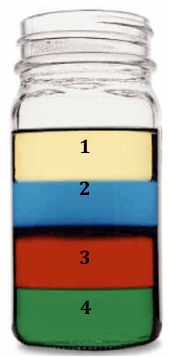
Put the liquids in order from most dense to least dense?
a)
4, 3, 2, 1
b)
1, 2, 3, 4
c)
3, 4, 2, 1, 
d)
4, 3, 1, 2
27.
True or False:  The density of a specific type of material never changes.  
a)
True
b)
False
28.

Which of the following is a correct description for solids?

a)

closely arranged and in fixed positions

b)

closely arranged and vibrate in fixed positions

c)

closely arranged and can move around

29.
Which of the following statements about the kinetic particle theory is not true?
a)
The particles of a gas move faster than those of a liquid.
b)
The particles of a solid have more kinetic energy than those of a gas.
c)
The particles that make up matter are always moving.
d)
The forces of attraction between the particles of a solid are very strong.
30.

Particles are always moving.

a)

True

b)

False

31.

In which state of matter will there be the LARGEST space between molecules?

a)

Solid

b)

Liquid

c)

Gas