wayground logo

Free Printable Worksheets

Font size

S
M
L
XL
Worksheets

Unit 5 Writing Equations

Total questions: 166

Worksheet time: 5hrs 10mins

Name
Class
Date
1.
Write an equation for this relationship.
a)
y = 4x
b)
y = 1/8x
c)
y = 1/4x
d)
y = 8x
2.
In a direct variation, y = 39 when x = 3. 
Find the value of y when x = 2.
a)
26
b)
3
c)
58.5
d)
2
3.
The amount of money earned on a job is directly proportional to the number of hours worked.  If $70.00 is earned in 5 hours, how much money is earned in 22 hours of work?
a)
$2
b)
$308
c)
$1.57
d)
$265
4.
Is the given table a direct variation? If so, what is the constant?
a)
Yes; 1/4
b)
Yes; 4
c)
Yes; 2
d)
No
5.
y varies directly with x. When y = 39,  x = 3.  Find the value of y when x = 2.
a)
26
b)
3
c)
58.5
d)
2
6.
Is this a direct variation?
y = 2x
a)
yes
b)
no
7.
Write the equation for the table given.
a)
y = 1/3x
b)
y = 3x
c)
y = 1/2x
8.
Does the relationship represent direct variation?
a)
Yes
b)
No
9.
Trina's paycheck earnings varies directly as the number of hours she works. If she works 19 hours and earns $187.15, what should she earn if she worked 40 hours? 
a)
$394
b)
$440
c)
$472.80
d)
$512.20
10.
y varies directly with x. When y is 16, x is 32. Which equation represents this situation?
a)
y = 32x
b)
y = 16x
c)
y = 2x
d)
y = (1/2)x
11.
What ordered pair does a direct variation always go through when graphed?
a)
(0, 0)
b)
(1, 0)
c)
(0, 1)
d)
(1, 1)
12.
Which graph shows a proportional relationship between x and y?
a)
A
b)
B
c)
C
d)
D
13.
 y varies directly with x.
 y is 84 when x is 16. What is the constant of proportionality?
a)
y = (21/4)x
b)
k = 21
c)
k = 5.25
d)
k = 4/21
14.
Write an equation for this relationship.
a)
y = 4x
b)
y = 1/8x
c)
y = 1/4x
d)
y = 8x
15.
In a direct variation, y = 39 when x = 3. 
Find the value of y when x = 2.
a)
26
b)
3
c)
58.5
d)
2
16.
The amount of money earned on a job is directly proportional to the number of hours worked.  If $70.00 is earned in 5 hours, how much money is earned in 22 hours of work?
a)
$2
b)
$308
c)
$1.57
d)
$265
17.
Is the given table a direct variation? If so, what is the constant?
a)
Yes; 1/4
b)
Yes; 4
c)
Yes; 2
d)
No
18.
y varies directly with x. When y = 39,  x = 3.  Find the value of y when x = 2.
a)
26
b)
3
c)
58.5
d)
2
19.

What is the ratio (k)for direct variation.

a)

k=x*y

b)

k=x/y

c)

k=y/x

d)

k=x+y

20.
Given (3, 21) and (x, 42) are part of the same direct variation. Find x.
a)
3
b)
6
c)
9
d)
12
21.
Which of the given graphs is a direct variation?
a)
A
b)
B
c)
C
d)
D
22.
Is this a direct variation?  y =2x + 1
a)
Yes
b)
No
23.

The y-intercept of a direct variation is always 0.

a)

True

b)

False

24.

Direct variation is X over Y.

a)

True

b)

False, because its Y over X.

25.

Direct variation is another vocabulary word for...

a)

Non Proportional

b)

Proportional

c)

Slope

d)

y-intercepot

26.

Which equation represents a direct variation.

a)

y=4x

b)

y=2x+4

c)

y=-4x+3

d)

y=x-1

27.

A graph of a direct variation must pass through the

a)

slope

b)

y-intercept

c)

equation

d)

origin

28.

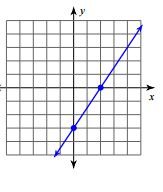
What is the equation for this direct variation?

a)

y=4x

b)

y=2x

c)

y=-2x

d)

y=1/2x

29.
Find the 22nd term of the following sequence:
5, 8, 11, ...
a)
14
b)
68
c)
63
d)
71
30.
Identify the common difference.
97, 86, 75, 64, ...
a)
8
b)
11
c)
-11
d)
-8
31.
Identify the common difference.
3, 7, 11, 15, ...
a)
6
b)
5
c)
4
d)
2
32.
Find the 32nd term of this sequence.
9, 4, -1, -6, -11, ...
a)
81
b)
-34
c)
-146
d)
-225
33.
Find the 25th term of the sequence if a1 = 5 and d = 0.5
a)
18
b)
17
c)
15
d)
14
34.
The next two terms of the sequence 4,7,10,13 are ....
a)
16 and 19
b)
15 and 19
c)
16 and 18
d)
15 and 18
35.
The next term of the sequence 2,4,8,16 is
a)
64
b)
32
c)
108
d)
20
36.
The next two terms of the sequence 4,7,10,13 are ....
a)
16 and 19
b)
15 and 19
c)
16 and 18
d)
15 and 18
37.
Find the common difference 10, 20, 30, 40.........
a)
Multiply by 10
b)
Add 10  
c)
Multiply by 2
38.
What is the next term in the sequence 1, 4, 9, 16, 25, ...?
a)
34
b)
36
c)
39
d)
41
39.
What is the 15th term of the sequence an = -3n+50
a)
95
b)
-5
c)
5
d)
-95
40.
What is the 10th term of the sequence an = 20-2n
a)
40
b)
-20
c)
7
d)
0
41.
Find the common difference: 29, 21, 13, 5, ...
a)
d = -10
b)
d = -9
c)
d = -8
d)
d = -7
42.
Find the common difference: -18, -23, -28, -33, ...
a)
d = -5
b)
d = 5
c)
d = -3
d)
d = 3
43.
Find a26 in the arithmetic sequence: -15, -35, -55, -75, ...
a)
-515
b)
-490
c)
-535
d)
460
44.
Is the sequence arithmetic: 37, 31, 25, 19, ...
a)
Yes
b)
No
45.
Identify the common difference.
3, 7, 11, 15, ...
a)
6
b)
5
c)
4
d)
2
46.
Find the first term of the given sequence:
a14=68
d=3
a)
14
b)
20
c)
26
d)
29
47.
What is the distance from one number to the next in a sequence of numbers that is represented by a (d) in an arithmetic sequence?
a)
Common denominator
b)
Common opposites
c)
Common domain
d)
Common difference
48.
Find the first term of the given sequence:
a14=68
d=3
a)
14
b)
20
c)
26
d)
29
49.
Given the sequence:
 25, 21, 17, 13,...
Write the explicit equation that models the sequence.  (Hint:  Simplify your equation.)
a)
an = 4n + 29
b)
an = -4n + 25
c)
an = -4n + 29
d)
an = 4n + 25
50.
Slope is know as rise/
a)
run
b)
fall
c)
none
d)
rise
51.
What type of slope does the graph have?
a)
Positive
b)
Negative
c)
Zero Slope
d)
Undefined
52.
What type of slope does the graph have?
a)
Zero
b)
Undefined
c)
Negative
d)
Positive
53.
What type of slope does the following graph have?
a)
Postive
b)
Negative
c)
Zero Slope
d)
Undefined
54.
In the equation y=mx+b, what does the m represent?
a)
slope
b)
y-intercept
c)
linear
d)
point-slope
55.
What is the slope in the equation y=2x + 3?
a)
2
b)
3
c)
5
d)
Cannot be Determined 
56.
What does 'b" represent in y=mx+b
a)
y-intercept
b)
macaroni
c)
nothing
d)
slope
57.
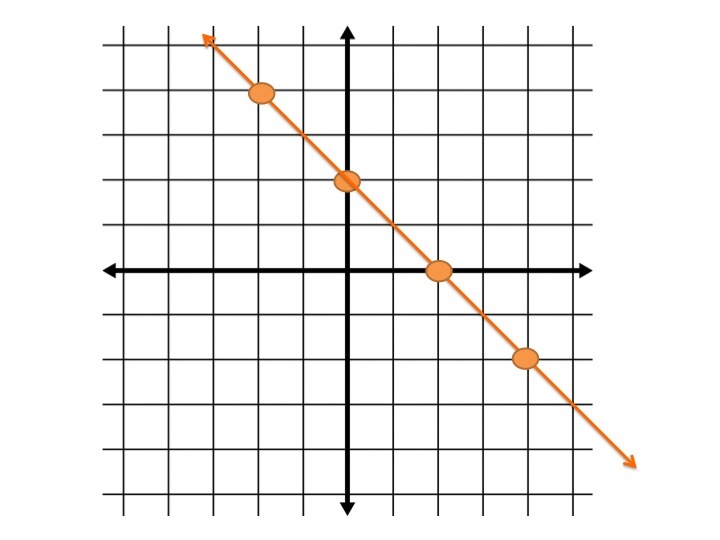
Write the equation for the line in slope-intercept form.
a)
y= -1x+3
b)
y= 4x+3
c)
y=1/4x+3
d)
y= -4x+3
58.
Find the slope
a)
-5/7
b)
7/5
c)
-7/5
d)
5/7
59.
What is the slope in the equation y=2x + 3?
a)
2
b)
3
c)
5
d)
Cannot be Determined 
60.
What is the y-intercept in the equation y= -2x + 5
a)
-2
b)
3
c)
5
d)
Cannot be Determined
61.
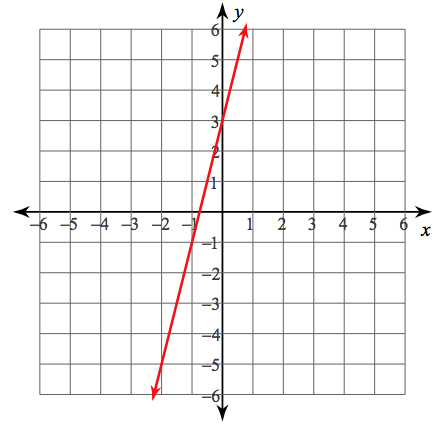
What is the equation of this line?
a)
y = 2x +2
b)
y = 2x -2
c)
y = -x + 2
d)
Cannot be Determined
62.
find the slope
a)
3/2
b)
-3/2
c)
(-0,-3)
d)
none of the above
63.
Find the slope of the line that passes through
(1, -19) and (-2, -7)
a)
-4
b)
4
c)
1/4
d)
-1/4
64.
Find the slope of the line that passes through (-9, -6) and (-9, -10)
a)
0
b)
Undefined
c)
-3
d)
-9
65.
How would you write the equation with a slope of 2/3 and a y-intercept of -3
a)
y=3/2x+3
b)
y=2/3-3
c)
y=2/3x-3
d)
y=2/3x+3
66.
If m=3 and b=6, what is the correct slope intercept equation?
a)
y=3-6
b)
y=3x-6
c)
y=3x+6
d)
y=6x+3
67.
Determine the slope and y-intercept from the following equation:   y = 3/2x + 3
a)
slope: 5   y-intercept:  (0,3) 
b)
slope: 3/2   y-intercept:  (0,3) 
c)
slope:  4  y-intercept:  (0,3/2)
d)
slope: 1/5   y-intercept:  (0,5) 
68.
Which of these represents slope-intercept form?
a)
y - y1 = m(x-x1)
b)
Ax + By = C
c)
y = mx + b
69.
Write the equation for the line in slope-intercept form.
a)
y= -1x+3
b)
y= 4x+3
c)
y=1/4x+3
d)
y= -4x+3
70.
Which of these lines has a slope of -3?
a)
A
b)
B
c)
C
d)
D
71.
Which of these represents point-slope form of a linear equation?
a)
y - y1 = m(x - x1)
b)
Ax + By = C
c)
y = mx + b
72.
Which of these represents slope-intercept form of a linear equation?
a)
y - y1 = m(x-x1)
b)
Ax + By = C
c)
y = mx + b
73.
For the equation
y + 1 = -3(x - 5),
the line contains the point (5, -1) and has a slope of?
a)
-1
b)
1
c)
-3
d)
5
74.
Write the equation in point-slope form of the line that passes through the given point and has the given slope:
 (-2, -1); m= -3
a)
y + 1 = -3(x - 2)
b)
y + 1 = -3(x + 2)
c)
y - 1 = 3(x - 1)
d)
y + 2 = -3(x + 1)
75.
Write the equation in point-slope form of the line that passes through the given point and has the given slope.
(4, -7); m = -1/4
a)
y +7 = -1/4(x - 4)
b)
y - 4 = -1/4(x + 7)
c)
y+ 7 = 4(x - 4)
d)
y - 7 = -1/4(x - 4)
76.
a)
y=2x+7
b)
y=-3x-5
c)
y=2x-1
d)
y=2x+6
77.
a)
y=2x+7
b)
y=-3x-5
c)
y=2x-1
d)
y=2x+6
78.
a)
y= 3/4 x + 3
b)
y= 1/2 x +3
c)
y= 2x+3
d)
y=2x-7
79.
Write the equation in point-slope form for the line that contains the points
(-2, -3), (4, 3)
a)
y - 3 = 1(x - 2)
b)
y + 3 = 1(x + 2)
c)
y -3 = -1(x + 2)
d)
y + 3 = -1(x - 2)
80.
Determine the slope and y-intercept from the following equation:   4x + y = -10
a)
slope: 4   y-intercept:  (0,10)
b)
slope: -4   y-intercept:  (0,-10)
c)
slope: -4   y-intercept:  (0,10)
d)
slope: 4   y-intercept:  (0,-10)
81.
What type of slope?
a)
negative
b)
positive
c)
zero slope
d)
downward slope
82.
What type of slope?
a)
undefined
b)
positive slope
c)
negative slope
d)
zero slope
83.
Write the equation in point-slope form of the line that passes through the given point and has the given slope.
(4, -7); m = -1/4
a)
y +7 = -1/4(x - 4)
b)
y - 4 = -1/4(x + 7)
c)
y+ 7 = 4(x - 4)
d)
y - 7 = -1/4(x - 4)
84.
Write the equation in point-slope form of the line that passes through the given point and has the given slope:
 (-2, -1); m= -3
a)
y + 1 = -3(x - 2)
b)
y + 1 = -3(x + 2)
c)
y - 1 = 3(x - 1)
d)
y + 2 = -3(x + 1)
85.
Write the equation of the line in Point-Slope form that goes through the point (10,5) and has a slope of -3
a)
y-5=-3(x-10)
b)
y=-3x+35
c)
y+5=-3(x+10)
d)
y=-3x-35
86.
Write the equation of a line parallel to the one pictured through the point (3,1) in point slope form.
a)
y-1=1/2(x-3)
b)
y+1=1/2(x+3)
c)
y-1=-1/2(x-1)
d)
y+1=-1/2(x+3)
87.
Write an equation  
m = 5/4 through (-4, -3)
a)
y = 5/4x +2
b)
y = -5/4x + 2
c)
y = 2x - 5/4
d)
y = 3/4x + 2
88.
Write an equation 
m = 1/3 through (4, 4)
a)
y = -1/3x + 8/3
b)
y = 8/3x - 1/3
c)
y = 8/3x + 1/3
d)
y = 1/3x + 8/3
89.
Write an equation  
m = -1/2 through (-2, 4)
a)
y = -3/2x + 3
b)
y = 3/2x + 3
c)
y = -1/2x + 3
d)
y = 3x - 3/2
90.
Write an equation  
m = 5 through (-1, -3)
a)
y = 5x + 2
b)
y = -5x - 5
c)
y = -5x + 2
d)
y = 2x - 5
91.
For the equation 
y - 3 = 2(x + 4), 
what is the ordered pair?
a)
(-4, 3)
b)
(3, -4)
c)
(-3, -4)
d)
(-4, -3)
92.
For the equation 
y + 1 = -3(x - 5), 
What is the slope?
a)
-1
b)
1
c)
-3
d)
5
93.
For the equation
y + 1 = -3(x - 5),
the line contains the point (5, -1) and has a slope of?
a)
-1
b)
1
c)
-3
d)
5
94.
For the equation
y - 3 = 2(x + 4),
the line has a slope of 2 and contains what point?
a)
(-4, 3)
b)
(3, -4)
c)
(-3, -4)
d)
(-4, -3)
95.
Write the equation in point-slope form of the line that passes through the given point and has the given slope.
(4, -7); m = -1/4
a)
y +7 = -1/4(x - 4)
b)
y - 4 = -1/4(x + 7)
c)
y+ 7 = 4(x - 4)
d)
y - 7 = -1/4(x - 4)
96.

Write this equation in slope intercept form.

y + 5 = -1/8 (x - 8)

a)

y = -1/8x - 4

b)

y = -1/8 x + 1

c)

y = -1/8 x -6

d)

y + 5 = -1/8x + 1

97.

Write this equation in slope intercept form.

y + 7 = 2/3 (x - 6)

a)

y + 7 = 2/3x - 4

b)

y = 2/3x + 3

c)

y = 2/3x - 4

d)

y = 2/3x - 11

98.

What is the letter that represents slope?

a)

x

b)

y

c)

m

d)

b

100.

What is the y intercept in this equation?


y = 3x

a)

0

b)

3

c)

there is no y intercept

100.

What is the y intercept in this equation?


y = 3x

a)

0

b)

3

c)

there is no y intercept

101.

What is the letter that represents the y intercept?

a)

b

b)

m

c)

x

d)

y

102.

Create the equation in slope intercept from (y = mx + b) for a line with a slope of 2 and goes through the point (4, 6)

a)

y = 2x - 2

b)

y = 2x + 12

c)

y = 4x - 6

d)

y = 2x + 2

103.
Slopes of parallel lines are...
a)
opposite reciprocals.
b)
opposites.
c)
identical.
d)
always 7.
104.
Slopes of perpendicular lines are...
a)
opposite reciprocals.
b)
opposites.
c)
identical.
d)
always 7.
105.
y = 3x +2
y = 3x - 3
These lines are...
a)
Parallel
b)
Perpendicular
c)
Neither
d)
The same line
106.
-6x + y = 2
6x + y = 2
These lines are...
a)
Parallel
b)
Perpendicular
c)
Neither
107.
y = -2/3x + 2
y = 3/2x + 9
These lines are...
a)
Parallel
b)
Perpendicular
c)
Neither
108.
What is the slope of a line parallel to the line whose equation is:  -2x + y = - 7?
a)
-2
b)
1/2
c)
-1/2
d)
2
109.
A line is perpendicular to    y = 2x - 7.
What is the slope of this line? 
a)
-2
b)
1/2
c)
-1/2
d)
2
110.
What is the equation of this line in slope-intercept form?
a)
y = 2x + 5
b)
y = -2x + 5
c)
y = -2x
d)
y = 5
111.
A line is perpendicular to    y = 2x - 7.
What is the slope of this line? 
a)
-2
b)
1/2
c)
-1/2
d)
2
112.
What is the slope of a line parallel to the line whose equation is:  -2x + y = - 7?
a)
-2
b)
1/2
c)
-1/2
d)
2
113.
y = 3/2x + 2
y = 2/3x + 6
These lines are...
a)
Parallel
b)
Perpendicular
c)
Neither
114.
A line is perpendicular to    y = 2x - 7.
What is the slope of this line? 
a)
-2
b)
1/2
c)
-1/2
d)
2
115.
Write in slope-intercept form.
2y = 4x + 6
a)
y = 2x + 3
b)
2y = 4x +6
c)
4x - 2y = -6
d)
y = 4x + 6
116.
Write in slope-intercept form:
3x + 3y = 6
a)
y = -1x + 2
b)
y = -1x + 3
c)
y = 1x + 2
d)
y = 3x + 3
117.
Which equation is parallel to:
y = 5/7x +2
a)
y = -7/5x +1
b)
y = 7/5x +4
c)
y = -5/7x -3
d)
y = 5/7x +5
118.
Which equation is perpendicular to:
 y = -6x +2
a)
y = 6x +1
b)
y = 1/6x +4
c)
y = -6x +3
d)
y = -1/6x +5
119.
These lines are.....
y = 4x
x+4y=12
a)
Parallel
b)
Perpendicular
c)
Neither
120.

Write the equation of the line that is parallel to the equation 6x + 3y = 12 and passes through the point (5, 3).

a)

y + 3 = 12(x + 5)

b)

y + 3 = 2(x +5)

c)

y - 3 = -2(x - 5)

d)

y = 0

121.

If the "solution" of two equations is where their lines intersect, how many "solutions" does the follow graph have?

a)

No Solutions

b)

5

c)

2

d)

1

122.

If the "solution" of two equations is where their lines intersect, how many "solutions" does the follow graph have?

a)

1

b)

4

c)

No Solutions

d)

2

123.

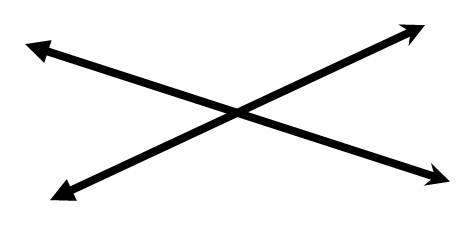
What type of line does the picture represent?

a)

Perpendicular

b)

Parallel

c)

Intersecting

d)

The number 4

124.

What type of line does the picture represent?

a)

Perpendicular

b)

Coach Jones' Chicken Legs

c)

Intersecting

d)

Parallel

125.

What type of line does the picture represent?

a)

Parallel

b)

Perpendicular

c)

Intersecting

d)

Toothpicks

126.

What is the slope of a line perpendicular to the line whose equation is: -x + 2y = 3 and passes through the point (1, -2)?

a)

y + 2 = -2(x - 1)

b)

y - 2 = -2(x - 1)

c)

y +1/2 = 2 (x +1)

d)

y = 0

127.
Write an equation that is parallel to the line
y = x - 5 through (1, -2)
a)
y = -3x +1
b)
y = x - 3
c)
y = x + 1
d)
y = 3x +1 
128.
A line is perpendicular to  
y = 2x - 7.
What is the slope of this line? 
a)
-2
b)
1/2
c)
-1/2
d)
2
129.
What is the slope of a line parallel to the line whose equation is:  -2x + y = - 7?
a)
-2
b)
1/2
c)
-1/2
d)
2
130.
Given the line 2x-3y=9, write the equation of a line perpendicular to it that passes through the point (4, -1)
a)
y = -3/2x - 7
b)
y = 2/3x + 4
c)
y = 2/3x - 1
d)
y = -3/2x + 5
131.

Write the equation of a line that passes through the point (2, 6) and is perpendicular to the line y = -4x + 8.

a)

y = 1/4x + 5.5

b)

y = 4x + 6

c)

y = -1/4x + 8

d)

y = -4x + 8

132.
What slope is perpendicular to:  
m = 3
a)
-3
b)
-1/3
c)
1/3
d)
3
133.
What slope is perpendicular to:  
m = 5/8
a)
-5/8
b)
5/8
c)
-8/5
d)
8/5
134.
What slope is parallel to:  
m = 4
a)
4
b)
-1/4
c)
-4
d)
1/4
135.
What slope is parallel to:  
m = 3/4
a)
4/3
b)
3/4
c)
-3/4
d)
-4/3
136.
What type of line does the picture represent? 
a)
Parallel
b)
Intersecting
c)
Perpendicular
137.
What type of line does the picture represent?
a)
Parallel
b)
Intersecting
c)
Perpendicular 
138.
What is the slope of a line parallel to the line whose equation is:  -2x + y = - 7?
a)
-2
b)
1/2
c)
-1/2
d)
2
139.
Evaluate each expression.
| x + 9 | = -5
a)
-14
b)
-4
c)
{-14, -4}
d)
no solution
140.
| x – 3 |= 0
a)
3
b)
-3
c)
{-3, 3}
d)
no solution
141.
∣ 2x + 9 ∣ = 15
a)
x = 3 
b)
x = 3
x = -6
c)
x = 3
x = -12
d)
x = 6
x = -12
142.
|v + 8| − 5 = 2 
a)
{-1,-15}
b)
{-1,-5}
c)
{-15,15}
d)
No Solution
143.
−2|−2r − 4| = -12
a)
{5,1}
b)
{-5,-1}
c)
{-5,1}
d)
No Solution
144.
Solve |2x –3| + 5 =10.
a)
-1, 1
b)
-1, 4
c)
-1, -4
d)
1, 4
145.
Solve |x – 12| - 3 = 11.
a)
x = -2
x = -26
b)
x = -2
x = 26
c)
x = 3
x = 25
d)
x = 4
x =  -7
146.
Solve the inequality.
x + 5 ≤ 13
a)
x ≥ 8
b)
x ≥ 18
c)
x ≤ 8 
d)
x ≤ 18 
147.
When you graph an inequality, you used a closed dot when you use which symbols?
a)
≤, ≥ 
b)
<, >
148.
When graphing an inequality, you use an open dot when you use which symbol?
a)
<, >
b)
≤,  
149.
In an equation or inequality, you want to get the variable...
a)
on one side
b)
to disappear
c)
isolated (by itself)
150.
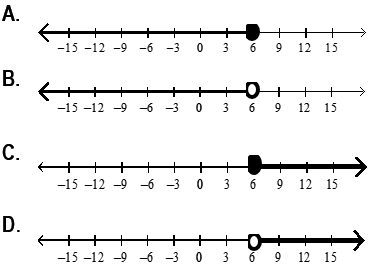
Pick the correct inequality.
a)
A
b)
B
c)
C
d)
D
151.
Match the graph with its inequality.
a)
11 < a
b)
11 > a
c)
 11 ≤ a
d)
 11 ≥ a
152.
Pick the correct letter for:
6 > x
a)
A
b)
B
c)
C
d)
D
153.
10 ≥ x - 3
a)
x ≤ 13
b)
x ≥ 13
c)
x ≤ 7
d)
x ≥ 7
154.
Which sentence represents m > 41?
a)
Mary’s points, m, totaled more than 41
b)
Calvin ran no less than 41 miles, m
c)
The temperature, m, was less than 41°F
d)
The magazines’ cost, m, was not more than $41.
155.

X - 10 > 25

a)

X > 35

b)

X < 35

c)

X > -35

d)

X < -35

156.
Solve the literal equation for the given variable.
a)
2A/h
b)
2/(h)
c)
2Ah
d)
Ah/2
157.
Solve for a.
a)
a = pw
b)
a = p/w
c)
a = w/p
d)
a = w + p
158.
S = 3F - 24  Solve for F
a)
F = (S + 24)/3
b)
F = S/3 + 24
c)
F = 3S + 24
d)
F = 3(S + 24)
159.
Solve for y:
8x + 4y= 16
a)
y = -8x + 16
b)
y = 2x -4
c)
y = -2x + 4
d)
y = -8x + 12
160.
Solve for y:
5x - y = 16
a)
-y = 5x + 16
b)
y = 5x + 16
c)
x = 5y - 16
d)
y = 5x - 16
161.
Solve m - n = 5 for m.
a)
m = 5 + n
b)
m = -5 - n
c)
m = -5 + n
d)
m = 5 - n
162.
IR = V
(solve for R) 
a)
R = IV
b)
R = I/V
c)
R = V/I
d)
R = V - I
163.
Solve:
y = mx + b , for b
a)
y - mx = b
b)
y + mx = b
c)
y/mx = b
d)
y + mx = -b
164.
Solve for x. 
z = xy
a)
x = z/y
b)
x = y/z
c)
x = yz
d)
y = xz
165.
Solve for w:
A = LW
a)
A = L/W
b)
w = L/A
c)
w = A
d)
w = A/L
166.
Solve for s. 
r = 2s - 8
a)
s =  r + 2  
b)
s = r/2 + 4
c)
s = r + 8 2
d)
s = 2r + 16