wayground logo

Free Printable Worksheets

NEW

Font size

S
M
L
XL
Worksheets

Transmutation, Fission, Fusion and Nuclear Applications

Total questions: 32

Worksheet time: 48mins
Name
Class
Date
1.
Takes two small nuclei and combines them into a larger nucleus
a)
fission
b)
fusion
2.
The splitting of a nucleus into smaller nuclei is
a)
fusion
b)
fission
c)
half-life
d)
gamma radiation
3.
How do nuclear power-plants work?
a)
Fusion
b)
Half-life
c)
Fission
d)
Fusion or fission
4.
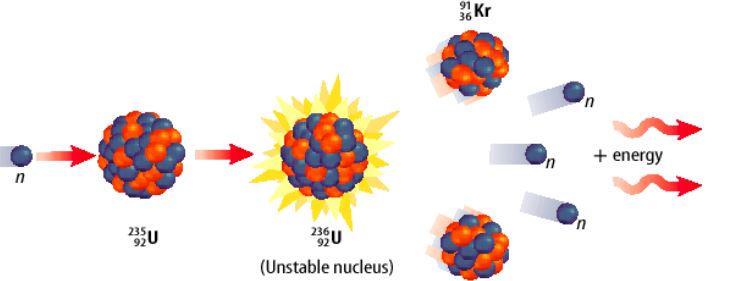
This is an example of...
a)
Fission  reaction
b)
Fusion reaction
c)
Decomposition reaction
d)
Decay
5.
Where does fusion occur naturally?
a)
Underwater
b)
All around us
c)
In the radioactive waste
d)
On the sun
6.
Which atoms combine together during fusion reaction on the sun?
a)
Helium and Hydrogen atoms
b)
Hydrogen atoms
c)
Hydrogen and Lithium atoms
d)
Hydrogen and Carbon atoms
7.
An example of an uncontrolled fission reaction is _______________
a)
Nuclear power plants
b)
Radio active decay
c)
Atomic Bomb
d)
On the surface of the sun
8.
Why do scientists most want to learn more about fusion?
a)
To win the Nobel prize
b)
To make energy for people to use
c)
To destroy the world
d)
To know more about stars
9.
_________ happens naturally due to an unstable nucleus.
a)
fission
b)
fusion
c)
radioactive decay
d)
K-capture
10.
Which of these statements correctly describes how the chain reaction occurs in nuclear fission.
a)
Uranium releases electrons to create   electricity
b)
When a nuclear fission reaction occurs, the electrons emitted can strike other nuclei in the sample, and cause them to split
c)
When a nuclear fission reaction occurs, the neutrons emitted can strike other nuclei in the sample, and cause them to split
d)
 Protons and neutrons change to electrons because the nuclei are so big
11.
What is a benefit of nuclear fission?
a)
The ability to absorb energy
b)
The ability to release tremendous amounts of energy
c)
The ability to produce more energy than nuclear fusion
d)
There are no beneficial aspects of nuclear fission
12.
The major drawback to nuclear fission reactors is the difficulty of achieving safe disposal of radioactive waste products.
a)
true
b)
false
13.
Requires temperatures of millions of degrees?
a)
Fission
b)
Fusion
14.
One disadvantage of nuclear energy is ___.
a)
it is a fossil fuel
b)
it leaves behind radioactive waste
c)
it emits large amounts of pollution into the atmosphere
d)
there are no disadvantages
15.
Which of the following is true about nuclear fusion?
a)
It is easy to implement.
b)
It produces less energy than nuclear fission.
c)
It produces more energy than nuclear fission.
d)
It has the ability to occur easily in everyday life.
16.
The splitting of a nucleus into smaller nuclei is
a)
fusion
b)
fission
c)
decay
d)
gamma radiation
17.
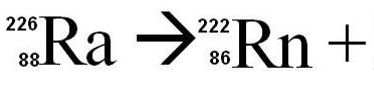
Complete the nuclear equation and determine the type of decay that is occurring in this reaction. 
a)
alpha
b)
beta
c)
gamma
d)
none
18.
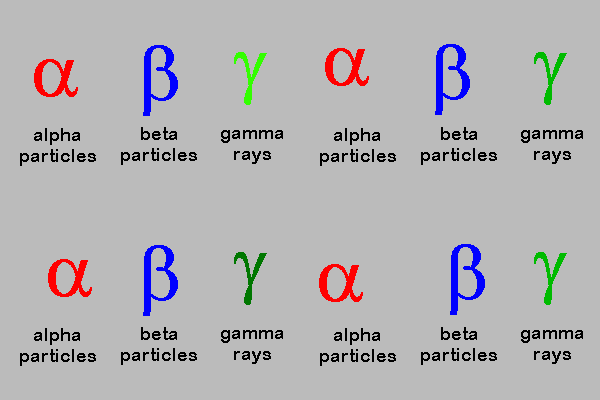
In order of most to least penetrating radiation we have
a)
Alpha , Beta,  Gamma
b)
Beta , Gamma , Alpha
c)
Gamma, Beta, Alpha
d)
Gamma, Alpha, Beta
19.

Which isotope is used to measure thyroid function?

a)

I-131

b)

C-14

c)

Co-60

d)

U-238

20.

Which isotope is used in cancer radiation therapy of tumors?

a)

Co-60

b)

I-131

c)

C-14

d)

U-238

21.

All elements after _______________ were created synthetically through bombardment reactions.

a)

Uranium

b)

Bismuth

c)

Curium

d)

Einsteinium

22.

Which of these isotopes would be most useful in dating human remains believed to be less than 500 years old?

a)

U-238

b)

U-235

c)

I-131

d)

C-14

23.

Which of these is created by bombardment reactions involving neutrons found in cosmic radiation and atmospheric nitrogen atoms?

a)

C-14

b)

U-238

c)

Co-60

d)

He-4

24.

A positively charged electron is known as a _________.

a)

proton

b)

beta particle

c)

alpha particle

d)

positron

25.

Oxygen-15 emits a positron. What new species is created?

a)

Oxygen-16

b)

Nitrogen-15

c)

Fluorine-15

d)

Fluorine-16

26.

Who performed the first artificial transmutation in 1919?

a)

Dalton

b)

Democritus

c)

Thomson

d)

Rutherford

27.

Zinc-66 is produced during the Beta decay of what nucleus?

a)

It cannot be determined.

b)

Cu-66

c)

Ga-66

d)

Ge-70

28.

The alchemists sought to turn cheaper elements into ______.

a)

Platinum

b)

Silver

c)

Gold

d)

Iron

29.

When Fluorine-17 emits a positron, what new element is formed?

a)

S-17

b)

O-17

c)

Ne-17

d)

No new element is formed.

30.

When Aluminum-27 is bombarded with an alpha particle, Silicon-30 and what other particle is produced?

a)

a neutron

b)

an alpha particle

c)

a beta particle

d)

a proton

31.

The instrument that can separate isotopes by mass is known as a ________________________.

a)

Niuclear Magnetic Resonance Imager

b)

Isotopometer

c)

Mass Spectrometer

d)

Gas Chromatograph

32.

Which of these isotopes would be most useful for calculating the age of a rock?

a)

Co-60

b)

C-14

c)

U-238

d)

I-131