
 Worksheets
Electricity
Total questions: 28
Worksheet time: 2hrs 20mins
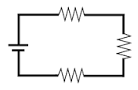
A pupil measures the potential difference across a device and the current in it.
Which calculation gives the resistance of the device?
current + potential difference
current ÷ potential difference
potential difference ÷ current
potential difference × current
RESISTANCE OF A CONDUCTOR DEPENDS
LENGTH
AREA
TEMPRATURE
ALL ABOVE
Which of the following correctly states relationship between voltage, resistance, and current in a circuit?
Current is directly related to voltage but inversely related to resistance.
Current is directly related to both voltage and resistance.
Current is inversely related to both voltage and resistance.
Current is directly related to voltage but is not affected by resistance.

In a closed circuit, how does battery voltage affect current?
As voltage increases, current increases.
As voltage increases, current decreases.
Voltage has no affect on current.
If voltage exceeds current, a short circuit circuit will develop.
If the length of a wire increases, the resistance ____________
a. decreases
b. increases
c. stays the same
d. unknown

Why is electricity transmitted in high voltages?
less dangerous to humans.
less prone to fire in transmission cables.
to power more appliances.
to reduce energy loss.
A battery of 10 volt carries 20,000 C of charge through a resistance of 20 Ω. The work done in 10 seconds is
2 x 10³ joule
2 x 10⁵ joule
2 x 10⁴ joule
2 x 10² joule

Calculate the current flows through the 10 Ω resistor in the following circuit.
1.2 A
0.6 A
0.2 A
2.0 A
Two resistors are connected in series gives an equivalent resistance of 10 Ω. When connected in parallel, gives 2.4 Ω. Then the individual resistance are
each of 5 Ω
6 Ω and 4 Ω
7 Ω and 4 Ω
8 Ω and 2 Ω

A cell, a resistor, a key, and an ammeter are arranged as shown in the circuit diagrams. The current recorded in the ammeter will be
maximum in (i)
maximum in (ii)
maximum in (iii)
same in all the cases

A student carries out an experiment and plots the V-I graph of three samples of nichrome wire with resistances R1 R2 and R3 respectively. Which of the following is true?
R1 = R2 = R3
R1 > R2 > R3
R3 > R2 > R1
R2 > R3 > R1

Which of the following is not correctly matched?(
(a)
(b)
(c)
The SI unit of resistivity is ……… .
Ohm
Ohm-metre
Ohm-cm
Ohm-joule

