wayground logo

Free Printable Worksheets

NEW

Font size

S
M
L
XL
Worksheets

Multiple Choice Reflection, Refraction, Diffraction

Total questions: 24

Worksheet time: 18mins

Name
Class
Date
1.
A student placed a pencil in a cup of water.  The pencil appears broken because light-
a)
always travels in a straight line
b)
bends when it passes through water
c)
makes the water in the glass evaporate
d)
reflects the pencil on the water's surface
2.
Refraction is the bending of a wave disturbance as it passes from one _________ into another.
a)
glass
b)
medium
c)
area
d)
boundary
3.
According to the Law of reflection, a light ray striking a mirror
a)
continues moving through the mirror in the same direction
b)
moves into the mirror at a slightly different angle
c)
bounces off the mirror toward the direction it came from
d)
bounces off the mirror at the same angle it hits.
4.
When light/waves move from one medium to another, change in ____ can be observed.
a)
speed, direction, frequency
b)
speed, direction
c)
frequency
d)
amplitude
5.
A material or substance that a matter wave travels through is  ________
a)
a block
b)
a wall
c)
a medium
d)
an electromagnetic spectrum
6.

What type of wave spreads out and goes through an opening or around corner?

a)

Reflection

b)

Refraction

c)

Interference

d)

Diffraction

7.

How are electromagnetic waves different from other waves?

a)

They have very short wavelengths

b)

They transmit energy instead of matter

c)

They can travel through a vacuum

8.

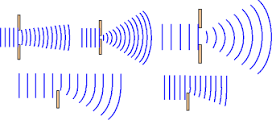
A wave of constant wavelength diffracts as it passes through an opening in a barrier. As the size of the opening is increased, the diffraction effects

a)

decrease

b)

increase

c)

remain the same

9.

Parallel waves strike an opening in a barrier and are diffracted. For which combination of wavelength and size of opening will diffraction effects be greatest?

a)

short wavelength and narrow opening

b)

short wavelength and wide opening

c)

long wavelength and narrow opening

d)

long wavelength and wide opening

10.
a)

absorption

b)

diffraction

c)

reflection

d)

refraction

e)

transmission

11.

Radio waves diffract around buildings more than light waves do because, compared to light waves, radio waves

a)

move faster

b)

move slower

c)

have a higher frequency

d)

have a longer wavelength

12.

The orca uses this behavior of waves to locate food.

a)

Refraction

b)

Reflection

c)

Absorption

d)

Diffraction

e)

Interference

13.
A ray of light is incident on a plane mirror and the angle of incidence is 25 degrees. What is the angle of reflection?
a)
A. 0 degrees
b)
B. 50 degrees
c)
C. 90 degrees
d)
D. 25 degrees
14.
Which answer explains why no sunlight gets into the cave chamber? 
a)
A. it is night time
b)
B. the cave is underground
c)
C. the light cannot get round the wiggles in the tunnel
d)
D. the caver’s lamp is brighter than the sunlight
15.
What does it mean to refract?
a)
bounce off
b)
to bend
c)
curve outward
d)
reflect
16.
What happens when light hits a mirror?
a)
it makes a color
b)
it reflects
c)
it makes a rainbow
d)
it passes through
17.
a)
Diffraction
b)
Interference
18.
A wave that requires a medium through wave which to travel
a)
A. electromagnetic  wave
b)
B. longitudinal wave
c)
C. mechanical wave
d)
D. transverse wave
19.
The number of times a wave passes a certain point in a set period of time
a)
Frequency
b)
Amplitude
c)
Wavelength
d)
Amplength
20.

Which transverse wave has the highest frequency?

a)

1

b)

2

c)

3

d)

4

21.
Which vocabulary term is used to identify the distance between points C & G?
a)
Amplitude
b)
Crest
c)
Frequency
d)
Wavelength
22.
All waves carry
a)
energy
b)
light 
c)
matter
d)
particles
23.
What kind of wave is pictured below?
a)
compressional wave
b)
transverse wave
c)
sound wave
d)
mechanical wave
24.
Bottom of the wave
a)
Crest
b)
Trough
c)
Frequency
d)
Wavelength