Wayground logo

Free Printable Worksheets

Font size

S
M
L
XL
Worksheets

Chemistry 2 Quiz

Total questions: 130

Worksheet time: 2hrs 9mins

Name
Class
Date
1.
H2O has how many elements
a)
1
b)
2
c)
3
d)
4
2.
CH4 is made of how many atoms?
a)
2
b)
4
c)
5
d)
8
3.
These two substances 
a)
Are made from different elements
b)
Have different properties
c)
Are examples of pure elements
4.
Which of the following is not a property?
(Properties are things that always stay the same about a substance)
a)
Size
b)
malleability
c)
color
d)
odor
5.
A recipe for a chemical substance is called a ________ _________.
a)
coefficent
b)
chemical formula
c)
Oxygen
d)
atom
6.
All ____________ are made up of two or more atoms bonded together.
a)
atoms
b)
molecules
c)
electrons
d)
elements
7.
What do we call a substance consisting of a single atom?
a)
coefficient
b)
element
c)
compound
d)
molecule
8.
What do we call a chemical substance made up of 2 or more different types atoms bonded together?
a)
formula
b)
atom
c)
subscript
d)
compound
9.
Which of the following is true about Vinegar (C2H4O2) and Sugar (C6H12O6)
a)
They are made from different elements
b)
They have different properties
c)
They have the same properties
d)
They have the same number of atoms
10.

All matter is made of tiny pieces called ___________.

a)

substances

b)

material

c)

properties

d)

atoms

11.

What are properties?

a)

Things that someone tells you about.

b)

Things that can be observed about a substance, such as color or smell.

c)

Properties are tiny pieces called matter.

d)

118 different types of atoms.

12.

What is the smallest atom on the periodic table?

a)

helium

b)

gold

c)

carbon

d)

hydrogen

13.

What state of matter will a liquid become if the particles gain kinetic energy?

a)

solid

b)

gas

c)

plasma

14.

How many electrons does a one helium atom have?

a)

1

b)

2

c)

3

d)

4

15.

What is it called when a liquid becomes a gas?

a)

condinsation

b)

sublimation

c)

evaportation

16.
The state of matter that takes the shape of its container is....
a)
Gas
b)
Solid
c)
Liquid
d)
None of these
17.
Thermal energy refers to....
a)
Heat energy
b)
Light energy
c)
Potential Energy
d)
Rotational energy
18.
During a chemical reaction, atoms are NOT
a)
Rearranged
b)
Created
c)
Broken
d)
Growing
19.
The state of matter with the molecules with the LOWEST amount of energy is....
a)
Gas
b)
Solid
c)
Liquid
20.
Which of the following is a REACTANT of photosynthesis?
a)
Oxygen
b)
Carbon dioxide
c)
Sugar
d)
Heat
21.
Which is the following is NOT a sign of a chemical change?
a)
Releasing a gas
b)
Releasing bubbles
c)
Changing state
d)
Rearranging atoms
22.
Thermal energy transfers...
a)
From colder to hotter material
b)
From hotter to colder material
c)
by going back and forth
d)
balancing equations
23.
The most basic building block of matter (smallest part of an element) is called a(n) __________. 
a)
Product
b)
Reactant
c)
Atom
d)
Molecule
24.
A physical property can be observed by _________________.
a)
burning the substance
b)
changing the chemical identity of a substance
c)
using the senses
d)
placing the substance in acid
25.
Signs that a chemical change has occurred include
a)
a change in color
b)
the release of bubbles
c)
the production of an odor
d)
all of the above
26.
A substance that is made up for one type of atom is called an:
a)
atom
b)
element
c)
compound
d)
mixture
27.
All matter is made of what 
a)
energy 
b)
atoms 
c)
electrons 
d)
compounds 
28.
In the compound 2H2, the H stands for 
a)
Helium 
b)
Hydrogen
c)
Herculineum
29.
H2
a)
Element
b)
Compound
30.
CO2
a)
Element
b)
Compound
31.
CaCo3
a)
Element
b)
Compound
32.
H2O
a)
Element
b)
Compound
33.
Where are electrons of an atom found?
a)
Nucleus
b)
Electron Cloud
c)
Some are in the nucleus and some in the electron cloud.
d)
They are moving everywhere.
34.
A negatively charged particle that moves around the nucleus is a(n)
a)
proton
b)
neutron
c)
electron
d)
quark
35.
Density is...
a)
the amount of mass in an object
b)
the amount of space an object takes up
c)
the amount of mass in a given space
d)
the weight of an object
36.
Burning a piece of paper 
a)
Chemical Change 
b)
Physical Change 
37.
Melting Ice 
a)
Chemical Change 
b)
Physical Change 
38.
How many ATOMS are in the following compound:  C2H4O2
a)
3
b)
8
c)
1
d)
6
39.
What is the symbol for chlorine?
a)
C
b)
Ch
c)
Ce
d)
Cl
40.
Which of these elements has a symbol which DOES NOT include a letter from its name?
a)
iron
b)
helium
c)
magnesium
d)
zinc
41.
A mixture can be separated by ________ means. 
a)
physical
b)
chemical
42.
Which of the following is NOT a mixture? 
a)
NaCl + H2O
b)
C6H12O6 + H2O
c)
C6H12O6
d)
SiO2 +H2O
43.
If an atom has 3 electrons, how many protons does it have?
a)
1
b)
2
c)
4
d)
3
44.
Particles in an atom that are neutral and have no charge are 
a)
negatrons 
b)
electrons 
c)
neutrons 
d)
protons 
45.
which of the following is an example of a physical change?
a)
a car rusting
b)
cutting a piece of wood
c)
acid rain corroding a barn door
d)
water seperating into hydrogen and oxygen atoms.
46.
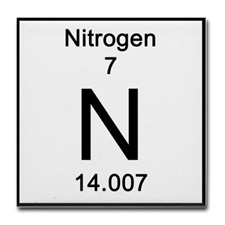
What is the number of protons that the element in this image contain?
a)
14
b)
7
c)
15
d)
18
47.
What is the atomic mass of "F"
a)
9
b)
18
c)
17
d)
19
48.
What is the number 22?
a)
APE number
b)
Atomic Mass
c)
Element Name
d)
Chemical Symbol
49.
The positive particles of an atom are 
a)
electrons 
b)
positrons 
c)
neutrons 
d)
protons 
50.
Something that is made up of only one kind of atom is known as _________________.
a)
a molecule
b)
a compound
c)
an element
d)
a proton
51.
How many elements are represented in the compound?
Na2CO3
a)
1
b)
2
c)
3
d)
4
52.
Is salt (NaCI) a compound or a element
a)
Compound
b)
element
53.
Which of the following is a sign that a chemical reaction has occurred?
a)
change in shape
b)
melting
c)
formation of a gas
d)
dissolving
54.
Is melting butter for popcorn a chemical or physical change?
a)
chemical
b)
physical
55.
Is burning wood a chemical or physical change?
a)
chemical
b)
physical
56.
When you break a cracker into pieces it is a 
a)
Chemical change
b)
Physical change
c)
Chemical Weathering
d)
Physical Weathering
57.
Which is a chemical change?
a)
freezing fruit juice
b)
slicing a potato
c)
boiling water
d)
copper metal turning green
58.
If there is no subscript, there is ______ atom(s) of that element.
a)
0
b)
2
c)
only 1
d)
1 million
59.

How many atoms of Hydrogen are in this compound

a)

1

b)

2

c)

3

d)

4

60.
How many elements are in the this compound?
H2CO4N5
a)
11
b)
4
c)
12
d)
5
61.
How many TOTAL atoms are in this compound?
H2C3O4N5
a)
5
b)
14
c)
15
d)
19
62.
How many elements are present in this compound?
Mg2As3COHNi2
a)
2
b)
4
c)
6
d)
10
63.
How many molecules of Carbon Dioxide?
6CO2
a)
12
b)
2
c)
6
d)
8
64.
5H2O
How many atoms of Hydrogen?
a)
2
b)
7
c)
10
d)
5
65.

Anything that has mass and takes up space is called

a)

matter

b)

element

c)

electron

d)

nucleus

66.

Select 2 physical properties.

a)

mass

b)

flammablity

c)

reactivity

d)

state of matter

67.

Select 2 chemical properties.

a)

flammabiltiy

b)

reactivity

c)

density

d)

conducting heat

68.

Select 2 physical changes.

a)

popsicle melting

b)

water boiling

c)

wood burning

d)

metal rusting

69.

Select 2 chemical changes.

a)

baking a cake

b)

copper turning green

c)

sugar dissolving in tea

d)

chocolate melting

70.

Select signs that indicate a chemical change has occurred.

a)

fizzing

b)

foaming

c)

production of heat

d)

change in odor

71.

The positive particle in the nucleus of an atom is called a(n)

a)

proton

b)

electron

c)

nuetron

d)

mixture

72.

The negative particle found outside the nucleus of an atom is called a(n)

a)

electron

b)

proton

c)

neutron

d)

atom

73.

The neutral particle found in the nucleus of an atom is called a(n)

a)

proton

b)

neutron

c)

electron

d)

atom

74.

Two or more elements chemically combined is called a(n)

a)

compound

b)

mixture

c)

element

d)

atom

75.

Hydrogen is an example of a(n)

a)

element

b)

compound

76.

Helium is an example of a(n)

a)

element

b)

compound

77.

Sugar (C6H12O6) is an example of a(n)

a)

compound

b)

element

78.

Hydrogen Peroxide (H2O2) is an example of a(n)

a)

compound

b)

element

79.

What is the atomic mass?

a)

22

b)

26

c)

48

d)

70

80.

What is the atomic number?

a)

19

b)

20

c)

39

d)

29

81.

How many protons does the element have?

a)

26

b)

30

c)

56

d)

82

82.

The atomic number tells us

a)

how many protons plus neutrons an element has.

b)

how many protons or neutrons an element has.

c)

how many protons or electrons an element has.

d)

how many protons, neutrons, and electrons an element has.

83.

The temperature at which matter turns from a solid to a liquid is called its

a)

melting point

b)

freezing point

c)

boiling point

d)

condensation point

84.

The ability for matter to dissolve is called

a)

conductivity

b)

solubility

c)

malleability

d)

flammability

85.
Jack has a rock. The rock has a mass of 14g and a volume of 2cm3. What is the density of the rock?
a)
7 mL
b)
7 g/cm3
c)
28 g/cm3
d)
1/7 g/cm3
86.
What is the volume of Object X?
a)
10.0 cm3
b)
15.0 cm3
c)
20.0 cm3
d)
25.0 cm3
87.
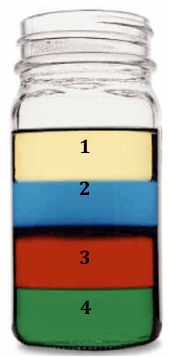
Put the liquids in order from most dense to least dense?
a)
4, 3, 2, 1
b)
1, 2, 3, 4
c)
3, 4, 2, 1, 
d)
4, 3, 1, 2
88.
Which box has a higher density?  
a)
Box A
b)
Box B
c)
cannot be determined
d)
they are the same
89.
What is the formula for density?
a)
density = mass x volume
b)
density = mass / volume
c)
density = mass + volume
d)
density = mass - volume
90.
Frank has an eraser. It has a mass of 4g, and a volume of 2cm3. What is its density?
a)
8 g/cm3
b)
2 g/cm3
c)
1/2 g/cm3
d)
24 g/cm3
91.
Which liquid has the highest density? 
a)
corn syrup
b)
lamp oil
c)
rubbing alcohol
d)
honey
92.
If an object has a density of 3.6 g/mL and you put it into water, will it sink or float?  
a)
sink
b)
float
93.
Which lab tool might you use to measure the volume of a liquid?
a)
electric scale
b)
bunsen burner
c)
test tube
d)
graduated cylinder
94.
What is the volume of the fish?
a)
18.0 cm3
b)
6.0 cm3 
c)
38.0 cm3
95.
True or False:  The density of a specific type of material never changes.  
a)
True
b)
False
96.
What do we know about the density of lamp oil, rubbing alcohol, and vegetable oil?  
a)
The density is greater than 1.0 g/mL
b)
The density is less than 1.0 g/mL
c)
The density is equal to 1.0 g/mL
d)
The density can not be determined
97.
Which will float in water (density= 1 g/mL)?
Corn syrup  1.37 g/mL
Vegetable oil  0.91 g/mL
Honey  1.42 g/mL
Lamp oil  0.81 g/mL
a)
Corn syrup and Honey
b)
Vegetable oil and Lamp oil
c)
Corn syrup and vegetable oil
d)
Honey and Lamp oil
98.
If the density of a bar of gold is 19.3 g/cm3and you cut it into 4 pieces,  what is the density of each piece of gold?  
a)
4.825 g/cm3
b)
9.65 g/cm3
c)
19.3 g/cm3
d)
38.6 g/cm3
99.
Frank has a paper clip. It has a mass of 9g and a volume of 3cm3. What is its density?
a)
3 g/cm3
b)
1/3 g/cm3
c)
27 g/cm3
d)
39 g/cm3
100.
Density is...
a)
the amount of mass in an object
b)
the amount of space an object takes up
c)
the amount of mass in a given space
d)
the weight of an object
101.
What is the formula for density?
a)
density = mass x volume
b)
density = mass / volume
c)
density = mass + volume
d)
density = mass - volume
102.
Here are 5 cubic centimeters (cm3).    All together they  have a mass of 20 g what is the density?
a)
20 g/cm3
b)
80 grams
c)
 4 g/cm3
d)
80 g/cm3
103.
Which would be the most useful for identifying an unknown liquid?
a)
Weight
b)
volume
c)
mass
d)
density
104.
How many elements are in C6H12O6?
a)
1
b)
2
c)
3
d)
4
105.
Element or compound?
O2
a)
Element
b)
Compound
106.
Element or compound?
H2O
a)
element
b)
compound
107.
Which is the correct formula for:
 three hydrogen (H)
one sulfur (S)
four oxygen (O)
a)
H3SO4
b)
HSO4
c)
H4S3O
d)
H2O
108.
How many Sodium (Na) are in 6NaCl?
a)
1
b)
12
c)
6
109.
How many O's are in Al₂(SO₄)₃
a)
4
b)
12
c)
7
d)
24
110.
How many Elements are in the compound C2H8O ?
a)
2
b)
1
c)
3
d)
0
111.
If there is no subscript, there is ______ atom(s) of that element.
a)
0
b)
2
c)
only 1
d)
1 million
112.
A physical change is?
a)
It changes the object into something different
b)
Objects or substances undergo a change that does not change their chemical composition
c)
it is just like a chemical reaction
d)
Paper burning
113.
A chemical change is?
a)
a shoe lace cut in half
b)
doesn't change anything
c)
changes the look of an object
d)
change that results in the formation of new chemical substances
114.
The arrow symbol used in a chemical equation
a)
Yield sign
b)
Subscript
c)
Coefficient
d)
Chemical formula
115.
A way to show the number and type of elements (atoms) in a molecule or compound with a combination of symbols and numbers.
a)
Molecule
b)
Chemical formula
c)
Physical change
d)
Coefficient
116.
The small number that is written below the symbol and shows how many atoms of each element is present.  
a)
Compound
b)
Molecule
c)
Coefficient
d)
Subscript
117.
The large number written in front of a chemical formula.  It shows the number of molecules.
a)
Molecule
b)
Compound
c)
Coeffiecient
d)
Subscript
118.
Which is the correct formula for:
 three hydrogen (H)
one sulfur (S)
four oxygen (O)
a)
H3SO4
b)
HSO4
c)
H4S3O
d)
H2O
119.
The law of conservation of matter states that
a)
chemical reactions change matter.
b)
in chemical reactions, the identity of reactants and products is conserved.
c)
atoms are neither created nor destroyed in chemical reactions.
d)
a chemical equation must be balanced.
120.
How many atoms of Al are in Al₂(SO₄)₃
a)
1
b)
2
c)
8
d)
12
121.
Number of N in (NH₄)₂CrO₄
a)
1
b)
2
c)
8
d)
16
122.
How many Chlorine are in MgCl2?
a)
2
b)
1
c)
3
123.
The blue numbers in the image below represent ________
a)
I don't know, and don't want to try
b)
coefficients
c)
subscripts
d)
none of the answers are correct
124.
The red numbers in the image below represent ________
a)
subscripts
b)
coefficients
c)
I don't know, and don't want to try
d)
None of the answers are correct
125.
Is the following equation balanced or unbalanced?
Fe + S --> FeS
a)
balanced
b)
unbalanced
126.
Which of the following is an unbalanced equation?
a)
CaCO3 --> CaO + CO2
b)
PbO2 + 2H2-->2Pb + H2O
c)
2Na+ 2H2O-->2NaOH + H2
d)
CS2 + 2O2 --> CO2 + 2SO2
127.
The following is an example of a physical change:
a)
ice melting
b)
paper burning
c)
metal rusting
d)
silver tarnishing
128.
What change in property occurs when a chemical reaction takes place?
a)
color change
b)
a solid is produced (precipitate)
c)
a gas is produced
d)
all are correct
129.
The following is an example of a chemical change:
a)
hair burning
b)
ice melting
c)
cutting hair
d)
bending metal
130.
This type of reaction releases energy in the form of heat:
a)
exothermic
b)
endothermic
c)
chemical
d)
physical