wayground logo

Free Printable Worksheets

Font size

S
M
L
XL
Worksheets

Newton's 1st and 2nd Laws of Motion

Total questions: 40

Worksheet time: 1hrs 20mins

Name
Class
Date
1.
What is Newton's First Law
a)
F=ma
b)
Every action has an equal and opposite reaction
c)
An object at rest stays at rest, an object in motion stays in motion. 
d)
Friction 
2.
According to Newton’s first law of motion, a moving object that is not acted on by an unbalanced force will
a)
remain in motion.
b)
eventually come to a stop.
c)
change its momentum.
d)
accelerate.
3.
According to Newton’s first law of motion, an object at rest that is not acted on by an unbalanced force will
a)
remain in motion.
b)
eventually come to a stop.
c)
change its momentum.
d)
remain at rest
4.
Describe the motion of a person not wearing a seat belt if the car stops suddenly.
a)
The person and car will stop together. 
b)
The person will stop faster than the car because they are lighter.
c)
The car will stop and the person will keep moving forward because of inertia 
d)
The car will stop and the person will speed up. 
5.
Which type of force(s) will cause a change in an object's motion?
a)
gravity
b)
zero net force
c)
balanced forces
d)
unbalanced forces
6.
What is the name for a push or pull?
a)
A movement
b)
A force
c)
Speed
d)
Density
7.

When an unbalanced force acts on an object, the force ______________________.

a)

changes the motion of the object

b)

is cancelled by another force

c)

does not change the motion of an object

d)

is equal to the weight of the object

8.

The picture is an example of Newton's...

a)

1st Law

b)

2nd Law

c)

3rd Law

9.

The picture is an example of Newton's...

a)

1st Law

b)

2nd Law

c)

3rd Law

10.

What is acceleration?

a)

The rate at which the speed of something is changed in a given direction

b)

A push or a pull on an object

c)

The amount of matter within an object

d)

The amount of force placed on an object

11.

According to Newton's second Law, which would take more force to slow down?

a)

The silver car

b)

The green car

c)

They would both take the same force

12.

Which of these best states Newton's Second Law?

a)

The greater the mass of an object the greater the force needed to change its motion.

b)

The greater the mass of an object the less force needed to change its motion.

c)

The mass of an object does not effect the force needed to change its motion

13.
As the acceleration of an object increases, what happens to the force of the object? 
a)
force increases
b)
force decreases
c)
force remain the same
d)
mass increases
14.

the amount of matter in an object

a)

VOLUME

b)

MASS

c)

MAGNITUDE

d)

AIR RESISTANCE

15.

States that the acceleration of an object is dependent on the mass of the object and the force acting upon it. (the relationship between mass, acceleration, and force)

a)

NEWTON'S 1ST LAW OF MOTION

b)

NEWTON'S 2ND LAW OF MOTION

c)

NEWTON'S 3RD LAW OF MOTION

d)

SPEED

16.

The variable in which the experimenter changes or manipulates; what you are testing in the investigation.

a)

DEPENDENT

b)

INDEPENDENT

c)

CONTROL

d)

CONSTANT

17.

The variable that responds to the independent variable and is what you are measuring or observing in an investigation.

a)

DEPENDENT

b)

INDEPENDENT

c)

CONTROL

d)

CONSTANT

18.

This remains the same throughout the entire experiment.

a)

DEPENDENT

b)

INDEPENDENT

c)

CONTROL

d)

CONSTANT

19.
Will it take more force to push an empty shopping cart or a shopping cart that is full?
a)
The empty shopping cart
b)
The full shopping cart
c)
They will take the same amount of force
20.
Which shopping cart will have more acceleration?  
a)
The empty shopping cart
b)
The shopping cart that's full
c)
They will be the same
21.
If you push the ping pong ball & the basketball with the same amount of force, which one will go a greater distance?
a)
The ping pong ball
b)
The basketball
c)
They will both travel the same distance
22.
Why would one ball travel a greater distance than the other when pushed with the same amount of force?
a)
Different sizes
b)
Different weights
c)
Different masses
d)
Different forces
23.
To make a ball move faster, you need to increase:
a)
The friction under the ball
b)
The force applied to the ball
c)
The mass of the ball
d)
The size of the ball
24.
What does this graph represent?
a)
Constant speed
b)
Acceleration
c)
Not moving
25.
What does this graph represent?
a)
Constant Speed
b)
Acceleration
c)
Not moving
26.

What is velocity?

a)

the quickness of an object

b)

the location of an object

c)

acceleration

d)

Another word for speed, but speed with a certain direction.

27.

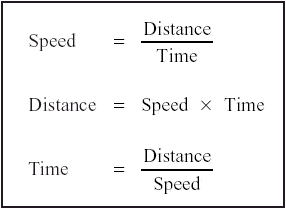
What is the formula used to calculate the velocity or speed of an object?

a)

V=time/distance

b)

V=time X distance

c)

V= distance X time

d)

V=distance/time

28.

What is the unit for velocity?

a)

meters

b)

seconds

c)

meters/second

d)

inches

29.

Calculate the average speed or velocity (in meter/sec) if a cheetah runs 180 meters in 10 seconds.

a)

198 m/sec

b)

170 m/sec

c)

12 m/sec

d)

18 m/sec

30.
In each of the following cases, determine where the car has no acceleration ?
a)
A car shortly after a stoplight turns green.
b)
A car approaching a red light
c)
A car with the cruise control set at 80 km/h
d)
A car turning a curve at a constant speed
31.
A runner races in the 100 meter dash.  It takes her 10 seconds to finish.  What is her average speed?
a)
10 m/s
b)
1000 m/s
c)
100 seconds
d)
10 seconds
32.

A runner is running around a 400m track. She runs around the track 4 times. It takes her 495 seconds. What is her velocity?

a)

3.23 m/s

b)

0.80 m/s

c)

3.23 m/s

d)

0.08 m/s

33.

1 kilogram = _____ grams

a)

100

b)

1,000

c)

10,000

d)

10

34.

Grams and kilograms are units for....?

a)

velocity

b)

distance

c)

time

d)

mass

35.

Convert 324 g to kg?

a)

324kg

b)

3.24kg

c)

0.324kg

d)

32.4kg

36.

Which of the following could be a unit for Distance?

a)

60 m

b)

50 m/s

c)

70 s

d)

50 m/s/s

37.

A car Travels 30 m/s. What is 30 m/s?

a)

The car's Distance

b)

The Time it took the car to travel

c)

The car's Velocity

d)

The car's Acceleration

38.
The stronger the force, the ________ the acceleration
a)
Stronger
b)
Weaker
c)
Both
39.
The harder you hit a baseball, the faster it accelerates.
a)
Newton's
1st
Law of Motion
b)
Newton's
2nd
Law of Motion
c)
Newton's
3rd
Law of Motion
40.
The faster an object moves, the ________ kinetic energy it has. 
a)
more
b)
less
c)
none of the above
d)
all of the above