wayground logo

Free Printable Worksheets

Font size

S
M
L
XL
Worksheets

Periodic Table Review

Total questions: 40

Worksheet time: 31mins

Name
Class
Date
1.
Particles in an atom that are neutral and have no charge are 
a)
negatrons 
b)
electrons 
c)
neutrons 
d)
protons 
2.
The smallest particle of any particular type of matter is known by which of the following terms?
a)
Compound
b)
Atom
c)
Chemical
d)
Element
3.
If an atom has 3 electrons, how many protons does it have?
a)
1
b)
2
c)
4
d)
3
4.
If the number of protons equal the number of _____, the atom will have no charge
a)
protons
b)
neutrons
c)
electrons
d)
nucleus
5.
The subatomic particle with a negative charge is the
a)
electron
b)
proton
c)
neutron
d)
nucleus 
6.
What is the mass number?
a)
the number of protons
b)
the number of protons and neutrons
c)
the number of neutrons
d)
the number of protons and electrons
7.

The elements on the left side of the periodic table are called..

a)

Metals

b)

Metalloid

c)

Nonmetals

8.

A substance that is made up of one type of atom is called an:

a)
atom
b)
element
c)
compound
d)
mixture
9.
Where on the periodic table are the metalloids found?
a)
Right Side
b)
Along the Zig Zag Line
c)
Right Side
10.
Silicon is a semiconductor and has properties of both metals and nonmetals. What type of element is Silicon? 
a)
Metal
b)
Nonmetal
c)
Metalloid
d)
Pretty
11.
Nonmetals are located in what section of this periodic table?
a)
Blue
b)
Yellow
c)
Pink
12.
Where are electrons of an atom found?
a)
Nucleus
b)

Orbits on the outside of the nucleus in the electron cloud.

c)
Some are in the nucleus and some in the electron cloud.
d)
They are moving everywhere.
13.
How many protons does Carbon have?
a)
3
b)
4
c)
5
d)
6
14.
What is the symbol for chlorine?
a)
C
b)
Ch
c)
Ce
d)
Cl
15.
What is the symbol for the element Neon?
a)
Na
b)
Ne
c)
He
d)
N
16.
A _________ is a substance made of two or more DIFFERENT elements chemically combined. 
a)
mixture
b)
compound
c)
substance 
17.
A bar of gold is made of only one ______
a)
Plasma 
b)
Mixture 
c)
Element 
d)
Compound
18.
These are the two particles located inside the nucleus of an atom 
a)
Protons and Electrons 
b)
Protons and Neutrons 
c)
Electrons and Neutrons 
d)
Neutrons and Molecules 
19.
If an atom has 3 electrons, how many protons does it have?
a)
1
b)
2
c)
4
d)
3
20.
Elements with similar properties
a)
Periods
b)
Groups
21.
On Periodic Table, how are elements ordered?
a)
color
b)
shape
c)
atomic number
d)
alphabetically
22.
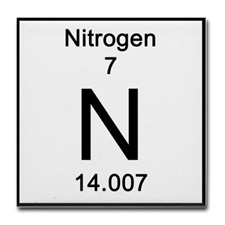
What is the number of protons that the element in this image contain?
a)
14
b)
7
c)
15
d)
18
23.
What is the atomic mass of "F"
a)
9
b)
18
c)
17
d)
19
24.
A "group" is a ____________ on the periodic table.
a)

column (up and down)

b)

row (left to right)

25.
A "period" is a ____________ on the periodic table.
a)

column (up and down)

b)

row (left to right)

26.
Helium, neon, argon, krypton, xenon, and radon are known as  _____________.
a)
halogens
b)
noble gases
c)
metalloids
d)
transition elements
27.
Is salt (NaCI) a compound or a element
a)
Compound
b)
element
28.

How many atoms of Hydrogen are in this compound

a)

1

b)

2

c)

3

d)

4

29.

What is the name of group 1 on the periodic table?

a)

Alkali Metals

b)

Alkaline Earth Metals

c)

Halogens

d)

Noble Gases

30.

What is the name of group 2 on the periodic table?

a)

Alkali Metals

b)

Alkaline Earth Metals

c)

Halogens

d)

Noble Gases

31.

What is the name of group 17 on the periodic table?

a)

Alkali Metals

b)

Alkaline Earth Metals

c)

Halogens

d)

Noble Gases

32.

What is the name of group 18 on the periodic table?

a)

Alkali Metals

b)

Alkaline Earth Metals

c)

Halogens

d)

Noble Gases

33.

How many valence electrons does Ne (neon) have?

a)

2

b)

4

c)

6

d)

8

34.

How many valence electrons does K (potassium) have?

a)

1

b)

3

c)

6

d)

8

35.

How many valence electrons does I (Iodine) have?

a)

1

b)

3

c)

7

d)

8

36.

How many valence electrons does Si (Silicon) have?

a)

3

b)

4

c)

7

d)

8

37.

Which type of elements are malleable, ductile, shiny, and conduct heat and electricity?

a)

Metal

b)

Nonmetal

c)

Metalloid

38.

Which type of elements are dull, brittle, and can not conduct heat or electricity?

a)

Metal

b)

Nonmetal

c)

Metalloid

39.

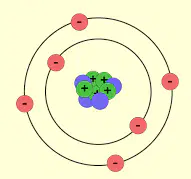
How many valence electrons does this atom have?

a)

2

b)

4

c)

6

d)

10

40.

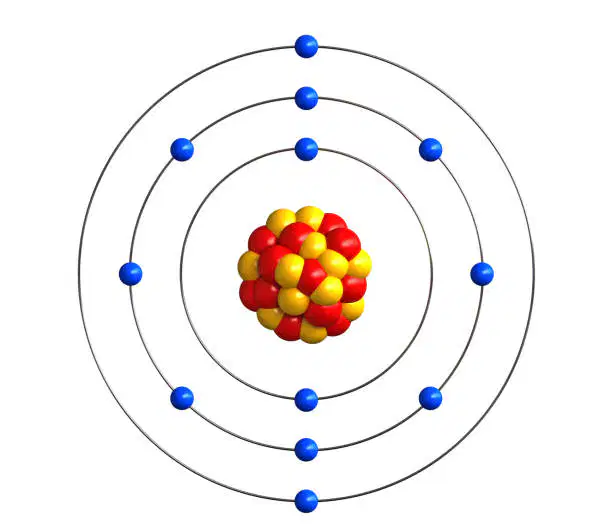
How many valence electrons does this atom have?

a)

2

b)

8

c)

12

d)

24