Wayground logo

Free Printable Worksheets

Font size

S
M
L
XL
Worksheets

nuclear

Total questions: 78

Worksheet time: 1hrs 15mins

Name
Class
Date
1.
This type of reaction occurs when light nuclei combine to form a larger, single nucleus.
a)
Fission
b)
Fusion
c)
single displacement
d)
double displacement
2.
This type of reaction occurs on the sun and in stars.
a)
Fission
b)
Fusion
c)
synthesis
d)
decomposition
3.
Nuclear reactions involve the particles in the ____.
a)
electron cloud
b)
neutrons
c)
nucleus
d)
half-life
4.
This type of  reaction occurs when a heavy nucleus, such as U-235, splits into two or more parts.
a)
Fission
b)
Fusion
c)
Chain reaction
d)
synthesis
5.
The least penetrating type of radiation
a)
Alpha particle
b)
Beta particle
c)
gamma ray
6.

Nuclear _______________ is when a large unstable nucleus breaks into two smaller nuclei.

a)

Fusion

b)

Fission

7.

Which particle of nuclear radiation penetrates the most material (making it the most harmful)?

a)

alpha particle

b)

beta particle

c)

gamma particle

d)

omega particle

8.

A particle made up of two protons and two neutrons, identical to a helium atom, ejected from a nucleus during a nuclear reaction:

a)

alpha particle

b)

beta particle

c)

gamma particle

d)

omega particle

9.

Atomic emission of high energy photons, (γ-particles) that does not alter the atom otherwise.

a)

alpha decay

b)

beta decay

c)

gamma decay

d)

omega decay

10.
Carbon-14 decays by emitting a beta particle, producing
a)
boron-14
b)
carbon-12
c)
nitrogen-14
d)
beryllium-10
11.
In order of most to least penetrating radiation we have
a)
Alpha , Beta,  Gamma
b)
Beta , Gamma , Alpha
c)
Gamma, Beta, Alpha
d)
Gamma, Alpha, Beta
12.
One disadvantage of nuclear energy is ___.
a)
it is a fossil fuel
b)
it leaves behind radioactive waste
c)
it emits large amounts of pollution into the atmosphere
d)
there are no disadvantages
13.
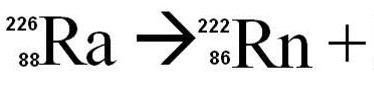
This is an example of ---
a)
Radioactive Decay
b)
Nuclear Fission
c)
Nuclear Fusion
d)
Fossil fuel reaction
14.
The technetium-99 isotope has a half-life of 6.0 hours. If 100.0 mg were injected into a patient how much remains after 18 hours?
a)
33.0 mg
b)
12.5 mg
c)
.33 mg
d)
15.8 mg
15.
Why does an atom undergo beta decay?
a)
It has too many electrons.
b)
It has an atomic number greater than 83
c)
It has more neutrons than protons
d)
It has more protons than neutrons
16.
What happens to the atomic number during alpha decay?
a)
The atomic number decreases by 4
b)
The atomic number increases by 1
c)
The atomic number decreases by 2.
d)
The atomic number stays the same.
17.
Arrange in order of increasing ability to penetrate matter.
a)
Beta, gamma, alpha
b)
Alpha, gamma, beta
c)
Gamma, beta, alpha
d)
Alpha, beta, gamma
18.
During fission, some of the nuclear mass is converted into
a)
energy
b)
heavier nuclei
c)
critical mass
d)
protons
19.
Which of the following is a disadvantage of nuclear energy as a power source?
a)
Nuclear energy produces less energy than the burning coal
b)
Nuclear energy produces air pollution
c)
Nuclear waste must be safely stored
d)
The fuel source is very limited
20.

In the symbol 167N what the 7 stand for?

a)

Mass number

b)

Atomic number

c)

Atomic mass

d)

Number of neutrons

21.
The half life of Thorium-234 is 24 days. What fraction of the element remains after 96 days
a)
1/2
b)
1/4
c)
1/8
d)
1/16
22.
Complete the nuclear equation and determine the type of decay that is occurring in this reaction. 
a)
alpha
b)
beta
c)
gamma
d)
none
23.
Alpha particles have a _____ charge.
a)
+2
b)
0
c)
+1
d)
-1
24.
Two or more nuclei combine to form one larger nucleus in the process of nuclear _____.
a)
Fusion
b)
Fission
c)
Tracing
d)
Decay
25.
Which produces more energy--nuclear fission or nuclear fusion?
a)
Fusion
b)
Fission
c)
They produce the same amount
d)
It depends on the elements used
26.
Barium-122 has a half-life of 2 minutes. A fresh sample weighing 80 g was obtained. If it takes 10 minutes to set up an experiment using barium-122, how much barium-122 will be left when the experiment begins?
a)
0.25g
b)
2.5g
c)
25g
d)
80g
27.
What does it mean when an element is radioactive?
a)
atom emits radiation
b)
nucei unstable due to uneven p to n ratio
c)
nuclei changes to become stable
d)
all of the above
28.
Carbon-12 has 98.2% abundance, carbon-13 has 1.7% abundance, and carbon-14 has 0.1% abundance.  Which isotope contributes most to the average atomic mass?
a)
Carbon-12
b)
Carbon-13
c)
Carbon-14
d)
They all contribute equally
29.
What is the half-life of an isotope if after 20.0 days you have 4.0 grams remaining of a 64.0 grams sample?
a)
1.25 days
b)
5.0 days
c)
0.000305 days
d)
4.25 days
30.
The force that holds the protons and neutrons together in the nucleus of an atom is called __________.
a)
Strong force
b)
magnetic force
c)
centripetal force
d)
electrostatic force
31.
Alpha particles.....
a)
a) are positively charged.
b)
b) consist of two protons and four neutrons.
c)
c) can penetrate any thickness of matter
d)
d) All of the above 
32.
During beta decay, a nucleus .... 
a)
gives up two protons and two neutrons.
b)
  maintains the same number of protons and neutrons.
c)
  loses a proton and gains a neutron.
d)
gains a proton and loses a neutron. 
33.
When a nucleus undergoes nuclear decay by gamma rays, the atomic number of the element....
a)
remains the same
b)
  decreases by one.
c)
increases by one.
d)
increases by two.
34.
The type of radioactive particle that can be stopped by a sheet of paper is the ____.
a)
alpha particle
b)
beta particle
c)
gamma ray
d)
uranium
35.
The most penetrating type of radiation is the ____.  
a)
alpha particle
b)
gamma ray
c)
beta particle
d)
uranium
36.

Nuclear energy is stored in the ____________ of the atom

a)

electron shell

b)

protons

c)

neutrons

d)

nucleus

37.

_____ ______________ are unstable, or radioactive.

a)

Some isotopes

b)

Some elements

c)

All isotopes

d)

All elements

38.

When radioactive isotopes decay they release energy and _______________________________________.

a)

become a different element

b)

become stable isotope of the same or a different element

c)

remain the same element

d)

may remain unstable

39.

Nuclear power plants use fuel rods of ___________________________ as the energy source for the plant to generate electricity.

a)

any form of uranium

b)

any unstable isotope

c)

uranium-238, a stable isotope,

d)

helium-4, a stable isotope,

40.

The half-life of Fellmanium-250 is 10 days, how much is left after 30 days if I started with 1600 atoms?

a)

400 atoms

b)

200 atoms

c)

100 atoms

d)

50 atoms

41.

The half-life of carbon-14 is 5,730 years. After two half-lives what fraction of the original C-14 is left?

a)

All if it, it takes thousands of years for it to decay

b)

1/2

c)

1/4

d)

1/8

42.

Which of the following is true about radioactivity?

a)

Radioactivity has only disadvantages, such as causing cancer and death.

b)

Radioactivity has only benefits, such as medical detection, treatment, and for making fire detectors.

c)

Radioactivity has both advantages and disadvantages.

43.
When one large nucleus is split into two smaller nuclei, the process is nuclear _____.
a)
Fusion
b)
Fission
c)
Tracing
d)
Decay
44.
An atom's _________ is its number of protons.
a)
atomic number
b)
mass number
c)
weight number
d)
football number
45.
When a chemical reaction occurs, a new _______ can be created, but never a new _______.
a)
compound, element
b)
element, compound
c)
isotope, ion
d)
cookie, cake
46.
Particles that are released from the nucleus during radioactive decay are collectively termed
a)
nuclear radiation
b)
UV radiation
c)
radio waves
d)
stadium waves
47.
What is emitted during Beta Radiation?
a)
A high-energy Electron.
b)
Protons.
c)
Neutrons.
d)
Nuclei
48.
What is emitted during Gamma Radiation?
a)
Particles.
b)
Protons
c)
Beta Rays.
d)
Gamma Rays.
49.
TRUE or FALSE: gamma changes the atomic number.
a)
True
b)
False
50.
What is radioactive decay?
a)
The spontaneous breakdown of an atomic nucleus resulting in only energy release
b)
The spontaneous breakdown of an atomic nucleus resulting in only matter release
c)
The spontaneous breakdown of an atomic nucleus resulting in a release of energy and matter
d)
The decay of the use of radios and the increased use of televisions.
51.
Which is not true of radioactive decay?
a)
It is a result of instability in atoms
b)
It happens only in nuclear power plants
c)
Radioactivity can be useful
d)
It is hazardous to human health
52.
Isotopes of the same element have different ____________. 
a)
 numbers of protons  
b)
numbers of electrons
c)
 symbols 
d)
numbers of neutrons
53.
When does radioactive decay occur?
a)
When the nucleus of an isotope is unstable
b)
When the nucleus of an isotope is stable
c)
When the electrons of an isotope are spinning
d)
When the electrons of an isotope are shared with another isotope
54.
What is Half-life?
a)
The amount of time it takes for some of the nuclei in a sample of the isotope to decay
b)
The amount of time it takes for half the electrons in a sample of the isotope to decay
c)
The amount of time it takes for half the nuclei in a sample of the isotope to decay
d)
the amount of time it takes to double the nuclei in a sample of the isotope to decay
55.
When nuclei decay, massive amounts of __________ is released.
a)
energy
b)
jello
c)
protons
d)
neutrons
56.
The time it takes for 50% of the nuclei in a radioactive sample to decay to its stable isotope is called _____.
a)
the daughter product
b)
geologic time
c)
the half-life
d)
the half-time
57.
Radiometric dating is possible because the rates of decay of radioactive isotopes _____.
a)
change over time
b)
change from place to place
c)
are constant
d)
vary widely
58.
When an unstable radioactive atom decays, it usually turns into:
a)
a more stable atom
b)
a less stable atom
c)
the exact same atom but with less pure energy
d)
empty space
59.
The original element that undergoes radioactive decay is known as the...
a)
daughter element
b)
half-life
c)
parent element
d)
carbon-14
60.
Why are isotopes with short half-lives not useful for dating very old rocks?
a)
because not enough of the parent isotope remains to measure accurately
b)
because not enough of the daughter product has formed to be detectable
c)
because neither the parent isotope nor the daughter product will be detectable
d)
because very old rocks would never have contained these isotopes
61.
What percent of carbon-14 would be left after 5730 years?
a)
100%
b)
75%
c)
50%
d)
25%
62.
What percent of carbon-14 would be left after 11,460 years?
a)
100%
b)
75%
c)
50%
d)
25%
63.
All plants and ANIMALS contain carbon.
a)
True
b)
False
64.
A sample of a certain radioactive material has a half life of 1 year. How much of this radioactive material will be left at the end of 3 years (fraction)?
a)
all of it
b)
1/2
c)
1/4
d)
1/8
65.
After the third half-life, how much of the sample is left?
a)
1/2
b)
1/3
c)
1/16
d)
1/8
66.
An igneous rock that is newly cooled so has had NO time to age will contain
a)
only parent isotopes
b)
only daughter material
c)
an even mix of parent and daughter
d)
can't be determined
67.
The Law of Conservation of Energy states:
a)
Energy can created or destroyed but not transformed 
b)
Energy cannot be created or destroyed, it can only transformed
c)
Energy can't be created, destroyed or transformed
68.
What process do humans use in in order to construct and use an Atomic Bomb? 
a)
Fusion
b)
Fission
c)
Alpha, Beta, and Gamma
d)
Isotopic implosion 
69.
What was the name of the area in 1986 in which there was a nuclear explosion at a power plant?
a)
Chernobyl
b)
Fukushima
c)
New York City
d)
Three Mile Island
70.
What process does the Sun go through in order to produce limitless energy for billions of years? 
a)
Fusion
b)
Fission
c)
Alpha, Beta, Gamma
d)
Isotopic implosion 
71.

An endless source of energy is impractical to produce because it requires a large amount of energy to force atoms to initially fuse together. Which type of energy production would this be?

a)

Fission

b)

Fusion

c)

Hydroelectricity

72.
E = mc2  says that a mass (m) can be converted into an amount of energy (E), where c is the speed of light. 
a)
True
b)
False
73.
Henri Becquerel was one of the first scientists to study radioactivity.
a)
True
b)
False
74.

The mass of nucleus is...

a)

equal to number of p+ + e-

b)

equal to number of e- + n0

c)

equal to number of p+ + n0

d)

equal to number of p+

75.
In the formula E = mc2, m stands for
a)
momentum
b)
mass
c)
motor
76.
In the formula E = mc2, e stands for
a)
energy
b)
elevation
c)
emission
77.
A small mass is converted into a large amount of energy during a chemical reaction. This energy is called
a)
nuclear energy
b)
binding energy
c)
fission energy
d)
fusion energy
78.
True or false: All isotopes have the same half-life
a)
true
b)
false