
 Worksheets
Psychology Final Exam Review
Total questions: 145
Worksheet time: 2hrs 58mins
Name
Class
Date
1.
Which of the following is an unconditioned response?
a)
Working for Money
b)
Raising your hand to ask a question.
c)
Jerking your hand off a very hot stove.
d)
Walking into a restaurant to eat.
2.
A brief electrical charge that travels down the axon of a neuron is called the
a)
synapse.
b)
agonist.
c)
action potential.
d)
myelin sheath.
3.
Which psychologist studied children’s thought processes (cognitive development)?
a)
Erik Erikson
b)
Carl Rogers
c)
Abraham Maslow
d)
Jean Piaget
4.
Which psychological perspective focuses on how we think about information?
a)
Cognitive
b)
Behavioral
c)
Evolutionary
d)
Psychodynamic
5.
Which psychological perspective would be most interested in studying our brain structures & chemistry, genetics, glands, etc.?
a)
Biological
b)
Structuralism
c)
Functionalism
d)
Humanistic
6.
Who is considered the "father of psychology" and began the first psychology lab?
a)
Wilhelm Wundt
b)
Wiliiam James
c)
Sigmund Freud
d)
Edward Titchener
7.
Which perspective studies learning and how rewards and punishments influence how humans and animals act (observable responses)?
a)
Cognitive
b)
Behaviorism
c)
Humanism
d)
Evolutionary
8.
What is the definition of psychology?
a)
Study of how we think about, influence, and relate to one another
b)
Study of behavior and logic
c)
Scientific study of behavior and mental processes
d)
Study of how how our influences affect us
9.
This lobe of the brain is primarily responsible for our sight.
a)
Frontal
b)
Parietal
c)
Temporal
d)
Occipital
10.
Neurons are:
a)
Cells that transmit nerve impulses
b)
Where memory is stored
c)
Chemicals that excite neighboring neurons
d)
Pathways from one lobe of our brain to another
11.
In the nature vs. nurture controversy, nature refers to ____________ while nurture refers to ______________.
a)
Environment/all living things
b)
Environment/genetics
c)
Genetics/environment
d)
All living things/ our biology
12.
This perspective of Psychology focuses on behavior that is adaptive or a result of our ancestor's experiences
a)
Humanistic
b)
Biological
c)
Evolutionary
d)
Cognitive
13.
This part of our brain is responsible for our emotions and aggression
a)
Amygdala
b)
Hypothalamus
c)
Hippocampus
d)
Pons
14.
Which of the following is a recall test of memory?
a)
A multiple choice question on a test
b)
Picking a suspect out of a photo lineup
c)
Identifying your best friends in a yearbook
d)
Writing an essay on the causes of WWI
15.
Episodic memories are
a)
Memories for autobiographical events in our lives
b)
Memories of terms, ideas, or concepts
c)
Vivid, almost perfect memories recreated through drawings or writings
d)
None of these
16.
Little Albert acquired his fear/phobia of white rats through which of the following?
a)
Operant Conditioning
b)
Classical Conditioning
c)
Social Learning
d)
Modeling
17.
Which of the following examples illustrates positive reinforcement?
a)
Taking away a cell phone for bad grades
b)
Adding an additional essay question to make sure kids understand the content better
c)
Grounding a teenager for talking back
d)
Bringing in treats when an entire class gets an A on a test
18.
You are angry at a friend for something they did, but you know fighting at school will get you suspended, so instead you go home and yell at your less-threatening little sister. This behavior displays which defense mechanism?
a)
Sublimation
b)
Denial
c)
Displacement
d)
Reaction Formation
19.
_______________ are personal judgements based on beliefs rather than facts.
a)
predictions
b)
biases
c)
perspectives
d)
observations
20.
Talking, facial expressions, and movements are elements of:
a)
behavior
b)
mental processes
c)
biopsychology
d)
humanism
21.
Freud proposed that there is a(n)__________________ mind in which we store all of our threatening urges and desires.
a)
conscious
b)
unconscious
c)
subconscious
d)
dark
22.
Pavlov’s work with learning in dogs focused on the concept of:
a)
conditioning
b)
shaping
c)
framing
d)
functionalism
23.
In a double-blind experiment, _______________ are kept unaware of which participants are in the control group(s) and which participants are in the experimental group(s).
a)
Only the participants
b)
Only the researcher(s)
c)
Both the researcher(s) and the participants
d)
Neither the researcher(s) nor the participants
24.
What is the name of the specialized cell that sends and receives messages in the nervous system?
a)
myelin
b)
axon
c)
neuron
d)
dendrite
25.
Messages from other cells are received by the:
a)
soma
b)
axon
c)
nucleus
d)
dendrites
26.
After a neurotransmitter travels across the ______________, it fits into a place on the dendrite of another neuron called the ______________.
a)
Synapse; receptor site
b)
Reflex arc; synaptic vesicle
c)
Axon terminal; terminal bulb
d)
Synaptic gap; GABA
27.
What two major areas make up the central nervous system?
a)
The glial cells and the stem cells
b)
The brain and the spinal cord
c)
The sensory system and the motor system
d)
The autonomic and the somatic nervous systems
28.
The visual centers of the brain area are contained in the:
a)
corpus callosum
b)
parietal lobes
c)
temporal lobes
d)
occipital lobes
29.
At the age of 21, Donte stands at 5 feet 2 inches in height. If it is believed than an endocrine gland is most likely responsible for Donte’s lack of growth, which gland might his doctor be most interested in studying?
a)
pineal gland
b)
adrenal gland
c)
thyroid gland
d)
pituitary gland
30.
During the embryonic period:
a)
The embryo remains unaffected by environmental influences
b)
Various organs and structures form but are not yet functional
c)
The embryo still has no beating heart
d)
The embryo grows to about 5 inches long
31.
According to Erikson’s psychological stages of development, how old is a child who feels capable and develops a sense of initiatives after successfully controlling his reactions and behaviors?
a)
infant
b)
toddler
c)
preschool age
d)
elementary school age
32.
The impulsive and often risky behavior that can still be seen in adolescence is partially the result of:
a)
Changes in the secondary sex characteristics
b)
Incomplete development of the prefrontal cortex of the brain
c)
The onset of the cohort effect
d)
The resolution of a personal fable
33.
When a person changes his or her own behavior to more closely match the actions of others, this is:
a)
Conformity
b)
Rationalization
c)
stereotyping
d)
compliance
34.
Which part of the brain is associated with emotions, such as fear and pleasure, in both humans and animals?
a)
cerebral cortex
b)
limbic system-amygdala
c)
cerebellum
d)
hypothalamus
35.
Psychologists are interested in a number of things, such as_________________________.
a)
How a person grows and matures.
b)
Learning, memory, growth and development.
c)
What someone has inherited from their parents.
36.
What type of psychologist may you see at a trial for a criminal?
a)
A criminal psychologist
b)
A counseling psychologist
c)
A forensic psychologist
d)
A clinical psychologist
37.
This research method is the cheapest and easiest way to study a large population.
a)
Correlation
b)
Case Study
c)
Survey
d)
Naturalistic Observation
38.
Which view of behavior is Freud the founder of?
a)
Behaviorism
b)
Psychoanalytic
c)
Cognitive
d)
Humanism
39.
Wrinkled part of the brain's surface where the body processes information
a)
Forebrain
b)
Cerebral Cortex
c)
Corpus Callosum
d)
Cerebellum
40.
The classic case of railroad worker Phineas Gage best illustrated that frontal lobe damage can
a)
prevent REM rebound.
b)
enhance moral reasoning skills.
c)
alter one's personality.
d)
facilitate neurogenesis.
41.

The occipital lobe controls __________.
a)
Vision
b)
Problem Solving
c)
Memory
d)
Arithmetic & Spelling
42.

Which Lobe
a)
Frontal
b)
Parietal
c)
Temporal
d)
Occipital
43.
Lobe that plays an integral role in the following functions: Hearing; Organization/Comprehension of language (speech)
a)
Frontal
b)
Parietal
c)
Occipital
d)
Temporal
44.
Lobe that plays a major role in the following functions/actions -Senses and integrates sensation(s) -Touch, pressure, temperature and pain; Spatial awareness and perception
a)
Frontal
b)
Parietal
c)
Temporal
d)
Occipital
45.
What part of the eye allows us to see color?
a)
cones
b)
rods
c)
iris
d)
eyeball
46.
Olfaction refers to which sense?
a)
Smell
b)
Taste
c)
Touch
d)
Sight
47.
Which of the following is the correct order of the structures through which light passes after entering the eye?
a)
Lens, pupil, cornea, retina
b)
Pupil, cornea, lens, retina
c)
Cornea, retina, pupil, lens
d)
Cornea, pupil, lens, retina
48.
Which of the following correctly lists the order of structures through which sound travels after entering the ear?
a)
Auditory canal, eardrum, middle ear, cochlea
b)
Eardrum, auditory canal, middle ear, cochlea
c)
Eardrum, middle ear, cochlea, auditory canal
d)
Auditory canal, middle ear, eardrum, cochlea
49.
light-sensitive inner surface of the eye,containing the rods and cones, is the
a)
Retina
b)
Fovea
c)
Optic Nerve
d)
Pupil
50.
light enters the eye through the
a)
lens
b)
optic nerve
c)
pupil
d)
retina
51.

_____ set up an experiment, known as the Stanford Prison experiment, where people played the role of a prison guard. The goal was to observe if this authority position would cause them to act differently.
a)
Solomon Asch
b)
Philip Zimbardo
c)
Stanley Milgram
d)
Leon Festinger
52.
What was Zimbardo studying in this experiment?
a)
The time it would take for someone to go on a hunger strike
b)
Obedience
c)
The effects of perceived power
d)
Torture
53.
Which of the following were problems raised by the study?
a)
A subject who wanted to leave was instead asked to inform on other prisoners
b)
Zimbardo's dual role as "warden" and head of the study
c)
The subjects acted as if they were performing roles and not as true subjects
d)
All of the above
54.
Distrust of others is symptomatic of
a)
mania
b)
dementia
c)
catatonia
d)
paranoia
55.
Which of the following responses was most likely acquired through classical conditioning?
a)
The startle response of a baby the first time the baby hears thunder
b)
A child's fear of dogs after the child has been bitten by a dog
c)
The uncontrollable blinking of a woman who has just gotten dust in her eye
d)
The salivation of a dog that is halfway through a bowl of its favorite food
56.
Which of the following is most characteristic of individuals with chronic schizophrenia?
a)
Extreme mood swings
b)
Disordered thinking
c)
Profound sadness
d)
Unaccountable loss of body function
57.
The key idea in the behavioristic view is that
a)
behavior is shaped and controlled by one's environment
b)
behavior is the result of clashing forces with the personality
c)
behavior can be understood in terms of the mental processing of information
d)
environment plays a very small role in controlling one's behavior
58.
Johnny is part of a study designed to test the ability of a pill to cure the migraines of people who experience chronic migraines. After a few days, Johnny finds that the pill has alleviated his migraines and he experiences far fewer than usual. However, unbeknownst to Johnny, the pill he has been taking is nothing more than a sugar pill. What effect is Johnny most likely under the influence of?
a)
The Stratified Effect
b)
The Self-Bias Effect
c)
The Placebo Effect
d)
The Psychoanalytic Effect
59.
A(n) ________ is a visual, mental representation of an event or object.
a)
symbol
b)
concept
c)
image
d)
heuristic
60.
What IQ is generally considered average?
a)
150
b)
125
c)
100
d)
70
61.
Failure to take action because of the presence of others is an example of
a)
altruism
b)
polarization
c)
social loafing
d)
the bystander effect
62.
What did Pavlov do to make his dog salivate?
a)
Shout "Dinner!"
b)
Ring a bell
c)
Open a door
d)
Take it for a walk
63.

According to Abraham Maslow’s hierarchy of needs, the need to have respect for ourselves and to be valued by others is classified within the category of
a)
physiological needs
b)
safety needs
c)
belongingness needs
d)
esteem needs
64.
Which of the following correctly lists Abraham Maslow’s hierarchy of needs from bottom to top?
a)
Safety, physiological, esteem
b)
Physiological, safety, esteem, belonging, self-actualization
c)
Physiological, safety, belonging, esteem, self-actualization
d)
Basic, subordinate, superordinate
65.
Losing your car due to bad grades.
a)
positive reinforcement
b)
negative reinforcement
c)
positive punishment
d)
negative punishment
66.
If a person does not eat for a period of time, it causes a need for food. This need produces a state of tension. The tension energizes the person to act in some way to find food, thereby returning the body to homeostasis. This is an example of
a)
intrinsic action pattern
b)
sympathetic nervous system
c)
extrinsic motivation
d)
drive reduction theory
67.
Who founded Behaviorism?
a)
B.F. Skinner
b)
John B. Watson
c)
William James
d)
Wilhelm Wundt
68.
An type of personality test that is projective (meaning there is no clear or specific answer)
a)
Wechsler Scale
b)
Stanford Binet test
c)
Ink blot test
d)
Intelligence Quotient
69.
present at birth, demands instant gratification
a)
id
b)
ego
c)
superego
70.
Steven's mom made him angry, so he punched his little sister. This is an example of
a)
denial
b)
sublimation
c)
displacement
d)
reaction formation
71.
If you wanted your neighbor's car, what part of your mind would stop you because it is morally wrong?
a)
id
b)
ego
c)
superego
72.

Specialized study of how an individual’s physical, social, emotional, moral, and intellectual development occur in sequential order as the individual matures
a)
Developmental psychology
b)
Maturation
c)
Schemas
d)
Socialization
73.
The principle that a given quantity does not change when its appearance is changed
a)
Conservation
b)
Egocentric
c)
Assimilation
d)
Accommodation
74.
Occurring automatically and involuntarily as a result of the nervous system's reaction to a stimulus
a)
reflexes
b)
gross motor skills
c)
fine motor skills
d)
development
75.
A reflex when touched on the cheek, the infant turns the head looking for food
a)
rooting
b)
Babinski
c)
sucking
d)
grasping
76.

what are 3 and 4 year olds typically not learning yet?
a)
colors
b)
shapes
c)
numbers and letters
d)
complex words
77.
Adolescence usually begins between the ages of:
a)
8-12
b)
12-15
c)
15-18
d)
over 18
78.
Suppose the ego were a hungry person in a crowded cafeteria. The ego would most likely:
a)
do nothing
b)
wait in line
c)
push to the head of the line
d)
feel guilty about being hungry
79.
Between the ages of 1 and 3 years, the child is said to go through the __________ stage
a)
phallic
b)
latency
c)
anal
d)
genital
80.
Tyler gets a bad grade on his psychology exam. When Mr. Robinson tries talking to him in class about why he performed so poorly, Tyler starts to cry and throw a temper tantrum. What defense mechanism is Tyler exhibiting?
a)
regression
b)
repression
c)
sublimation
d)
reaction formation
81.
The unconscious contains?
a)
material that we are aware of
b)
material that we can bring to our attention
c)
repressed memories and emotions
d)
thoughts, perception, and memories
82.
Self-actualization (Maslow) refers to:
a)
A tendency that causes human personality problems.
b)
what it is that makes certain men and women famous
c)
anyone who is making full use of his or her potentials.
d)
the requirements necessary for becoming famous, academically distinguished, or rich
83.
A sleep disturbance in which one awakens several times during the night and has difficulty returning to sleep is:
a)
narcolepsy
b)
sleep apnea
c)
insomnia
d)
nightmares
84.
Often your face and fingers twitch and your eyes move rapidly during:
a)
NREM sleep
b)
Stage 4 Sleep
c)
Stage 3 Sleep
d)
REM Sleep
85.
A type of altered consciousness in which people become highly suggestible is called:
a)
meditation
b)
relaxation
c)
hypnosis
d)
biofeedback
86.
A sleep disturbance characterized by snoring, short silences, and gasps is called:
a)
narcolepsy
b)
sleep apnea
c)
insomnia
d)
sleep terrors
87.
Basic requirement for survival
a)
homeostasis
b)
need
c)
drive
d)
emotion
88.
An unlearned stimulus that causes you to behave in a certain way. (food=slobber)
a)
Conditioned Response
b)
Conditioned Stimulus
c)
Unconditioned Stimulus
d)
conditioned Stimulus
89.
When you are taught to behave in a certain way when given a stimulus.
a)
Conditioned Response
b)
Conditioned Stimulus
c)
Unconditioned Stimulus
d)
conditioned Stimulus
90.
When you don't have to be taught to act a certain way in response to some stimulus. Innate.
a)
Conditioned Response
b)
Conditioned Stimulus
c)
Unconditioned Stimulus
d)
Unconditioned Response
91.
Practicing a piece of information over and over to keep it in your short term memory longer.
a)
Chaining
b)
Generalization
c)
Taste Aversion
d)
Maintenance Rehearsal
92.
Not being able to recall events
a)
Schema
b)
Confabulation
c)
Amnesia
d)
Projection
93.
Desmond believes that nature is far more important in shaping personality than nurture. Desmond probably believes in the strong influence of
a)
environment.
b)
culture.
c)
reinforcement.
d)
genetic.
94.

The cerebrum is divided into four lobes
a)
Upper brain, thalamus, brain stem
b)
Frontal lobe, parietal lobe, occipital lobe, temporal lobe
c)
Temporal lobe, frontal lobe, ear lobe
95.
The brain stem is ______________
a)
It contains fibers
b)
the part connected to the mid brain
c)
The stem-like part of the base of the brain that is connected to the spinal cord
96.
The cerebellum controls ____________
a)
Controls senses
b)
controls movement, posture, balance and coordination
97.
What is the function of the hippocampus ?
a)
Helps coordinate muscles
b)
It is involved in emotion , memory and spatial orientation
98.
The thalamus is the place _________
a)
that first receives messages signaling such sensations as pain, pressure and temperature from sensory receptors
b)
It is the central monitor to keep temperature, makes you feel hungry, slept and is in charge of growth
99.
The lobe of the brain important for vision is called:
a)
Occipital Lobe
b)
Temporal Lobe
c)
Frontal Lobe
100.
The lobe of the brain important for the sense of touch is called:
a)
Temporal Lobe
b)
Parietal lobe
c)
Occipital lobe
101.
This part of the limbic system controls aggression and fear.
a)
Amygdala
b)
Hypothalamus
c)
Cerebellum
d)
Hippocampus
102.
If you somehow lost your vision, hearing, and sense of taste, which part of the brain might have been effected?
a)
Cerebellum
b)
Reticular Formation
c)
Thalamus
d)
Amygdala
103.
Controls all endocrine glands and is primary hormone secreting structure in the brain. Controls the hypothalamus.
a)
pituitary gland
b)
pineal gland
c)
amygdala
d)
thalamus
104.

The area of the brain most associated with forming memories is the:
a)
Cerebellum
b)
Hippocampus
c)
Amygdala
d)
Pons
105.
Which type of brain scan is useful for looking at the structure of the brain?
a)
CAT
b)
PET
c)
fmRI
d)
EEG
106.
Which of the following images is a PET scan?
a)
b)
c)
d)
107.
Which brain scan involves injecting a form of radioactive glucose into the body?
a)
CAT
b)
MRI
c)
PET
d)
EEG
108.
This tiny gland produces hormones involved in regulating growth, puberty, metabolism, water and mineral balance, the body's response to stress, and more.
a)
spinal gland
b)
cerebrum gland
c)
pituatary gland
109.
The _______ lobe, located behind the forehead, does much of the work of complex thinking, like planning, imagining, making decisions, and reasoning.
a)
frontal lobe
b)
parietal lobe
c)
temporal lobe
d)
occipital lobe
110.
The ______ lobe, in the rear of the brain, processes light and other visual information from the eyes.
a)
fontal lobe
b)
parietal lobe
c)
tempral lobe
d)
occipital lobe
111.
The _____ lobe, located behind the frontal lobe, processes messages related to touch, taste, and temperature.
a)
frontal lobe
b)
parietal lobe
c)
temporal lobe
d)
occipital lobe
112.
The _____ lobe, found near the ears, processes hearing and is involved in memory retrieval.
a)
frontal lobe
b)
parietal lobe
c)
temporal lobe
d)
occipital lobe
113.

a)
Thalamus
b)
Frontal lobe
c)
Pons
d)
Hipocampus
114.

a)
Cerebrum
b)
Cerebellum
c)
Brain Stem
d)
Diencephalon
115.

a)
frontal
b)
temporal
c)
occipital
d)
parietal
116.

What functions does this lobe carry out?
a)
Hearing and auditory processing
b)
Vision and visual processing
c)
Processing fear
d)
Judgment, impulse control, planning
117.

This lobe receives and processes visual information and then sends it to other parts of the brain for further processing and storage.
a)
Occipital Lobe
b)
Parietal Lobe
c)
Temporal Lobe
d)
Frontal Lobe
118.
For a person to see clearly, an image must be focused exactly on the ________________.
a)
pupil
b)
iris
c)
cornea
d)
retina
119.
For a person to see clearly, an image must be focused exactly on the ________________.
a)
pupil
b)
iris
c)
cornea
d)
retina
120.
The _________ controls how much light enters the black hole in the center of the eye.
a)
cornea
b)
iris
c)
pupil
d)
retina
121.
Which part of the ear is a stretched membrane at the entrance of the middle ear?
a)
stirrup
b)
cochlea
c)
eardrum
d)
hammer
122.
The part of the ear that is shaped like a snail shell is the ________________.
a)
eustachian tube
b)
cochlea
c)
eardrum
d)
semi-circular canal
123.
What happens to the eardrum when sound hits it to allow transmission of sound to the inner ear?
a)
it vibrates
b)
it fills with fluid
c)
it ruptures
d)
it glows
124.

What is letter B
a)
Optic nerve
b)
Lens
c)
Cornea
d)
Retina
125.

What is letter F?
a)
Retina
b)
Pupil
c)
Vitreous humor
d)
Iris
126.

What is letter G?
a)
Sclera
b)
Retina
c)
Lens
d)
Vitreous humor
127.

What is letter H?
a)
Cornea
b)
Optic nerve
c)
Iris
d)
Retina
128.

What is letter I?
a)
Cornea
b)
Lens
c)
Vitreous humor
d)
Optic nerve
129.

What part of the ear sends signals to the brain?
a)
optic nerve
b)
ear canal
c)
auditory nerve
d)
middle ear
130.

Which part of the ear is shaped like a snail shell?
a)
eardrum
b)
auditory nerve
c)
cochlea
d)
anvil
131.

A
a)
Dendrite
b)
Axon
c)
Axon Terminal
d)
Cell Body
132.
The part of the neuron that insulates the axon and increases the speed of the neural message within the neuron.
a)
Synapse
b)
Dendrite
c)
Myelin Sheath
d)
Axon Terminal Button
133.
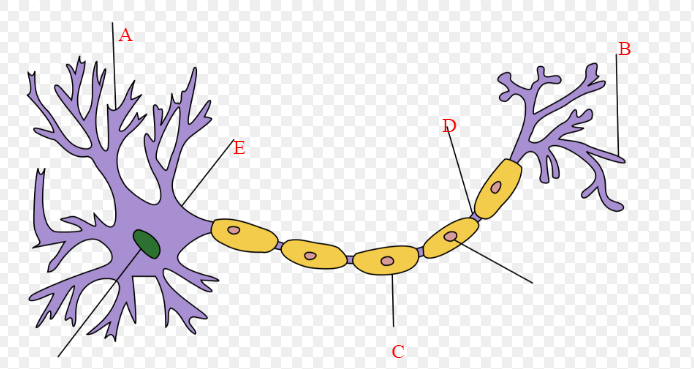
B
a)
Dendrite
b)
Axon
c)
Axon Terminal
d)
Cell Body
134.

E
a)
Synapse
b)
Cell Body
c)
Axon
d)
Dendrite
135.
This part of the neuron receives chemical messages from the neurotransmitters of other neurons.
a)
Axon Terminal
b)
Dendrites
c)
Myelin Sheath
d)
Cell Body
136.
A chemical produced by neurons that carries messages to other neurons
a)
myelin sheath
b)
neurotransmitter
c)
axon
d)
axon terminal
137.
The tiny gap between neurons where nerve impulses are sent from one neuron to another. It is where communication occurs between an axon and dendrite
a)
synapse
b)
axon terminal
c)
impulse
d)
myelin
138.
The part of the neuron that brings information to the cell body is called a(n) ___________.
a)
dendrite
b)
axon
c)
nucleus
d)
node of Ranvier
139.
Location at which a neuron can transfer an impulse to another cell with the use of neurotransmitters is called __________.
a)
myelin sheath
b)
axon
c)
threshold
d)
synapse
140.
What is the chemical used by a neuron to transmit an impulse across a synapse to another nerve cell?
a)
Neurotransmitters
b)
Synapse
c)
Threshold
d)
Impulse
141.
What is the insulating membrane that surrounds parts of the axon that helps the impulses travel faster called?
a)
Axon
b)
Dendrites
c)
Node of Ranvier
d)
Myelin Sheath
142.
The most influential endocrine glands is (are) the
a)
pituitary
b)
adrenal glands
c)
thyroid glands
d)
parasympathetic
143.

This brain part, which was named for because it looks like a sea horse, is part of the limbic system which helps with memories.
a)
Amygdala
b)
Hippocampus
c)
Hypothalamus
d)
Pituitary Gland
144.
Mr. Fuller enjoys seeing kids light up with interesting psychological facts like, the brain has enough electrical current to light a 20W light bulb. When this happens, Mr. Fuller gets a little happy release of endorphins and dopamine. These chemicals are called
a)
neurons
b)
neurotransmitters
c)
synaptic release
d)
brain blood
145.
Which statement best describes what psychologists learned from the accident of Phineas Gage?
a)
The brain is not critical for life
b)
all people could survive a traumatic injury to the head
c)
different parts of the brain are responsible for different functions
d)
the brain would not likely have any long term effect on a person
100 %

