
NEW
Font size
S
M
L
XL
 Worksheets
Intro to ionic bonding
Total questions: 37
Worksheet time: 1hrs 11mins
Name
Class
Date
1.
Ionic Bonding involves...
a)
The transfer of protons
b)
The transfer of nuetrons
c)
The transfer of electrons
d)
None Of the above
2.
What do atoms that form positive ions tend to do?
a)
Tend to lose electrons
b)
Tend to lose protons
c)
Tend to gain electrons
d)
Tend to gain protons
3.
What usually forms the positive ion?
a)
Metal
b)
Non Metals
c)
None
4.
What happens when the sodium atom loses an electron?
a)
It become negatively charged
b)
It become positively charged
c)
none
5.
What usually forms the negative ion?
a)
nonmetals
b)
metal
c)
none
6.
What charges attract?
a)
Opposite
b)
Same
7.

What elements generally make an ionic bond?
a)
metal and nonmetal
b)
2 or more nonmetals
c)
metal
d)
none of the above
8.

What elements generally make a covalent bond?
a)
metal and nonmetal
b)
2 or more nonmetals
c)
metal
d)
none of the above
9.
Predict the bond that will form between Be and F.
a)
Ionic
b)
Covalent
10.
What is the number of valence electrons for Oxygen?
a)
8
b)
6
c)
2
d)
1
11.
What is the number of valence electrons for Beryillum?
a)
1
b)
4
c)
2
d)
7
12.
Anion is another term for an atom that gains one or more electrons.
a)
TRUE
b)
FALSE
13.
Ionic Bonding involves...
a)
The transfer of protons
b)
The transfer of nuetrons
c)
The transfer of electrons
d)
None Of the above
14.
What formula results when Ca+2 and Br- ions bond?
a)
Ca2Br2
b)
CaBr
c)
Ca(br)2
d)
CaBr2
15.
Li+ combines with P3- to form
a)
LiP
b)
Li3P
c)
LiP3
d)
Li3P3
16.
What formula results when Al+3 and PO4-3 ions bond?
a)
Al(PO3)4
b)
Al(PO4)
c)
Al(PO4)3
17.
What formula results when Fe+3 and CO3-2 ions bond?
a)
FeCO3
b)
Fe2CO3
c)
Fe2(CO3)3
d)
Fe3(CO3)2
18.
What is the formula for magnesium chloride?
a)
MgCl
b)
Mg2Cl
c)
MgCl2
d)
Mg(ClO3)2
19.
Name KF
a)
Potassium fluoride
b)
Potassium fluorite
c)
Fluorine potasside
d)
Potassium fluorate
20.
Name NaBr
a)
Bromide sodide
b)
Sodium bromide
c)
Sodium bromate
d)
Sodium bromite
21.
What is the formula for calcium chloride?
a)
CaCl
b)
CaCl2
c)
Ca2Cl
d)
CaCl3
22.
What is the formula for Sodium Oxide?
a)
NaO
b)
NaO2
c)
Na2O
d)
Na2O2
23.
What is the formula for Sodium Oxide?
a)
NaO
b)
NaO2
c)
Na2O
d)
Na2O2
24.
Name Fe(NO3)3
a)
Iron (III) Nitrate
b)
Iron (III) Nitride
c)
Iron (VI) Nitrate
d)
Iron Nitrate
25.
What is the formula for calcium carbonate?
a)
CaCO
b)
CaCO2
c)
CaCO3
d)
Ca3CO3
26.
Name PbO
a)
lead oxide
b)
lead oxygen
c)
lead (II) oxide
d)
lead (I) oxide
27.
What is the formula for magnesium phosphide?
a)
Mg3P2
b)
Mg2P3
c)
Mg2PO3
d)
Mg3(PO3)2
28.
What is the formula for sodium phosphate?
a)
Na3PO4
b)
Na3PO3
c)
Na3P
d)
Na3PO
29.
What is the formula for tin (II) nitride?
a)
Sn3N2
b)
SnN2
c)
Sn3N
d)
SnN
30.
How do covalent bonds form?
a)
Donating & receiving valence e- between atoms.
b)
Opposite slight charges attract each other between compounds.
c)
Scientists are still not sure how they form.
d)
Sharing valence e- between atoms.
31.

What two types of atoms make a covalent bond?
a)
2 Nonmetals
b)
1 Nonmetal and 1 Metal
c)
2 Metals
d)
2 Noble Gases
32.
What do we call a covalent bond where electrons are shared UNEVENLY or UNEQUALLY?
a)
Ionic
b)
Polar Covalent
c)
Nonpolar Covalent
d)
Van der Waals Force
33.
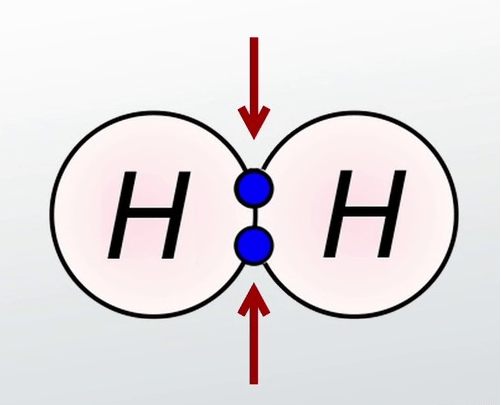
What type of bond is shown in this image?
a)
Ionic
b)
Polar Covalent
c)
Nonpolar Covalent
d)
Van der Waals Force
34.
phosphorus trichloride
a)
KCl3
b)
PCl3
c)
K3Cl
d)
P3Cl
35.
silicon dioxide
a)
SO2
b)
NaO2
c)
SiO2
d)
SiO
36.
The chemical formula of carbon tetrachloride is
a)
CCl
b)
C₄Cl
c)
CCl₄
d)
C(IV)Cl
37.
The chemical formula of dinitrogen textroxide is
a)
Ni₂O₄
b)
NiO
c)
N₂O₄
d)
NiO₂
Reset

