wayground logo

Free Printable Worksheets

NEW

Font size

S
M
L
XL
Worksheets

Unit 3 Test Review Env Sci: Population Ecology

Total questions: 50

Worksheet time: 43mins

Name
Class
Date
1.
A living or once-living organisms in an ecosystem is a
a)
population
b)
biotic factor
c)
abiotic factor
d)
community
2.
Which of the following is not an abiotic factor?
a)
sun
b)
temperature
c)
soil
d)
grass
3.
Which of the following is not a biotic factor?
a)
mushroom
b)
air
c)
elephant
d)
coyote
4.
A nonliving element in an ecosystem is an 
a)
animal
b)
abiotic factor
c)
biotic factor
d)
organism
5.
Temperature, light, air, water, and soil are all  _____  parts of the environment
a)
alive
b)
biotic 
c)
abiotic
d)
living
6.
Limiting factors are sometimes helpful because they can keep the population from getting too large.
a)
True
b)
False
7.
Food, water, sunlight, shelter, and space are resources that are often __________.
a)
limiting factors
b)
wet
c)
messy
d)
found in rocks
8.
Any thing or organism that regulates the size of a population of another organism is known as __________.
a)
a limiting measure
b)
a limiting factor
c)
factorization
d)
materialization of precipitation
9.
A group of the same type of organisms living in the same place at the same time.
a)
threatened species
b)
populations
c)
community
d)
limiting factor
10.
As a population grows, it will most likely stop growing at what size?
a)
Growth limit
b)
Exponential limit
c)
Carrying Capacity
d)
It won't stop growing
11.
Which dispersion pattern usually is a result of resources not being evenly spread out in the environment?
a)
Uniform
b)
Random
c)
Clumped
d)
None of these
12.
Which dispersion pattern is described by organisms being spaced out equally?
a)
Uniform
b)
Random
c)
Clumped 
d)
None of these
13.
What will happen to the population when the death rate is larger than the birth rate?
a)
grow
b)
shrink
c)
stay the same
d)
None of these
14.
What will happen to the population when the birth rate is larger than the death rate?
a)
grow
b)
shrink
c)
stay the same
15.
What is the carrying capacity of the following graph?
a)
1000
b)
8000
c)
800
d)
600
16.
Which kind of dispersion is #1?
a)
clumped
b)
random
c)
uniform
17.
What point on the graph represents the carrying capacity?
a)
A
b)
B
c)
C
d)
D
18.
What factor describes when populations decrease because animals are moving out of a population?
a)
Emigration
b)
Limiting Factors
c)
Immigration
d)
Exponential Growth
19.
Which limiting factor would increase due to the number of individuals in a population?
a)
Unusual weather
b)
Natural disaster
c)
Births
d)
Disease
20.
sage plants secrete chemicals that prevent other plants from growing nearby, such that the plants are equally spaced in their habitat 
a)
random distribution
b)
uniform distribution
c)
clumped distribution 
21.
dandelions use the wind to disperse their seeds and will germinate if they land in a favorable environment 
a)
random distribution
b)
clumped distribution 
c)
uniform distribution 
22.
herding animals, such as bison, live in large groups 
a)
uniform distribution 
b)
random distribution
c)
clumped distribution 
23.
factors that limit population growth related to the number of individuals/unit area 
a)
abiotic factors 
b)
density-dependent factors
c)
K-selected factors
d)
density-independent factors
24.
factors that limit population growth that are unrelated to population size/unit area
a)
density-independent factors 
b)
logistic factors 
c)
density-dependent factors 
d)
K-selected factors 
25.
Which of the following is NOT true regarding a predator-prey relationship?
a)
when graphing this relationship over time, the peak of the predator population tends to lag behind the peak of the prey population
b)
the relationship is an example of a density-dependent limiting factor 
c)
the prey population is generally smaller than the predator population 
d)
the predator population is generally smaller than the prey population 
26.
Which of the following is NOT a density-dependent limiting factor?
a)
waste accumulation 
b)
parasitism/disease
c)
competition 
d)
forest fire 
27.

A population’s emigration in one month totaled 2 individuals. During the same period, immigration was 12 individuals. Natality (births) was 8, and mortality was 15 due to a parasite infection. What was the net effect on the population size?

a)

+5

b)

+3

c)

0

d)

-4

28.

Factors like predation can have a positive benefit to the population of prey organisms because predators tend to keep prey populations below their ___________.

a)

carrying capacity

b)

sustainibility number

c)

exponential growth point

d)

competition level

29.

As a population of a species increases within a territory, which of the following most likely also increases?

a)

Immigration

b)

Food supply

c)

Carrying capacity

d)

Competition

30.

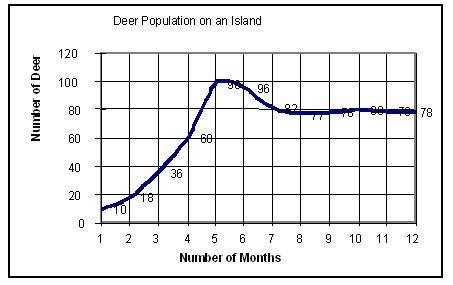
Which choice most closely approximates is the deer population's carrying capacity on the island based on the graph below?

a)

100

b)

80

c)

60

d)

10

31.

Which of the following populations is most likely to go extinct?

a)

a very small population in an unstable environment

b)

a moderate-sized population of r strategists

c)

a large population with lots of genetic variability

d)

all would be equally likely to go extinct

32.

Which of these pictures show a producer?

a)
b)
c)
d)
33.

What do the arrows represent in this food chain?

a)

What animals eat

b)

What animals are bigger

c)

How energy flows

34.
Which biome, because of its climate, has the largest number of species of plants and animals?
a)
Tundra
b)
Rainforest
c)
Desert
d)
Pineforest
35.

What is a biome?

a)

A community of living things.

b)

A large region of earth with a certain type of climate

c)

An area of earth only found in the United States.

36.

1. The most important abiotic factors when studying biomes are?

a)

temperature and water

b)

sun and temperature

c)

sun and water

37.
What is the carrying capacity for this sheep population?
a)
1.8 million
b)
1.25 million
c)
1.6 million
d)
1.o million
38.
Refer to the diagram of the survivorship curve.
Which curve best describes an organism that invests a lot of energy in parenting?
a)
A
b)
B
c)
C
d)
this is not a survivorship curve
39.
Populations of different organisms living in an area
a)
species
b)
community
c)
niche
d)
biome
40.
Organisms that look similar and can produce fertile offspring
a)
Species
b)
Fish
c)
Community
d)
Trees
41.
All of the living and nonliving things in an area that interact with each other are called a/an ______.
a)
community
b)
habitat
c)
population
d)
ecosystem
42.
The role an organism plays in its environment.
a)
niche
b)
species
c)
reproduction
d)
adaptation
43.
If a country has a death rate of 30 and a birth rate of 45 the natural rate of increase would show the population is ______.
a)
Increasing
b)
Decreasing
c)
Staying the same
d)
Fluctuating too much
44.
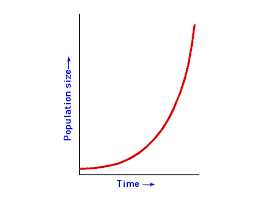
What type of growth is shown in the diagram?
a)
exponential growth
b)
logistic growth 
c)
predator-prey cycle
d)
boom-bust curve
45.
If a disease destroying barley plants in a field swept through an ecosystem, what would happen to the barley eating bird population in the the field ?
a)
The bird population would stay the same
b)
The bird population would infinitely increase
c)
The bird population would decrease
46.
If the amount of food or resources available increases, the carrying capacity for an animal:
a)
Stays the same
b)
Increases
c)
Decreases
d)
Fluctuates
47.
Which limiting factor is density independent?
a)
competition
b)
disease
c)
natural disasters
48.
An environmental factor such as predation, disease, and competition that depends on the number of members in a population per unit
a)
dispersion
b)
density- independent factor
c)
density- dependent factor
49.
Individuals of a population who exit an area.
a)
Immigration
b)
Emigration
c)
Mitigation
d)
Lingation
50.
If the number of births in a population is the same as the number of deaths in a population, what will happen to the growth of the population?
a)
It will increase
b)
It will decrease
c)
It will stay the same
d)
It don't matter