

wayground logo

Free Printable Worksheets

Font size

S
M
L
XL
Worksheets

SEMHS World History Final 2018 ANCIENT Egypt, Greece & Rome

Total questions: 100

Worksheet time: 3hrs 9mins
Name
Class
Date
1.
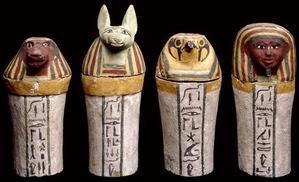
What might you find in canopic jars?
a)
A mummy's ka
b)
A mummy's internal organs
c)
A mummy's posessions
d)
A mummy's limbs
2.

What can you conclude from the fact that the Egyptians painted the walls of the mummies' tombs with pictures of servants, food and animals?

a)

They wanted to liven up the dull brick walls.

b)

They believe the dead needed these things in the afterlife.

c)

They wanted to protect the dead against grave robbers.

d)

They believe these images warded off evil spirits.

3.

Mummies are studied so that we can know more about ancient life.

a)

Yes

b)

No

4.

Instead of writing on clay tablets, the ancient Egyptians invented a type of paper called

a)

Rice paper

b)

Muslin

c)

Booly

d)

Papyrus

5.

The plants used to make Egyptian paper were found

a)

Along the Nile River

b)

In the Desert

c)

By trading with other countries

d)

At Hobby Lobby

6.

Ancient Egyptians wrote words with characters called

a)

Cuneiform

b)

Hieroglyphics

c)

Squiggles

d)

Sanskrit

7.

The most famous Great Pyramids of Giza were commissioned (ordered to be built) by

a)

King Khufu

b)

King Tut

c)

Queen Cleopatra

d)

King Ramses

8.

Anubis was a god with a human body and head of a jackal, known as the god of

a)

Love

b)

War

c)

Gods

d)

Death

9.

Embalmers

a)

prepare the body for mummification.

b)

guard the tombs.

c)

are rulers.

d)

are special mummies.

10.

Mummification was important because

a)

People loved to wrap things.

b)

They could use it for DNA later on.

c)

Eguptians liked creepy things.

d)

They believed in the afterlife.

11.

A large stone coffin is a

a)

sarcophagus

b)

sausage

c)

pyramid

d)

chamber

12.

afterlife

a)

death

b)

a life

c)

a life believed to preceed death

d)

a life believed to follow death

13.

dynasty

a)

t.v. show that started in 2012.

b)

line of rulers from the same family

c)

something you measure with

d)

a dead king

14.

Which one of following was not an invention of Ancient Egyptians:

a)

Paper

b)

Calander

c)

Heiroglyphics

d)

Cell Phones

15.

What is the correct spelling of Mr. Ma Hee Yaz name?

a)

Meheya

b)

Mija

c)

Majia

d)

Mejia

16.
The ruler of all the Greek gods was... 
a)
Poseidon.
b)
Ares.  
c)
Zeus.
d)
Athena.  
17.
According to the ancient Greeks, the gods and goddesses lived...
a)
in Athens.
b)
on Mount Olympus.
c)
in Sparta.
d)
in Turkey.
18.
What does the word "Democracy" mean?
a)
"rule by the government"
b)
"rule by the many"
c)
"rule by the wealthy"
d)
"rule by the people"
19.
Greek has many _________that are like mini countries.
a)
counties
b)
city-states
c)
provinces
d)
parishes
20.
The Greeks used a writing system developed by 
a)
Egyptians
b)
Phoenicians 
c)
Mycenaeans
d)
Romans
21.
The games held every four years at a festival to honor Zeus were called
a)
Goodwill Games
b)
Marathons
c)
Olympics
d)
Triathlons 
22.
A militaristic city-state where boys were trained from an early age to fight.
a)
Athens
b)
Delphi
c)
Corinth
d)
Sparta
23.
A city-state which favored democracy and a well-rounded education. 
(Also, the largest city-state by a wide margin)
a)
Sparta
b)
Athens
c)
Delphi
d)
Corinth
24.
Stories that portray Greek Gods and goddesses are called 
a)
essays
b)
fables
c)
histories
d)
myths
25.
Athens main rival was the city state of 
a)
Anatolia
b)
Marathon
c)
Sparta
d)
Thermopylae
26.

What are the kings and queens of Egypt called?

a)

Pets

b)

Priest

c)

Pharaoh

d)

Both B and C

27.

What are calendars used for?

a)

to keep track of flooding´s

b)

weather

c)

days

d)

months

28.

What were irrigation systems made for?

a)

To grow grass

b)

To help the crops

c)

To grow crops

d)

to water the crops

29.

What physical features of earth caused people to form villages?

a)

glaciers

b)

fertile soil for growing crops

c)

soil

d)

grass

30.
How often did the Nile flood?
a)
Once
b)
Twice
c)
Once a Year
d)
Twice a Year
31.
Which direction does the Nile flow?
a)
North
b)
South
c)
East
d)
West
32.
The primary way of traveling along the Nile River was with boats.
a)
True
b)
False
33.
What body of water does the nile River empty into?
a)
Atlantic Ocean
b)
Red Sea
c)
Mediterranean Sea
d)
Indian Ocean
34.
Which is the longest river in the world?
a)
Nile River
b)
Yellow River
c)
Mississippi River
d)
Amazon River
35.
The Nile River flows through two important regions in Egypt called
a)
Mesopotamia
b)
Upper and Lower Egypt
c)
Eastern and Western Egypt
d)
Nubia and Cairo
36.
What is a dynasty?
a)
a collection of queens
b)
a collection of kingdoms
c)
series of rulers from different families
d)
series of rulers from the same family
37.
Who would the people blame if crops did not grow or if disease struck?
a)
the farmers
b)
the mummies
c)
the pharaoh
d)
the dynasty that was in power
38.
Who was the most famous pharaoh of the Old Kingdom?
a)
Horus
b)
Sinai
c)
Menes
d)
Khufu
39.
Which of the following beliefs was  central to Egyptian religion?
a)
the afterlife
b)
the pyramids
c)
the pharaohs
d)
the heavens
40.

People in ancient Greece adapted to their environment by

a)

growing rice

b)

making papyrus paper

c)

making silk

d)

building ships to fish and trade

41.

Ancient Greeks painted pictures on pottery because

a)

they wanted to make the pottery look beautiful

b)

they wanted to tell a story

c)

they wanted to make a calendar

d)

they wanted to have fun

42.
Rome’s 200 years of peace was called the...
a)
Age of Augustus.
b)
Resurrection.
c)
Pax Romana.
d)
Crucifixion.
43.
What Roman architectural contribution allowed the construction of higher, more stable structures such as the aqueducts and the Colosseum?
a)
columns
b)
arches
c)
lintels
d)
marble
44.
How did the Romans carry water from mountains into cities?
a)
by combining a set of layers
b)
by combining a set of arches
c)
by building aqueducts
d)
by building a bridge
45.
Roman roads were built primarily in order to allow...
a)
senators to get to the Senate.
b)
Rome’s armies to travel through the empire.
c)
merchants to travel safely.
d)
slaves to travel into the countryside.
46.
What material did the Romans invent that helped their structures last?
a)
volcanic rock
b)
asphalt
c)
cement
d)
lime
47.
How did Constantine affect Christianity?
a)
He made Christianity legal in 313 AD
b)
He placed even more bans on the religion.
c)
He persecuted Christians in the Colosseum.
d)
He moved the capital of Rome to the Eastern Empire.
48.
Which apostle was most responsible for spreading the Christian faith immediately after the death of Jesus by writing letters?
a)
Peter
b)
James
c)
Paul 
d)
John
49.
The Roman Empire fell for all of the following reasons EXCEPT...
a)
barbarian invasions
b)
strong leadership
c)
inflation
d)
political corruption
50.
Who is the leader of the Catholic Church?
a)
Patriarch
b)
Pope
c)
Roman Emperor
d)
Paul
51.
Which popular Roman attraction is pictured?
a)
Colosseum
b)
Pantheon
c)
Circus Maxiums
d)
Forum
52.
What do the first 4 books of the New Testament describe?
a)
The life and teachings of Jesus
b)
The life and teachings of Paul
c)
The life of Christians in the Roman Empire
d)
The life of Jews in the Roman Empire
53.
Gladiator fights mostly took place in the
a)
Circus Maximus
b)
Forum
c)
Colosseum
d)
Pantheon
54.
Rome is located in which country?
a)
Greece
b)
Italy
c)
Egypt
d)
France
55.
The Roman city destroyed by Mt. Vesuvius in 79 AD is 
a)
Herculaneum
b)
Pompeii
c)
Rome
d)
Constantinople
56.

Who was Augustus

a)

A Peace Maker

b)

A Priest

c)

The Leader of Egypt

d)

The First Empior of Rome

57.

Why did the Roman republic have three branches of government?

a)

They provided one strong ruler.

b)

They provided a dynasty of powerful rulers.

c)

They provided a system of checks and balances.

d)

They provided a way to divide society by social classes.

58.
Brutus decides to kill Caesar because
a)
Caesar is a tryant
b)
Caesar has learned of the plot
c)
Caesar might turn into a tyrant
d)
Caesar already ahs too much power.
59.

What territory north of Italy did Julius Caesar conquer?

a)

France

b)

Gaul

c)

Egypt

d)

Greece

60.

What happened when Julius Caesar returned to Rome with his army?

a)

A parade with exotic animals

b)

The Senate assassinated him

c)

Pax Romana

d)

Civil war broke out

61.

How did Julius Caesar die?

a)

Stabbed 23 times by Senate members

b)

Poisonous snake bite

c)

Committed suicide after losing a battle

d)

Killed in battle

62.

"Pax Romana" means ________ in Rome

a)

Pride

b)

Pyramids

c)

Prosperity

d)

Peace

63.

When the republic failed, Rome became a/an:

a)

Monarchy

b)

Republic

c)

Empire

64.
Peasants, craftspeople, traders, other workers made up our group
a)
patrician
b)
plebeian
65.
The rule of a single king
a)
Dictator
b)
Emperor
c)
Monarchy
d)
Tyranny
66.
Which civilization did not influence Rome?
a)
Etruscans
b)
Egyptians
c)
Greeks
d)
Latins
67.
What Rome acquired from the Greeks:
a)
Their common language
b)
Their gods and architecture
c)
Clothing styles
d)
Fight techniques
68.
The Senate was made up of patricians of Rome
a)
True
b)
False
69.
who was the youngest Egyptian king
a)
hatshepsut
b)
king tut
c)
randy
d)
khfu
70.
True or False? There was an Upper and Lower Egypt.
a)
True
b)
False
71.
Because one physical feature was so vital to ancient settlers of Egypt and Kush, MOST of their settlements were
a)
on hills
b)
in a desert
c)
near a river
d)
around trees
72.
How did the desert help the people of Egypt and Kush?
a)
It had fertile land for crops.
b)
It made trade and travel easier.
c)
It was grassy for grazing sheep.
d)
It gave protection from invaders.
73.
What was a MAJOR purpose for building the pyramids?
a)
temples for religious worship
b)
storehouses for reserves of grain
c)
homes for the pharaohs' servants
d)
tombs for pharaohs when they died
74.
The Old Kingdom is also known as the 
a)
Age of the Nobles
b)
Age of the Empire
c)
Age of the Pyramids 
75.
How did most people in Egypt earn a living?
a)
trade
b)
fishing 
c)
farming
d)
metal working
76.
Why were tombs filled with art, jewelry, etc.....?
a)
Tombs were museums.
b)
Tombs were private storage for the pharaoh.
c)
Tombs were the safest place in the kingdom.
d)
They believed the dead enjoyed their materials in the afterlife.
77.
Who would write and record information?
a)
slaves
b)
scribes
c)
farmers
d)
craftspeople
78.
Egyptian writing system
a)
papyrus
b)
alaphabet
c)
cuneiform
d)
heiroglyphics
79.
Who is at the top of the Egyptian social hierarchy?
a)
slaves
b)
pharaoh
c)
scribe
d)
merchant
80.

Who held the least power in the Ancient Egyptian social structure?

a)

slaves

b)

scribes

c)

pharaoh

d)

craftsmen

81.

small

a)

a. macro

b)

b. acro

c)

c. mis

d)

d. micro

82.

false

a)

a. hetero

b)

b. tele

c)

c. psuedo

d)

d. peri

83.

many

a)

a. poly

b)

b. peri

c)

c. homo

d)

d. pan

84.
A small group of people having control of a country
a)
Theocracy
b)
Oligarchy
c)
monotheism 
d)
Democracy
85.
A government in which a person or small group rules with unlimited power.
a)
Tyranny
b)
Democracy
c)
Oligarchy
d)
Dictatorship
86.
A government that is ruled by the people. 
a)
Democracy
b)
Theocracy
c)
Oligarchy
d)
Dictatorship
87.
Everything that has to do with being a citizen of a country. 
a)
City-State
b)
membership
c)
citizenship
d)
democracy
88.
A series of wars fought between Persia and Greece. The conflict began when Persia invaded Greek colonies.
a)
Persian Wars
b)
Peloponnesian Wars
c)
Afganistan Wars
d)
Iraqi Wars
89.

Papyrus

a)

a furry water animal

b)

a paper like material made from a weed and used to write on

c)

a dessert land

d)

the name of an Egyptian king

90.

what is the largest desert in the world

a)

Vegas

b)

Red Desert

c)

Sahara Desert

d)

Nile Desert

91.

Why were pyramids built?

a)

To hide gold

b)

to honor Kings in the afterlife

c)

to punish the Kings

d)

To punish the Egyptian people who had to build them

92.

What is embalming?

a)

Process developed by the Ancient Egyptians of preserving a body after death

b)

Desert region in northern Africa; largest, hot desert in the world

c)

Steep rapids formed by cliffs and boulders in a river

93.
The nobility in Roman society
a)
Plebians
b)
Patricans
c)
Romans
d)
Senators
94.
I am the name of the series of battles between Rome and Carthage that lasted more than 100 years.
a)
Punic Wars
b)
Gauls
c)
barbarian
95.
Rome was built by this river.
a)
Nile River
b)
Tiber River
c)
Mississippi River
96.
Who was the Parthenon made to honor?
a)
Nero
b)
Zeus
c)
Athena
d)
Minerva 
97.
Nike is the goddess of 
a)
losers
b)
victory
98.
What is this?
a)
The Super Sand Cat
b)
The Pharaoh 
c)
The Great Sphinx of Giza
d)
Chester Cheetah
99.
Ancient Egyptian history is divided into what? 
a)
Chapters
b)
Ages
c)
Dynasties
d)
Kingdoms
100.

Where is Egypt located?

a)

Northern Africa

b)

South America

c)

Central Asia

d)

Central Africa
