wayground logo

Free Printable Worksheets

NEW

Font size

S
M
L
XL
Worksheets

(H) Periodic Table Test Review

Total questions: 47

Worksheet time: 2hrs 5mins

Name
Class
Date
1.

As atoms of elements in group 16 are considered in order from top to bottom, the electronegativity of each element....

a)

decreases

b)

increases

c)

remains the same

d)

none of the above

2.

Which atom has the largest atomic radius?

a)

potassium

b)

rubidium

c)

francium

d)

cesium

3.

As you move down the periodic table atoms get bigger. This is because ____________.

a)

The atoms have more mass.

b)

The atoms have more protons.

c)

The atoms have more energy levels

d)

The atoms have more nuetrons

4.

As you move across the periodic table atoms tend to get smaller because, ______________.

a)

the atoms have more mass.

b)

the atoms have less mass

c)

the atoms have more protons.

d)

the atoms have less electrons.

5.
Atoms that have a high electronegativity, _______________.
a)
give up their electrons more easily.
b)
hold on to their electrons more tightly.
c)
have more electron shells.
6.
Ionization energy is...
a)
the energy required to add an electron to a specific atom
b)
how much energy it takes to remove an electron from an atom
c)
the energy required to shield the outer electrons from the nucleus
d)
a measure of the ability of an atom to attract electrons
7.

Metals have the largest -

a)

atomic radius and electronegativity

b)

electronegativity and ionization energy

c)

atomic radius only

d)

ionization energy and atomic radius

8.

The element with the largest electronegativity in the halogens is -

a)

At

b)

F

c)

Cl

d)

Br

9.

The element with the lowest electronegativity in Period 3 is -

a)

Na

b)

Cl

c)

Ar

d)

Mg

10.

The electronegativity of Cl is the highest in Period 3. Why?

a)

Cl is the largest and has the greatest effective nuclear charge

b)

Cl is the smallest and has the lowest effective nuclear charge

c)

Cl is the largest and has the lowest effective nuclear charge

d)

Cl is the smallest and has the greatest effective nuclear charge

11.

The element with the smallest ionization energy in Period 6 is -

a)

Rn

b)

Cs

c)

Os

d)

Tm

12.

As we go from the left side to the right side on the periodic table, electronegativity...

a)

Increases

b)

Decreases

c)

Remains constant

13.

The tendency of an atom to attract electrons and acquire a negative charge

a)

electronegativity

b)

charge

c)

bonding ability

d)

electron configuration

14.
Vertical columns of elements (families) on the periodic table with similar valence electron configurations and similar properties
a)
groups
b)
periods
c)
quadrants
d)
rows
15.

An electron that resides in the outermost shell, or principal quantum level, of an atom

a)

periodic trend

b)

electron shell

c)

ionic radius

d)

valence electron

16.

Which has the greater EN (electronegativity)

Cl or Al?

a)

Cl

b)

Al

17.
Which has the greater EN: 
H or F?
a)
H
b)
F
18.

The term that is related to the number of protons is

a)

Ionization energy

b)

Electronegativity

c)

Nuclear Charge

d)

Shielding effect

19.
Electronegativity __________ from left to right within a period and __________ from top to bottom within a group.
a)
decreases, increases 
b)
increases, increases
c)
increases, decreases 
d)
stays the same, increases
20.
Who was the first to organize the periodic table based on increasing atomic mass
a)
Mendeleev
b)
Moseley
c)
Newton
d)
Schrodinger
21.
Group 1A, very reactive in water
a)
Transition Metals 
b)
Alkali Metals
c)
Alkaline Earth Metals
22.
Group 2A, includes Mg & Ca
a)
Alkali Metals
b)
Alkaline Earth Metals
c)
Transition Metals
23.
Which of the following has the highest Ionization energy?
a)
Li
b)
K
c)
Cl
d)
Ca
24.
Atomic radius generally increases as we move __________.  
a)
down a group and from right to left across a period 
b)
up a group and from left to right across a period 
c)
down a group and from left to right across a period 
d)
up a group and from right to left across a period 
25.

This trend illustrates the attraction of an atom for electrons.

a)

Atomic Size

b)

Metallic Character

c)

Electronegativity

d)

Ionization Energy

26.

This trend illustrates the energy associated with the removal of an electron from an atom.

a)

Atomic Size

b)

Metallic Character

c)

Electronegativity

d)

Ionization Energy

27.

In general, which group will have the overall highest electronegativity values?

a)

Noble Gases

b)

Halogens

c)

Alkali Metals

d)

Alkaline Earth Metals

28.

Which element will have the lowest ionization energy?

a)

Na

b)

Cl

c)

K

d)

Br

29.
According to the diagram Li will form a ____________ with a _________ charge.
a)
cation, +1
b)
anion, +1
c)
cation, -1
d)
anion, -1
30.
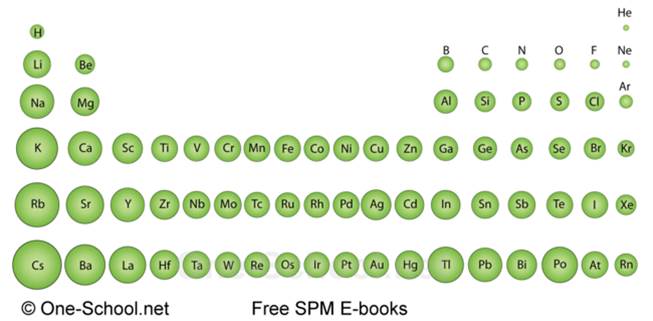
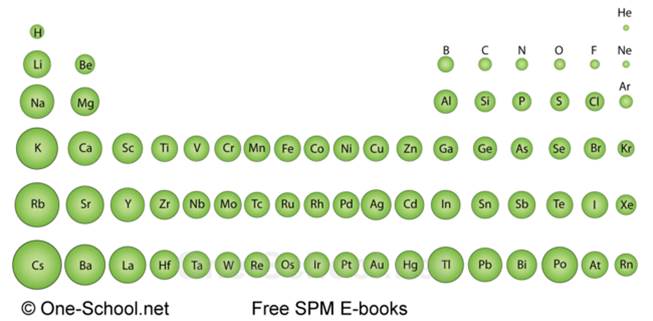
The trend of ionization energy seen on the periodic table is increase across a period and up a column. As seen in the image. Which would have a greater ionization energy, K or Na?
a)
K
b)
Na
31.
Which element would use less energy to remove an electron from its orbital? P or Ar
a)
P
b)
Ar
32.
Rank in order of lowest to highest ionization energy: Si, Mg, S
a)
S, Mg, Si
b)
Mg, Si, S
c)
Si, Mg, S
33.
Put the following in order of increasing ionization energy:Neon, Lithium, Carbon
a)
Lithium, Carbon, Neon
b)
Carbon, Lithium, Neon
c)
Neon, Carbon, Lithium
d)
Lithium, Neon, Carbon
34.
Which of the following would produce an anion?
a)
Ca
b)
Al
c)
K
d)
F
35.

A horizontal row on the periodic table is called a ______________

a)

Period

b)

Group

36.

Which group of elements has the lowest ionization energy?

a)

Group 1

b)

Group 2

c)

Group 3

d)

Group 4

37.

Order the following in decreasing electronegativity value:

Ga, Fe, As, K

a)

Ga, Fe, As, K

b)

K, As, Fe, Ga

c)

As, Ga, Fe, K

d)

Fe, K, Ga, As

38.
Which of the following is true?
a)
Electronegativity increases from right to left across a period
b)
Atomic Radii decrease from left to right across a period
c)
Ionization energy increases from left to right across a period
d)
Oxidation numbers increase from right to left across a period
39.
Which of the following is true?
a)
Electronegativity increases up a group
b)
Atomic Radii increases up a group
c)
Ionization energy increases down a group
d)
Oxidation numbers increase down a group
40.

Our modern Periodic Table is organized by increasing....

a)

oxidation numbers

b)

average atomic mass

c)

atomic number

d)

alphabetical order

41.

The table shows the first ionization energy and atomic radius of several elements. Which of the following best helps to explain the deviation of the first ionization energy of oxygen from the overall trend?

a)

The atomic radius of oxygen is greater than the atomic radius of fluorine.

b)

The atomic radius of oxygen is less than the atomic radius of nitrogen.

c)

There is repulsion between paired electrons in oxygen’s 2p orbitals.

d)

There is attraction between paired electrons in oxygen’s 2p orbitals.

42.

The ionization energies for element X are listed in the table on the right. On the basis of the data, element X is most likely to be

a)

Be

b)

B

c)

C

d)

F

43.

For element X represented above, which of the following is the most likely explanation for the large difference between the second and third ionization energies?

a)

The effective nuclear charge decreases with successive ionizations.

b)

The shielding of outer electrons increases with successive ionizations.

c)

The electron removed during the third ionization is, on average, much closer to the nucleus than the first two electrons removed were.

d)

The ionic radius increases with successive ionizations.

44.
The graph above shows the ionization energy values as the elements are arranged on the periodic table. Which conclusion cannot be drawn from the graph?
a)
The ionization energy drops significantly as you move down a group because the valence electrons are in a shell further from the nucleus.
b)
The ionization energy increases gradually as you move right across a period because the valence electrons are in a shell further from the nucleus.
c)
The ionization energy increases gradually as you move right across a period because you are adding more protons.
d)
The ionization energy increases when the valence electrons are more attracted to the nucleus.
45.

Which of these has the greatest ionic radius?

a)

potassium

b)

aluminum

c)

carbon

d)

oxygen

46.
What is the term that describes the adding of energy levels as you move down the periodic table?
a)
multiplying
b)
Shielding
c)
growing 
d)
layering
47.

Which of the following elements have the smallest ionic Radius?

a)

Oxygen

b)

Selenium

c)

Sulfur

d)

Tellurium