wayground logo

Free Printable Worksheets

NEW

Font size

S
M
L
XL
Worksheets

Physics - Force & Motion Unit Review

Total questions: 54

Worksheet time: 2hrs 32mins

Name
Class
Date
1.

If a car is moving a 65 mile per hour (constant speed), what will happen to the motion of the car if no new force is applied?

a)

The car will speed up.

b)

The car will slow down.

c)

The car will stay at 65 mph.

d)

The car will stop.

2.
Which is not an example of acceleration?
a)
Driving at a constant speed 
b)
A bat hitting a ball
c)
Throwing a football 
d)
Kicking a soccer ball
3.
In each of the following cases, determine where the car has no acceleration ?
a)
A car shortly after a stoplight turns green.
b)
A car approaching a red light
c)
A car with the cruise control set at 80 km/h
d)
A car turning a curve at a constant speed
4.
If you increase the mass on an object, its acceleration
a)
decreases
b)
stays the same
c)
also increases
d)
stops
5.
If you increase the force on an object, its acceleration? 
a)
decreases
b)
stays the same
c)
also increases
d)
stops
6.
a force that opposes motion between any surfaces that are touching
a)
velocity
b)
friction
c)
inertia
d)
position
7.
The SI unit for force
a)
distance
b)
Newton (N)
c)
frame of reference
d)
inertia
8.

While you’re ice-skating with your friends, you push off from one end of the rink and slide forward. Based on Newton’s first law of motion, what is true?

a)

You will lose your balance and fall over before you reach the middle of the ice rink.

b)

You will continue to slide across the ice until a force makes you stop or change direction.

c)

The force of gravity will make you keep your velocity until your friends make you stop.

d)

The size of your ice skates will determine how quickly or slowly you travel across the ice

9.

What is defined as a push or pull?

a)

force

b)

motion

c)

vector

d)

speed

10.
An _______ force must act on an object for it to CHANGE it's motion
a)
balanced
b)
unbalanced
c)
gravitational
d)
electrical
11.
What two quantities must I know to calculate something's speed?
a)
time and weight
b)
position and distance
c)
distance and time
d)
distance and speed
12.
According to the graph how far does the person travel in the first 5 seconds?
a)
2 m
b)
10 m
c)
0 m
d)
5 m
13.
Objects with greater _________ also have greater inertia.
a)
speed
b)
mass
c)
temperature
d)
friction
14.
LT5: What is velocity?
a)
Time + Distance
b)
Speed in a given direction
c)
A fast dinosaur
d)
The direction a storm is moving
15.
The graph represents
a)
no motion
b)
Constant velocity
c)
Acceleration
d)
negative acceleration
16.
Which type of force(s) will cause a change in an object's motion?
a)
gravity
b)
zero net force
c)
balanced forces
d)
unbalanced forces
17.

Raoul throws a ball into the air and watches it go up for a long time. Then it starts to fall back toward him. What force causes the ball to return to the ground?

a)

friction

b)

gravity

c)

motion

d)

wind

18.

Which of the following statements is true?

a)

Unbalanced forces do not cause a change in motion.

b)

Balanced forces do not cause a change in motion.

c)

Gravity always causes a change in motion.

d)

Balanced forces always cause a change in motion.

19.
What is the speed of a car that travels 400 m in 20 minutes?
a)
20 mi/hr
b)
20 m/min
c)
800 m/min
d)
200 mi/hr
20.
Which of the following is a unit of speed?
a)
km/hr
b)
hr
c)
km
d)
sec
21.
Mr. Rudman speed walked 2 miles in 10 minutes. What is his speed?
a)
0.2 mi/min
b)
2 mi/min
c)
20 mi/min
d)
40 mi/min
22.
How far will a person go if they jog for 2 hours at a speed of 12 km/hr?
a)
6 km
b)
0.5 km
c)
10 km
d)
24 km
23.
What is the equation to calculate time?
a)
time = speed/distance
b)
time = distance/speed 
c)
time = speed x distance 
d)
time = distance x speed
24.
What is the equation to calculate distance?
a)
distance = speed/time
b)
distance = time/speed
c)
distance = speed/distance
d)
distance = speed x time 
25.
A speed boat travels 200 miles at a speed of 20 miles/hr. How much time will it take to travel the 200 miles?
a)
10 hrs
b)
10 miles
c)
400 hrs
d)
100 km
26.

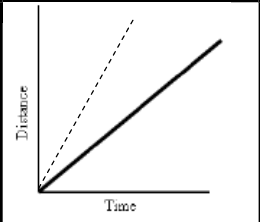
Which of these graphs represent a constant speed?

a)
b)
c)
27.

What is instantaneous speed?

a)

Overall speed of an object.

b)

Speed of an object at a specific moment.

c)

Speed that happens instantly.

d)

Distance v. time

28.

What kind of speed does this graph represent?

a)

No speed.

b)

Constant Speed.

c)

Increasing speed.

d)

Decreasing speed.

29.

The reference point allows you to determine the ______________ of an object.

a)

state

b)

position

c)

dimension

d)

speeed

30.

The difference between the initial and final position of an object is ______________________.

a)

displacement

b)

speed

c)

velocity

d)

time

31.
Force = Mass x Acceleration
a)
Newton's 1st Law
b)
Newton's 2nd Law
c)
Newton's 3rd Law
d)
Newton's 4th Law
32.
"For every action, there is an equal and opposite reaction."
a)
Newton's 1st Law
b)
Newton's 2nd Law
c)
Newton's 3rd Law
d)
Newton's 4th Law
33.
"An object in motion (or at rest) will to stay in motion (or at rest) until an outside force acts upon it."
a)
Newton's 1st Law
b)
Newton's 2nd Law
c)
Newton's 3rd Law
d)
Newton's 4th Law
34.
Which of the following is the units for acceleration?
a)
kg*m/sec/sec
b)
kg*m/sec
c)
m/sec/sec
d)
m/sec
35.
How many significant figures does the following number have: 0.002040
a)
6
b)
4
c)
3
d)
2
36.
How many significant figures does the following number have: 0.998005
a)
9
b)
10
c)
6
d)
5
37.
How many significant figures does the following number have: 100.00210
a)
7
b)
5
c)
10
d)
8
38.
Round 0.010229 to four sig figs
a)
1022
b)
1023
c)
0.01023
d)
0.01022
39.
Round 1047.78 to three sig figs
a)
104
b)
105
c)
1050
d)
1050.00
40.
What is 78.5 rounded to one significant figure?
a)
79
b)
78.5
c)
70
d)
80
41.
Calculate 0.020 cm x 50 cm x 11.1 cm and give your answer with the correct number of significant figures.
a)
10 cm3
b)
11.1 cm3
c)
11 cm3
d)
11. cm3
42.
When performing the calculation 34.530 g + 12.1 g + 1222.34 g the final answer must have
a)
Three significant figures
b)
One decimal place
c)
Two decimal places
d)
Three decimal places
43.
Velocity
a)
Vector
b)
Scalar
44.
Mass
a)
Vector
b)
Scalar
45.

17 m/s, East

a)

Vector

b)

Scalar

46.

10 mph

a)

scalar

b)

vector

47.
A hiker walks 5 kilometers due north and then 7 kilometers due east. What is the magnitude of the resultant vector?
a)
2 km
b)
8.6 km
c)
12 km
d)
12.6 km
48.
What is the net force?
100 N        230 N
<------        --------->
a)
30 N to the right
b)
230 N to the right
c)
130 N to the right
d)
This is a balanced force
49.
a)
b)
c)
d)
50.
a)
b)
c)
d)
51.
What does this graph represent?
a)
Constant Speed
b)
Acceleration
c)
Not moving
52.
At 60 seconds, how far had this object traveled? 
a)
0 m
b)
10 m
c)
20 m
d)
40 m
53.
What does this graph represent?
a)
Constant speed
b)
Acceleration
c)
Not moving
54.
What is this graph showing?
a)
Constant Speed
b)
Acceleration (speeding up)
c)
Deceleration (slowing down)
d)
No motion