wayground logo

Free Printable Worksheets

Font size

S
M
L
XL
Worksheets

Nuclear Processes

Total questions: 52

Worksheet time: 2hrs 48mins
Name
Class
Date
1.
Which process involves the joining of small nuclei?
a)
Beta decay
b)
Alpha decay
c)
Nuclear fission
d)
Nuclear fusion
2.
What is nuclear fission?
a)
Big nucleus splits to small nuclei
b)
Small nuclei fuse into a bigger nucleus
c)
Stars
d)
Making compounds
3.

Nuclear processes violate the law of conservation of mass because they involve the conversion of

a)

energy into mass.

b)

mass into momentum.

c)

mass into energy.

d)

mass into different mass.

4.
_______________ is the process by which unstable atoms emit radiation until they become stable.
a)
Radiation
b)
Chemical Reaction
c)
Radioactive Decay
d)
Isotopes
5.

_______ occurs when unstable nuclei release a helium nucleus.

a)

Alpha Decay

b)

Beta Decay

c)

Gamma Decay

d)

Gamora Decay

6.

_______ occurs when a neutron turns into a proton and the atom releases an electron.

a)

Alpha Decay

b)

Beta Decay

c)

Gamma Decay

d)

Gamora Decay

7.
If the half life of a radioactive element is 100yrs, how long would it take for the radioactivity to reduce by one half?
a)
200yrs
b)
100yrs
c)
50yrs
d)
300yrs
8.

_______ occurs when an excited nucleus releases radiation.

a)

Alpha Decay

b)

Beta Decay

c)

Gamma Decay

d)

Gamora Decay

9.

Which subatomic particles are found in the nucleus of an atom?

a)

Protons & Neutrons

b)

Just Neutrons

c)

Protons & Electrons

d)

Neutrons & Electrons

10.

Which of the following are benefits of nuclear power? (multiple select)

a)

No greenhouse gas emissions

b)

Hazardous radioactive waste

c)

High power output

d)

Potential for catastrophic meltdowns.

e)

Relatively cheap to run

11.

Which of the following are downsides of nuclear power? (multiple select)

a)

No greenhouse gas emissions

b)

Hazardous radioactive waste

c)

High power output

d)

Potential for catastrophic meltdowns.

e)

Expensive to build

12.

(T/F) Nuclear power plants contribute to global warming.

a)

True

b)

False

13.

(T/F) Nuclear power plants do not release CO2 into the atmosphere.

a)

True

b)

False

14.

(T/F) Nuclear power causes more deaths than any other power source.

a)

True

b)

False

15.

(T/F) Nuclear power causes the least amount of deaths on average out of any power source.

a)

True

b)

False

16.

How do nuclear reactions (fusion & fission) compare to chemical reactions?

a)

They both release about the same amount of energy.

b)

Nuclear reactions release much more energy.

c)

Nuclear reactions release less energy.

17.

The time it takes for half of a sample of radioactive material to decay is called...

a)

Decay Time

b)

Half Life

c)

Gamma Period

d)

Half Time

18.
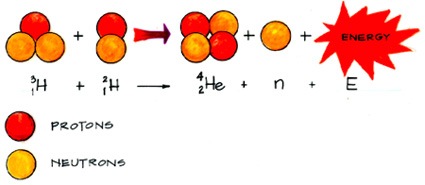
Identify elements A and B and the process, C, in the illustration below.
a)
Deuterium, Tritium, Nuclear Fusion
b)
Deuterium, Tritium, Nuclear Fission
c)
Tritium, Hydrogen, Nuclear Fusion
d)
Deuterium, Hydrogen, Nuclear Fission
19.
Two reactions occur that do not obey the Law of Conservation of Mass. The first reaction involves light elements forming heavier ones. The second reaction has heavy elements forming lighter ones. Which statement describes these reactions?
a)
Both reactions may be nuclear fusion
b)
Both reactions may be nuclear fission
c)
The first reaction is nuclear fusion, and the second is nuclear fission
d)
The first reaction is nuclear fission, and the second is nuclear fusion
20.
A nuclear fission reaction occurs when a uranium-235  atom is bombarded with a neutron. This reaction is used to produce energy in a nuclear power plant. Why is it not possible to carry out a nuclear fusion reaction in a nuclear reactor?
a)
A fusion reaction releases harmful rays
b)
A fusion reaction is difficult to control
c)
A fusion reaction requires extremely low temperature and pressure
d)
A fusion reaction requires extremely high temperature and pressure
21.
In nuclear fusion, two positively charged nuclei must touch and bind together. This requires that the nuclei approach each other at.....
a)
low temperatures and low velocity
b)
low temperatures and high velocity
c)
high temperatures and high velocity
d)
high temperatures and low velocity
22.
Which of the following statements BEST describes nuclear fission?
a)
Nuclear fission inside stars can absorb or release energy
b)
Nuclear fission causes the reaction inside an atomic bomb
c)
Nuclear fission is usually present in endothermic reactions
d)
Nuclear fission cannot be used to produce power in nuclear energy plants
23.
The half life of iodine-131 is 8.040 days. What percentage of an iodine-131 sample will remain after 40.20 days?
a)
312.5%
b)
31.25%
c)
.3125%
d)
3.125%
24.
Has a mass of 4 and a charge of +2
a)
Alpha
b)
Beta
c)
Gamma
25.
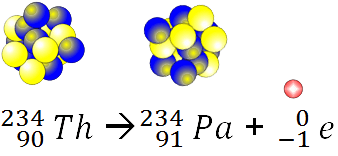
Which type of nuclear radiation is being emitted here?
a)
Alpha
b)
beta
c)
gamma 
d)
none
26.
Has the symbol
a)
Alpha
b)
Beta 
c)
Gamma
27.

What does the "E" stand for in E=mc^2?

a)

Equivalence

b)

Energy

28.

What does "M" stand for in E=mc^2?

a)

Momentum

b)

Mass

c)

Movement

29.

What does "C^2" stand for in E=mc^2?

a)

speed of light

b)

speed of light times itself

c)

mass times two

30.

Can mass be energy?

a)

Yes

b)

No

31.

Can energy be mass?

a)

No

b)

Yes

32.

Who created the equation?

a)

Kevin Hart

b)

Elmer Henley

c)

Einstein

33.
How do nuclear power-plants work?
a)
Fusion
b)
Half-life
c)
Fission
d)
Fusion or fission
34.
Where does fusion occur naturally?
a)
Underwater
b)
All around us
c)
In the radioactive waste
d)
On the sun
35.
What is a half-life?
a)
The average time it takes for any element to disappear completely 
b)
The time it takes for a radioactive atom to lose half its neutrons
c)
The time it takes for half of any number of radioactive atoms to decay
d)
The time it takes for a radioactive atom to lose half its electrons 
36.
This is an example of...
a)
Fission  reaction
b)
Fusion reaction
c)
Decomposition reaction
d)
Combustion
37.
Splitting a uranium atom is called - 
a)
fission
b)
fusion
38.
All of the following are problems of nuclear energy except ---
a)
storage of radioactive fuel
b)
air pollution
c)
security concerns
d)
natural disasters (tsunamis, earthquakes, etc.)
39.
What is an advantage  of nuclear energy?
a)
radioactive waste
b)
no air pollution
c)
we will never run out
d)
it is the safest way to make energy
40.
How do atoms with stable nuclei differ from atoms with unstable nuclei? Nuclei is the plural of nucleus.
a)
The number of particles in stable nuclei never changes; the number of particles in unstable nuclei does change 
b)
Stable nuclei contain equal numbers of protons and neutrons; unstable nuclei do not 
c)
Stable nuclei emit electrons; unstable nuclei emit protons and neutrons 
d)
Stable nuclei can be found everywhere; unstable nuclei do not occur in nature
41.
When a nucleus undergoes nuclear decay by gamma rays, the atomic number of the element....
a)
remains the same
b)
  decreases by one.
c)
increases by one.
d)
increases by two.
42.
Radioactive materials have unstable...
a)
electrons
b)
protons
c)
nuclei
d)
neutrons
43.
The type of radioactive particle that can be stopped by a sheet of paper is the ____.
a)
alpha particle
b)
beta particle
c)
gamma ray
d)
uranium
44.
The most penetrating type of radiation is the ____.  
a)
alpha particle
b)
gamma ray
c)
beta particle
d)
uranium
45.
A helium nucleus with two protons and two neutrons is called a(n) ____.  
a)
alpha particle
b)
electroscope
c)
beta particle
d)
gamma ray
46.
Negatively charged particles emitted from a nucleus at a high speed are ____.  
a)
alpha particle
b)
gamma rays
c)
beta particles
d)
X rays
47.
The three types of nuclear radiation in increasing order of penetrating power are ____.  
a)
  alpha, beta, gamma 
b)
X ray, beta, gamma
c)
alpha, gamma, beta 
d)
X ray, gamma, beta 
48.

The energy equivalent of 5.0 × 10⁻³ kg is

a)

4.5 X 10¹⁴ J

b)

1.37 X 10¹⁴ J

c)

2.25 X 10¹⁶ J

d)

2.34 X 10¹⁵ J

49.

How much energy is produced when 0.250 universal mass units of matter is completely converted into energy?

a)

2.25 X 10¹⁶ J

b)

2.34 X 10¹⁵ J

c)

1.8 X 10¹² J

d)

3.737x10^-11 J

50.

What is the energy equivalent of a mass of 0.026 kilogram?

a)

2.34 X 10¹⁵ J

b)

9 X 10¹⁶ J

c)

1.14 X 10⁻³⁰ J

d)

1.8 X 10¹² J

51.

The energy produced by the complete conversion of 2.0 × 10⁻⁵ kilogram of mass into energy is

a)

1.8 X10¹² J

b)

9 X10¹⁶ J

c)

2.25 X 10¹⁶ J

d)

1.37 X 10¹⁴ J

52.

The total conversion of 1.00 kilograms of the Sun’s mass into energy yields

a)

9 X 10¹⁶ J

b)

1.14 X 10⁻³⁰ J

c)

1.8 X 10¹² J

d)

2.34 X 10¹⁵ J