
 Worksheets
Physical/Earth Science Semester 1 Review.
Total questions: 67
Worksheet time: 2hrs 14mins
Which tectonic plate movement could form transform faults?
Plates spreading apart
Plates sliding past each other
Plates colliding and crumpling
One plate sinking under another

Which statement best explains the major difference between Wegener’s continental drift hypothesis and the theory of plate tectonics?
Wegener’s continental drift hypothesis was not supported by evidence
Wegener’s continental drift hypothesis did not give a plausible explanation for how continents move
Wegener’s continental drift hypothesis did not state that the continents were arranged into a supercontinent many millions of years ago
Wegener’s continental drift hypothesis did not give an accurate estimate for the length of time involved in continent motion
What is the main cause of Earth’s seasons?
The distance to the sun
The distance to the moon
Earth’s axial tilt
Earth’s orbit
What information did Einstein's equation E = MC^2 provide about stars?
Explains how mass is converted to large amounts of energy.
Describes nuclear fission not fusion.
Describes the Doppler effect.
Explains wavelength of light.
Scientists hypothesize that the sun formed approximately
less than a billion years ago.
4 to 5 billion years ago.
less than a million years ago.
less than a million years ago.
How do scientists determine the composition and temperature of stars?
Analyzing vibrations.
Magnetic testing.
Sampling matter on the surface of stars.
Analyzing spectra of the light that stars give off.
Similar to the sun, about 90 percent of the stars on the H-R diagram are considered to be___________stars.
Nebula.
Main Sequence
Red Dwarf.
Giant.

A__________is an object so dense that nothing, including light, can escape its gravitational field.
Supernova.
Neutron Star.
Black Hole.
Super Giant.
Dark, cooler areas on the sun's surface are associated with:
Intense magnetism.
High temperature.
the core.
black holes.
The____states that between 13 and 14 billion years ago, the universe began expanding out of an enormous explosion.
H-R Diagram.
Binary Star Theory.
Big Bang Theory.
Big Crunch Theory.
Edwin Hubble demonstrated that Red Shift in the spectrum of the light from an object indicates the object is moving _____you.
Away from.
parallel to.
at a right angle from.
none of the above.

Based on the data, which graph best represents the relationship between elevation above sea level and air pressure?
A
B
C
D
Based on the rock cycle we've discussed, what can igneous rock form as it cools?
Magma.
Sedimentary rock.
Neither A nor B.
Both A and B.

What do you use the triple beam balance to measure?
weight
mass
volume
energy
LxWxH measures?
Density
mass
displacement
volume

A graduated cylinder is used to measure?
mass
weight
volume
density


The diagram shows layers of rock, A, B, C, D, and
igneous intrusion E.
Place the rock layers in order from oldest to youngest.
D – C – B – E – A
A – B – C – D – E
E – D – C – B – A
A – E – B – C – D

Fossils were discovered in four different sedimentary rock layers as shown below.
Which best describes the age of the fish relative to the age of the fern and the age of the shell?
The fish is older than both the fern and the shell.
The fish is younger than both the fern and the shell.
The fish is older than the fern, but younger than the shell.
The fish is younger than the fern, but older than the shell.

An undisturbed rock geologic column has a fossil of a reptile species in the lowest rock layer, an index fossil that was present 1 million years ago in the middle rock layer, and a fossil of a clam species in the topmost rock layer. Which conclusion is most likely correct?
The clam species is older than one million years old.
The reptile species is older than one million years old.
The index fossil is older than the reptile species fossil.
The clam species fossil is older than the reptile species fossil.

A rock sample is arranged in four undisturbed layers, W, X, Y and Z, as shown in the diagram below.
Which is most likely true about the layers according to the law of superposition?
W is the oldest rock layer and Z is the youngest rock layer.
W is the youngest rock layer and Z is the oldest rock layer.
X is the youngest rock layer and W is the oldest rock layer.
X is the oldest rock layer and Y is the oldest rock layer.

The rock layers below were dated using the radioactive decay method.
If the layers have been undisturbed, which best represents their arrangement from bottom to top?
W, X, Y, Z
X, Y, W, Z
Z, W, Y, X
Z, Y, X, W

A section of a rock layer is shown.
The evidence in these rock layers best supports which conclusion?
The oldest fossils in this section of rock are trilobites.
Eurypterids are related to modern-day scorpions and crabs.
Eurypterids were the least common type of organism in this
section of rock.
There is some overlap in the presence of brachiopods and ammonites on Earth.

How is sediment formed?
Weathering and Erosion
Melting
Pressure


Which one is not a part the water cycle?
evaporation
convection
condensation
precipitation


Which layer of the Earth is liquid iron?
Crust
Mantle
Outer Core
Inner Core

Which of the following occurs because of convection currents?
Tectonic plates on the crust move.
The mantle increases in size.
Pressure in the crust increases.
Pressure in the crust decreases.

What is the plate boundary?
convergent
transform
divergent
congruent

What type of plate boundary?
transform
strike-slip
divergent
rift

Where is the Ring of Fire located
Atlantic Ocean
Indian Ocean
Arctic Ocean
Pacific Rim


What is a rock cycle?
an idealized cycle of processes undergone by rocks in the earth's crust, involving igneous intrusion, uplift, erosion, transportation, deposition as sedimentary rock, metamorphism.
an idealized cycle of processes undergone by rocks in the earth's crust, involving igneous intrusion, uplift, erosion, deposition as sedimentary rock, metamorphism.
an idealized cycle of processes undergone by rocks in the earth's crust, involving igneous, uplift, transportation, deposition as sedimentary rock, metamorphism.

What is the process for Metamorphic rock to become Sedimentary rock?
Heat and pressure
Erosion
Melting

Which type of wave arrives first during an earthquake?
Primary (p-wave) waves
Secondary (s-wave) waves
Rayleigh Waves
Love Waves
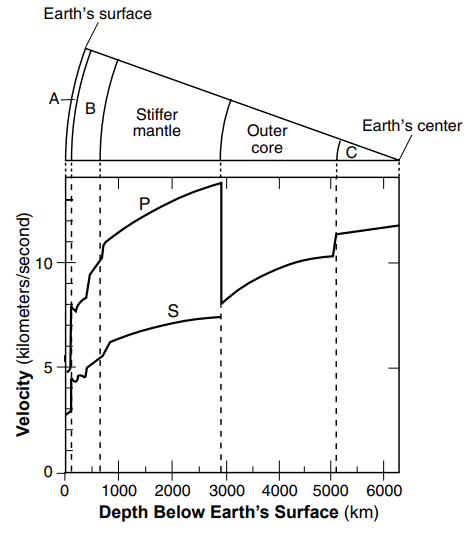
Primary (P) Waves can pass through...
solids only
liquids only
gases only
solids, liquids, and gases

An instrument that detects and measures earthquakes is a
seismogram
focus seismic map
focus
seismograph

What is Pangaea?
The name of a German Scientist
the name of the supercontinent that existed millions of years ago
another name for continental drift
the name of an ancient fossil

A subduction zone is formed.
when one tectonic plate sinks below another
at every type of convergent plate boundary
at every type of divergent plate boundary
at transform boundaries


Why is California so prone to Earthquakes?
Its is along the San Andreas fault.
There are a lot of people there.
Greenhouse gases
The Government

The "S" in S wave means?
Sight
Superstitious
Superposition
Secondary

Massive pieces of land that are part of the Earth's crust and upper mantle
Tectonic plates
Trenches
Divergent boundary
Continental shelves

