
 Worksheets
Fall ACP Review - Forces
Total questions: 35
Worksheet time: 33mins

Two objects with masses A m and B m are separated by a distance, d, and exert a force, F, on each other. What new force will exist between these objects if d is doubled as shown in the diagram?
F/2
F/4
2F
4F
If the mass of a balloon is 300 kg and the lift force provided by the atmosphere is 3300 N, what is the net force on the balloon?
Upward, 360 N
Downward, 300 N
Toward the north, 300 N
Toward the east, 360 N
A force of 24.0 N was used to push an object weighing 29.5 N along a flat frictionless horizontal surface. What is the magnitude of the acceleration achieved by the object? (Hint: find the object's mass from its weight)
0.8 m/s2
1.2 m/s2
5.5 m/s2
8.0 m/s2


A box with mass of 100 kilograms hangs from a rope. What is the tension in the rope?
100 N
10.2 N
980 N
Need more information


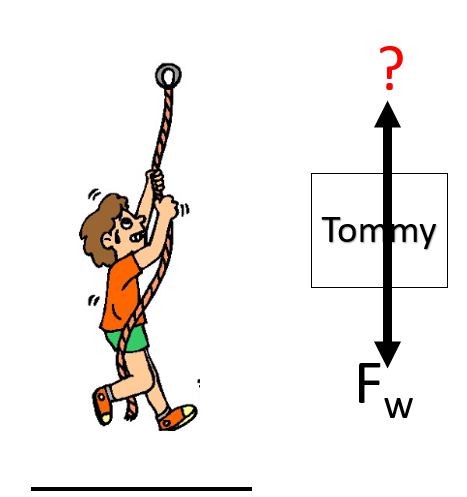
A box slides across a floor at a constant velocity. What forces act on the box?
friction, gravity
friction, tension, gravity
friction, normal force, gravity
friction, normal force, net force

If there are 2 or more forces acting on an object and the object is at rest OR in constant motion then the forces are....
Unbalanced
Unequal
Balanced
All the same

What is the net force? If the object has a mass of 50 kg, what is its acceleration?
400 N; 20000 m/s2
400 N; 8 m/s2
800 N; 16 m/s2
−800 N; - 16 m/s2
Your car has a mass of 2500 kg and a force of 5000 N. What is its acceleration?
20 m/s2
2 m/s2
0.5 m/s2
120 N
A net force of 250 N is applied to an object that accelerates at a rate of 5 m/sec2. What is the mass of the object?
50 kg
245 kg
0.02 kg
1250 kg
What is the Fgrav on a car of mass 1500 kg?
1500 N
14700 N
153.06 N
0 N
What is the mass of a hamster with a force of gravity equal to 29.4 Newtons?
288 kg
288 N
3 kg
3 N

Which FBD represents an object in constant velocity motion along a frictionless surface?
A
B
C
D

What happens to the force of gravity if the separation distance is tripled?
Fg decreases to 1/3 of the original magnitude
Fg increases to 1/3 of the original magnitude
Fg decreases to 1/6 of the original magnitude
Fg decreases to 1/9 of the original magnitude
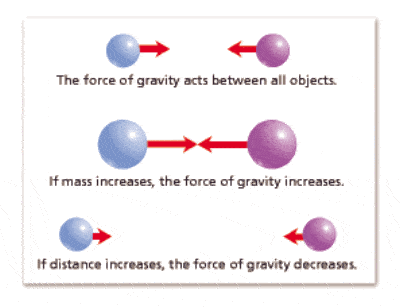
What is the Universal law of gravitation equation?
G = Fg⋅m1⋅m2/d2
Fg = G⋅m1⋅m2/d2
Fg = G⋅d2/m1⋅m2
G = Fg⋅d2/m1⋅m2
Find the force of gravity (Fg) for two objects with:
m1 = 100 kg
m2 = 1000 kg
d = 500 m
2.67 * 10-11 N
0.4 N
6.67 * 10-11 N
1.3 * 10-8 N
m1 = 6.0 * 1024 kg
m2 = 1000 kg
d = 6.4 * 106 m

Newton's second law states that an unbalanced force will accelerate an object of mass m (F = m⋅a). What happens to the acceleration if you double the force acting on this object?
It also doubles
It's cut in half
Nothing changes

