wayground logo

Free Printable Worksheets

NEW

Font size

S
M
L
XL
Worksheets

Environmental Science Chap 3 & 13 Reveiw

Total questions: 51

Worksheet time: 39mins

Name
Class
Date
1.
What are the two main factors that determine the climate of an area?
a)
precipitation and humidity
b)
temperature and air pressure
c)
wind conditions and humidity
d)
temperature and precipitation
2.
What are the 3 major climate zones in order from equator to the poles?
a)
polar, temperate, tropical
b)
tropical, temperate, polar
c)
temperate, polar, tropical
3.
Which BEST describes why latitudes closest to the equator have warmer climates?
a)
they are at lower elevations
b)
they receive more solar energy
c)
they are nearer to ocean currents
d)
they get more winds that carry energy in the form of heat
4.
What is the measure of distance in degrees north and south from the equator?
a)
latitude
b)
longitude
c)
elevation
d)
topography
5.
Which of the following can be defined as: a change in conditions that causes the Pacific Ocean to be warmer, leading to worldwide changes in weather
a)
El Nino
b)
La Nina
6.
Which of the following prevents UV rays from reaching Earth?
a)
The ozone layer
b)
The biosphere
c)
The lithosphere
d)
The hydrosphere
7.
Which type of gases are contributing to global warming?
a)
Chemical gases
b)
Greenhouse gases
c)
Oxygen
d)
Radon 
8.
The ozone layer is damaged by
a)
CFCs
b)
Increase in greenhouse gases
c)
Increased global temperatures
d)
Sulfuric and nitric acids
9.
Greenhouses gases
a)
Absorb and radiate heat
b)
Destroy the ozone layer
c)
Cause respiratory problems
d)
Create smog
10.
Which of the following are greenhouse gases?
a)
Carbon dioxide
b)
Methane
c)
Water vapor
d)
All answers are correct
11.
Increase in which gas is primarily responsible for increased global warming?
a)
Carbon dioxide
b)
Water vapor
c)
Methane
d)
Nitric oxides
12.
What is the process of water droplets or ice crystals falling from the sky?
a)
evaporating
b)
condensing
c)
precipitating
d)
runoff
13.
Where is most water found on Earth?
a)
glaciers
b)
lakes
c)
rivers
d)
oceans
14.
Which of the following removes carbon from the atmosphere?
a)
Combustion
b)
Respiration
c)
Photosynthesis
d)
Death
15.
How much of the atmosphere is composed of nitrogen gas?
a)
87%
b)
38%
c)
78%
d)
21%
16.
Photosynthesis
a)
absorbs CO2
b)
releases CO2
17.
Respiration
a)
absorbs CO2
b)
releases CO2
18.

The _______is the layer of the Earth's atmosphere closest to the surface.

a)

plates

b)

crust

c)

mesopshere

d)

troposphere

19.

Ozone molecules are made up of how many oxygen molecules?

a)

6

b)

4

c)

5

d)

3

20.

_______ is the Earth's second most abundant gas.

a)

nitrogen

b)

oxygen

c)

argon

d)

ions

21.

Phytoplankton are tiny marine algae.

a)

true

b)

false

22.

Plants need ______ to survive.

a)

wind

b)

space

c)

sunlight

23.

The ______ contains all of the water on or near the Earth's surface.

a)

mesosphere

b)

hydrosphere

c)

oceans

d)

troposphere

24.

The _____Ocean is the largest ocean.

a)

Atlantic

b)

Arctic

c)

Indian

d)

Pacific

25.

The salinity of the ocean water is the concentration of all the undissolved salt it contains.

a)

true

b)

false

26.

The atmosphere does not insulate Earth's surface.

a)

true

b)

false

27.

Most of the salt in the ocean is ____

a)

chlorine

b)

rock salt

c)

sodium chloride

d)

sodium hydroxide

28.

Earth is a _____ system.

a)

open

b)

closed

29.

There is more fresh water on Earth than salt water.

a)

true

b)

false

30.

This layer is the farthest layer from the Earth .

a)

troposphere

b)

mesosphere

c)

thermosphere

d)

stratosphere

31.

The continuous movement of water by evaporation, condensation, and precipitation is called the water cycle.

a)

true

b)

false

32.
Where you will find the ozone layer.
a)
stratosphere
b)
thermosphere
c)
exosphere
d)
mesosphere
33.
Where weather occurs.
a)
stratosphere
b)
thermosphere
c)
troposphere
d)
mesosphere
34.
Where we live.
a)
stratosphere
b)
thermosphere
c)
troposphere
d)
mesosphere
35.
Where satellites orbit.
a)
troposphere
b)
thermosphere
c)
exosphere
d)
mesosphere
36.
Water vapor is a greenhouse gas
a)
True
b)
False
37.
Things you can do to help decrease global warming include:
a)
Eat more ice cream.
b)
Keep your freezer door open.
c)
Keep your air conditioner on high.
d)
Turn off your lights when you’re not using them.
38.
Melting of glaciers and polar ice caps....
a)
will result in cooler temperatures in the Arctic
b)
will result in sea-levels rising
c)
Will have no effect on ecosystems
d)
None of the above
39.
Human activity is adding additional greenhouse gases to the amount that are in the atmosphere naturally
a)
True
b)
False
40.
The warming of the atmosphere by the trapping of heat being radiated to space is called
a)
evaporation
b)
condensation
c)
the greenhouse effect
d)
radiation
41.
Which of these sets of three items produce CFCs
a)
cars, factories, and cardboard
b)
spray cans, cardboard, insulation
c)
spray cans, refrigerant, cardboard
d)
spray cans, refrigerant, insulation
42.
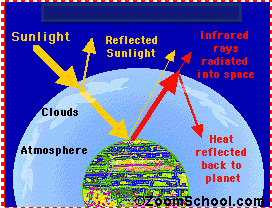
What does this diagram illustrate?
a)
Ozone Layer
b)
The Greenhouse Effect
c)
Ultraviolet Radiation
d)
Layers of the atmosphere
43.
What chemical is responsible for breaking up the ozone?
a)
CFCs
b)
Carbon Dioxide
c)
Nitrogen
d)
Oxygen
44.
Scientists say that ________ may cause the earth's temperature to rise by 3 degrees.
a)
global warming
b)
global heating
c)
world warming
d)
world heating
45.
__________ is the transfer of energy through space by electromagnetic waves.
a)
aviation
b)
conduction
c)
radiation
d)
convection
46.
Water rising and sinking as it is heated in a pot is an example of __________.
a)
radiation
b)
conduction
c)
evaporation
d)
convection
47.
The transfer of thermal energy between Earth's surface and the lowest part of the atmosphere (which is in contact with the Earth) is an example of __________.
a)
conduction
b)
convection
c)
condensation
d)
radiation
48.
This is the term for what is happening in the atmosphere at a place in a moment.
a)
Weather
b)
Temperature
c)
Forecast
d)
Climate
49.
What is the average weather in an area over a long period of time?
a)
Biome
b)
Forecast
c)
Climate
d)
Weather
50.
Without the greenhouse effect, Earth would be...
a)
Hotter than the sun
b)
.Relatively the same temperature as now
c)
Uninhabitably frigid
d)
Substantially warmer than it is now
51.

A chlorofluorocarbon molecule contains from 1 to 4 chlorine atoms. About how many ozone molecules can 1 chlorine atom destroy?

a)

4

b)

100,000

c)

40,000

d)

1