Wayground logo

Free Printable Worksheets

Font size

S
M
L
XL
Worksheets

Earth and Its Changing Features

Total questions: 99

Worksheet time: 1hrs 22mins

Name
Class
Date
1.

What is the correct definition for LANDFORMS?

a)

large amount of water covering an area of land that is usually dry

b)

when rocks and sediments are picked up and moved to another place

c)

natural formation of rock and dirt, found on Earth

d)

a large body of water

2.

Earthquakes, tsunamis, floods, and forest fires are examples of

a)

erosion

b)

natural disaster

c)

weathering

d)

exotic foods

3.

This picture shows a

a)

tornado

b)

flood

c)

landslide

d)

forest fire

4.

This picture shows a

a)

tornado

b)

flood

c)

landslide

d)

canyon

5.

Thin outer layer of the Earth on which we live

a)

Crust

b)

Crystal

c)

Cast

d)

Core

6.

When particles that have been carried along by erosion are dropped off

a)

abrasion

b)

deposition

c)

wind erosion

d)

detour

7.

Scientist who studies the structure of the Earth, rocks and minerals

a)

geologist

b)

geography

c)

guide

d)

microbiologist

8.

Process where the products of weathering are moved and carried away to somewhere else

a)

erasing

b)

deposition

c)

erosion

d)

dripping

9.

Type of weathering where water repeatedly freezes and expands inside cracks in rock

a)

root wedging

b)

forest wedging

c)

frost line

d)

frost wedging

10.

The inner core is:

a)

made up of hot liquid metal

b)

located in the center of Earth

c)

makes up the continents and the ocean floors

d)

the thickest layer

11.

The outer core is:

a)

made up of hot liquid metal

b)

located in the center of Earth

c)

makes up the continents and the ocean floors

d)

the thickest layer

12.

The mantle is:

a)

made up of hot liquid metal

b)

located in the center of Earth

c)

makes up the continents and the ocean floors

d)

the thickest layer

13.
The Earth's crust:
a)
Made up of hot liquid metal
b)
located in the center of Earth
c)
Makes up the continents and the ocean floors
d)
the thickest layer
14.

The surface of the Earth is made up of large pieces called:

a)

plates

b)

layers

c)

rocks

d)

platters

15.

It takes _____________ for mountains to form

a)

hundreds of years

b)

thousands of years

c)

millions of years

d)

hundreds of hours

16.

When the roof of a cave collapses and leaves a circular depression in the ground above, this is called a(n) ___________________________.

a)

sinkhole

b)

glacier

c)

groundwater depression

d)

none of these are correct

17.

When sediment (dirt and rocks) are moved from one location to another, it is called ____________________________.

a)

erosion

b)

weathering

c)

karst motion

d)

a volcano

18.
The process that breaks down rocks in Earth’s crust into smaller pieces
a)
weathering
b)
landform
c)
minerals
d)
fault
19.
The  movement of weathered material
a)
deposition
b)
landslide
c)
landform
d)
erosion
20.

The dropping off of pieces of rock and soil

a)

landslide

b)

transports

c)

deposition

d)

volcano

21.
The rapid downhill movement of a large amount of rock and soil
a)
transports
b)
volcano
c)
landslide
d)
fault
22.
Tiny pieces of rock wear down bigger rocks through ____________
a)
ice wedging
b)
chemical weathering
c)
abrasion
d)
deposition
23.
In deposition, __________ builds up in a place.
a)
water
b)
ice
c)
sediment
d)
carbon dioxide
24.

Earthquakes and ____________ can change Earth's surface quickly.

a)

wind

b)

volcanoes

c)

water

d)

ants

25.

__________ carries dust and soil through the air.

a)

water

b)

wind

c)

glaciers

d)

mud slides

26.

What caused this landform ?

a)

water

b)

glacier

c)

wind

d)

rain

27.

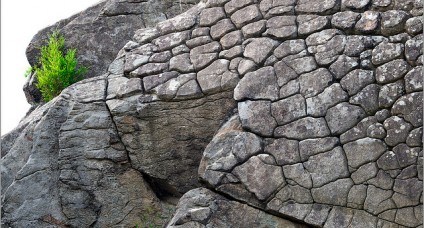
What is causing the crack in this photo?

a)

water

b)

wind

c)

root wedging

d)

frost wedging

28.

What process caused the canyon in the photo to form?

a)

chemical weathering

b)

a mudslide

c)

water erosion

d)

deposition

29.
What is weathering?
a)
When Earth material, like rock, sand, and soil are being carried away from their original location
b)
When Earth materials are broken down into smaller pieces
c)
When Earth materials, like rock, sand, and soil, are dropped or deposited into a new location.
d)
When the Earth changes quickly and it looks different from before.
30.
What is erosion?
a)
When Earth materials, like rock, sand, and soil are being carried away from their original location
b)
When Earth materials are broke down into smaller pieces
c)
When Earth materials, like rock, sand, and soil, are dropped or deposited into a new location
d)
When the Earth changes quickly and it looks different from before
31.
What do all of these words have in common? landslide, flood, earthquake, volcanic eruption
a)
They are all rapid processes
b)
They are all slow processes
c)
They are all landforms
d)
They are all water features
32.
Which rapid process occurs when the plates of Earth shift rapidly and the surface of the ground shakes and rolls causing damage to Earth's surface, like cracks, and other openings, and damage to roads and buildings?
a)
landslide
b)
earthquake
c)
flood
d)
volcanic eruptions
33.
What is deposition?
a)
When Earth materials, like rock, sand, and soil are being carried away from their original location.
b)
When Earth materials are broken down into smaller pieces.
c)
When Earth materials like rock, sand, and soil, are dropped or deposited into a new location.
d)
When the Earth changes quickly and it looks different from before.
34.
What event can cause most landslides?
a)
Too much rain soaking the ground of a mountain and making the soil loose.
b)
Too much shaking of the Earth's water
c)
Too much lava coming out of a volcano during an eruption
d)
Too much wind blowing the side of a mountain.
35.
Which of the following is in the picture?
a)
volcanic eruption
b)
landslide
c)
weathering of the rocks
d)
flood
36.
What are the agents of erosion?
a)
mudflow, plateaus, valleys
b)
gravity, running water, glaciers, waves, and wind
c)
weathering
d)
sediment, deposition, 
37.
The material moved by erosion is called
a)
soil
b)
rocks
c)
sediment
d)
agent
38.
What is it called when rock and soil move very slowly downhill
a)
landslide 
b)
mudflow 
c)
slump
d)
creep
39.
Which of the following shows the correct order of the layers of the earth, from outside to middle?
a)
crust, mantle, inner core, outer core
b)
mantle, crust, outer core, inner core
c)
crust, mantle, outer core, inner core
d)
inner core, outer core, mantle, crust
40.
Which layer is made of molten iron and nickel?
a)
inner core
b)
outer core
c)
crust
d)
mantle
41.
Sabrina found a rock in Indiana that contained a fossil of a fish.  Which conclusion could she draw from her discovery?
a)
Sedimentary rocks only can be found in Indiana.
b)
All rock types could be found in Indiana.
c)
Indiana used to be under water.
d)
The rock was carried by erosion.
42.
The process by which running water, wind, or ice carry away bits of broken-up rock
a)
weathering
b)
sedimentation
c)
erosion
d)
cementation
43.
The process by which sediments settle out of water or wind
a)
deposition
b)
cementation
c)
weathering
d)
erosion
44.
The process that breaks up rock on Earth's surface?
a)
deposition
b)
erosion
c)
compaction
d)
weathering
45.
How does wind abrasion work?
a)
Sediment is blown off a surface from wind.
b)
Wind-blown sediment strikes a surface.
c)
Wind blows large chunks of rock off a surface.
d)
Sediment falls off of a surface on its own.
46.
What causes dunes to form?
a)
glacial deposits
b)
mountain building
c)
blowing wind
d)
movement along faults
47.
A break in the Earth's crust 
a)
fault 
b)
mountain
c)
plate
d)
fossil 
48.
Which landform is created by running water cutting deep into the earth?
a)
Canyon
b)
Delta
c)
Mountain
d)
Dune
49.
Which landform is created by plates pushing together?
a)
Canyon
b)
Delta
c)
Mountain
d)
Sea arch
50.
Which landform is created by blowing wind?
a)
Canyon
b)
Sand dune
c)
Delta
d)
Mountain
51.
Which landform is created by deposition of sediments at the mouth of a river?
a)
Dune
b)
Canyon
c)
Delta
d)
Glacier
52.
Which of these things cause weathering?
a)
Wind
b)
Water
c)
Ice
d)
All of these
53.
Which of Earth's layers is found at the center, is the hottest layer, and is made of solid metal?
a)
crust
b)
mantle
c)
inner core
d)
outer core
54.
What is the thinnest, outermost layer of Earth called?
a)
crust
b)
mantle
c)
outer core
d)
inner core
55.
The mantle is made of hot, soft rock called...
a)
lava
b)
magma
c)
plates
d)
faults
56.
An opening in Earth's crust through which lava flows is called ...
a)
an earthquake
b)
the mantle
c)
a volcano
d)
a mountain
57.
Earth's crust is broken up into several large rocky pieces called ...
a)
plates
b)
faults
c)
fossils
d)
puzzle pieces
58.
Large cracks where the pieces of Earth's crust move (bend or break) are called...
a)
plates
b)
valleys
c)
volcanoes
d)
faults
59.
When Earth's plates rub or scrape against one another, the release of energy causes ...
a)
a volcano
b)
an earthquake
c)
a tornado
d)
continental drift
60.
The process that breaks down rocks into sediment is called...
a)
erosion
b)
a landslide
c)
weathering
d)
an avalanche
61.
The process that carries sediment away from one place to another is called...
a)
erosion
b)
weathering
c)
waterfall
d)
landslide
62.

What happens to rock when it weathers?

a)

It settles out of the water carrying it.

b)

It creates a valley.

c)

It forms a delta.

d)

It breaks into small pieces.

63.

When water fills cracks in rocks and freezes, it can break rocks apart. This happens because water ______________ when it freezes.

a)

contracts

b)

evaporates

c)

expands

d)

condenses

64.

Is abrasion an example of physical or chemical weathering?

a)

physical

b)

chemical

65.

Does acid rain describe physical or chemical weathering?

a)

physical

b)

chemical

66.

Is freezing an example of physical or chemical weathering?

a)

physical

b)

chemical

67.

Do tree roots cause physical or chemical weathering?

a)

physical

b)

chemical

68.

Caves are most likely to form from the chemical weathering of which kind of rock?

a)

granite

b)

limestone

c)

basalt

d)

sandstone

69.
How does a tsunami form?
a)
A crustal giant sneezes sending a wave crashing to the shore.
b)
Too many cruise liners trying to dock at the same time.
c)
From energy released by an undersea earthquake.
d)
Tsunamis are not real.
70.

What causes earthquakes and volcanoes?

a)

Plate movement

b)

The moon's pull on the Earth

c)

Solar flares

d)

The Earth's tilt

71.

What force has caused the fastest change in Earth’s environment in the last 50 years?

a)

Erosion

b)

Human actions

c)

Weathering

d)

Volcanic eruptions

72.

What is the main force that carved out the Grand Canyon?

a)

glaciers

b)

wind

c)

water

d)

humans

73.

What is the correct order of occurrence?

a)

deposition, erosion, weathering

b)

erosion, weathering, deposition

c)

erosion, deposition, weathering

d)

weathering, erosion, deposition

74.

Acid rain destroys statues and cemeteries. It's an example of:

a)

chemical weathering

b)

abrasion

c)

erosion

d)

mechanical/physical weathering

75.

There are many forces that cause weathering and erosion. But the number one case is:

a)

glaciers

b)

wind

c)

water

d)

temperature change

76.

What pulls pieces of rock down a mountain to cause a landslide?

a)

abrasion

b)

gravity

c)

erosion

d)

deposition

77.
Wind, water, gravity, plants & animals are all causes of _________.
a)
chemical weathering
b)
mechanical weathering
c)
oxidation
d)
mass movement
78.
What is it called when wind blows sand & silt against exposed rock, eventually wearing away the rock's surface?
a)
erosion
b)
abrasion
c)
chemical weathering
d)
oxidation
79.
As a glacier moves across land it is carrying sediments. These sediments are cutting into the rock it's passing over. What processes are happening at the same time?
a)
The moving & the cutting are both erosion
b)
The moving is erosion & the cutting is weathering.
c)
The moving & the cutting are both weathering.
d)
The  moving is weathering & the cutting is deposition.
80.
Which of these was most likely formed by water?
a)
a mountain range
b)
a desert
c)
a sand dune
d)
a canyon (like the Grand Canyon)
81.
Sediment that is left behind in rivers lakes and oceans
a)
weathering
b)
erosion
c)
cementation
d)
deposition
82.

Which of the following is Earth's surface layer?

a)

core

b)

crust

c)

mantle

d)

plate

83.

The Theory of Continental Drift says

a)

Earth's surface is made up of moving plates

b)

Earth's continents are moving

c)

ocean water around the continents is drifting

d)

the continents are worn down by erosion

84.

Which of the following is true about Earth's plates?

a)

They rise and fall within the mantle

b)

They are made of soft rocks that flow like liquid

c)

They are pieces of rock that never move

d)

They are pieces of rock that constantly move.

85.

Where two tectonic plates meet it is called a

a)

zone

b)

boundary

c)

edge

d)

line

86.

Earthquakes most commonly occur

a)

at night

b)

during thunder storms

c)

in valleys

d)

at plate boundaries

87.

The hottest and densest layer of earth is

a)

inner core

b)

outer core

c)

mantle

d)

crust

88.

Which of the following is an example of chemical weathering?

a)

Splits in a rock due to tree roots

b)

Pulverized rock resulting from a landslide

c)

A rock broken into chunks after being carried by rapidly flowing water

d)

The dissolving of limestone by acid rain

89.

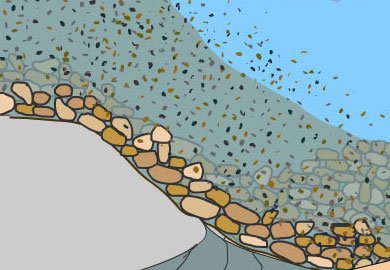
In the jar shown, a sample of soil was mixed with water and then allowed to settle for 24 hours. The jar serves as a model for what process?

a)

Evaporation of water from a muddy pond

b)

Formation of soil from parent material

c)

Deposition of sediment in a lake bed

d)

Erosion of rock particles by water

90.

Which layer of the soil profile would be affected the most by weathering and erosion?

a)

1

b)

2

c)

3

d)

4

91.

Which of the following is the cause of erosion?

a)

Wind

b)

Water

c)

Ice

d)

All of the above

92.
Volcanic belts form along
a)
islands in the Pacific Ocean
b)
North American mountain ranges
c)
the boundaries of Earth's plates
d)
the coast of Antarctica
93.
an opening of Earth from which lava, ash, and steam escape
a)
layer
b)
dangerous
c)
erupt
d)
volcano
94.

How do volcanoes form islands?

a)

Ash from a volcano becomes soil when it cools down.

b)

Layers of lava build up over time and appear above water.

c)

Many volcanoes join together to form a flat piece of land.

95.

Deposition is likely to occur along the outside of a river bend because the water?

a)

changes direction

b)

flows across soil

c)

warms up

d)

slows down

96.

You helped your family pour concrete last fall. In the spring, you observe these small plants starting to grow in the cracks. What do you think will likely happen if these plants are left to grow?

a)

the plant roots will cause the concrete to break apart

b)

the plants will die and the cracks will get smaller

c)

the concrete will absorb the plants

d)

the cracks in the sidewalk will heal

97.

What is the first job of the cleanup crew after an oil spill?

a)

To make the oil thinner

b)

To keep the oil from spreading

c)

to go to lunch

d)

to pay someone else to clean up the mess

98.

What environment does an OIL SPILL effect most DIRECTLY?

a)

forests

b)

grassland

c)

oceans

d)

deserts

99.
How can we prevent an oil spill?
a)
Recycle
b)
decrease greenhouse gases
c)
secure pipelines and oil transports
d)
Fish less