

wayground logo

Free Printable Worksheets

Font size

S
M
L
XL
Worksheets

United States History Fall 2019 Review

Total questions: 122

Worksheet time: 41mins

Name
Class
Date
1.
What brought the original colonists from England to Jamestown?
a)
the search for food
b)
the search for gold and silver
c)
the search for tobacco
d)
the search for religious freedom
2.
Columbus went _____________ from Europe to try to reach Asia. 
a)
north
b)
south
c)
east
d)
west
3.
During the Age of Exploration, Europe looked for sea routes to the East in order to __________.
a)
find a faster trade route to Asia
b)
spread Christianity
c)
colonize new territories
d)
all of the above
4.
Which of these best descirbes the environment of New England colonies?
a)
long, hot summers and mild winters
b)
harsh winters and rocky, hilly land
c)
broad coastal plains and fertile soil
d)
broad rivers, swamps, and wetlands
5.
One colony was founded on the hope it would serve as a buffer to  the Spanish territory. What region was this colony in?
a)
New England
b)
Middle
c)
Southern
d)
All colonies
6.
Which of the three colonial regions was the most dependent on the ocean for its economy?
a)
New England
b)
Middle 
c)
Southern
d)
All Colonies
7.

True or False: Jamestown colonists faced starvation and disease.

a)

True

b)

False

8.
True or False: New England economy was based on tobacco
a)
True
b)
False
9.
True or False: Economy of Middle Colonies was based on trade and staple crops.
a)
true
b)
false
10.
Which was the biggest impact Europeans had on Native Americans?
a)
introduced new animals as a source of meat
b)
introduced new plants as a source of food
c)
introduced new religion to help civilize the native population
d)
introduced new diseases that devastated the native population
11.
In the triangular trade routes, what was the leg of the trip called that brought Africans to the New World?
a)
Slave Trade Passage
b)
Slave Passage
c)
African Passage
d)
Middle Passage
12.

Took over the colony after people looked for gold and silver instead of getting food for the winter. Said, "If you don't work, you don't eat!"

a)

John Winthrop

b)

John Brown

c)

John Locke

d)

John Smith

13.

People who signed contracts to work for 4-7 years for those who paid for their journey to America are called

a)

slaves

b)

indentured servants

c)

Puritans

d)

Pilgrims

14.

Attack led by a former indentured servant and his followers when Jamestown began taxing them

a)

Toleration Act of 1649

b)

Mayflower Compact

c)

Bacon's Rebellion

d)

Fundamental Orders of Connecticut

15.

Bill that made it a crime to limit or restrict religious rights of Christians in Maryland.

a)

Toleration Act of 1649

b)

Fundamental Orders of Connecticut

c)

Bacon's Rebellion

d)

Mayflower Compact

16.

Protestant group who wanted to reform or purify the Anglican Church.

a)

Pilgrims

b)

Puritans

c)

Christians

d)

Anglicans

17.

Group that wanted to separate from the Church of England and avoid religious persecution.

a)

Pilgrims

b)

PUritans

c)

Anglicans

d)

Catholics

18.

Leader of a group of Puritans who left seeking religious freedom and helped found Massachusetts Colony

a)

John Locke

b)

John Smith

c)

John Wintrhop

d)

Jonathan Edwards

19.

This act reduced the powers of the English monarch while increasing the power of Parliament

a)

English Bill of Rights

b)

Toleration Act of 1649

c)

Mayflower Compact

d)

Fundamental Orders of Connecticut

20.

Religious movement that swept through the colonies in the 1730s and 1740s and changed colonial religion

a)

Enlightenment

b)

salutary neglect

c)

Great Awakening

d)

Mayflower Compact

21.

Movement that took place in the 1700s and spread the idea that reason and logic could improve society

a)

Enlightenment

b)

salutary neglect

c)

Great Awakening

d)

Mayflower Compact

22.

Hands off policy where Britain interfered very little in colonial affairs

a)

Enlightenment

b)

salutary neglect

c)

Great Awakening

d)

Mayflower Compact

23.

Georgia, South Carolina, North Carolina, Virginia and Maryland make up the

a)

Middle Colonies

b)

New England Colonies

c)

Southern colonies

24.

Massachusetts, New Hampshire, Rhode Island, and Connecticut make up the

a)

New England Colonies

b)

Middle Colonies

c)

Southern Colonies

25.

New York, New Jersey, Pennsylvania and Delaware make up the

a)

New England Colonies

b)

Middle Colonies

c)

Southern Colonies

26.

The group of colonies known as the Bread Basket Colonies were located in this region

a)

New England

b)

Middle

c)

Southern

27.

Control of the ______________ River Valley was the main cause of the French and Indian War

a)

Mississippi

b)

Missouri

c)

Ohio

d)

Colorado

28.

This treaty ended the French and Indian War

a)

Treaty of Versailles

b)

Treaty of Guadalupe Hidalgo

c)

Treaty of Paris of 1763

d)

Treaty of Ghent

29.

The English government wanted to use Georgia as

a)

a buffer colony and a military outpost

b)

a debtors colony

c)

a colony for prisoners

d)

a tobacco growing colony

30.

What were the 2 main reasons for the French and Indian War?

a)

Control of land and trade with Native Americans

b)

land and slaves

c)

gold and religion

d)

religion and taxes

31.

Why was George Washington sent to the Ohio River Valley before the French and Indian War?

a)

to talk to the French

b)

to drive out the Spanish

c)

to drive out the French

d)

to negotiate a treaty with the Indians

32.

After the French and Indian War, who controlled most of Canada and land east of the Mississippi River?

a)

Britain

b)

France

c)

Spain

33.

How did the outcome of the French and Indian War (Treat of Paris of 1763) affect who controlled North America?

a)

Spain lost all control of its territory in North America

b)

Britain lost all control of its territory in North America

c)

France lost all control of its territory in North America

34.

Based on the Treaty of Paris of 1763...

a)

the British gained all the land west of the Mississippi River

b)

Spain gained all the land west of the Mississippi River

c)

France gained all the land west of the Mississippi River

35.

Based on the Treaty of Paris, who had to give up Florida and give it to Britain?

a)

France

b)

Spain

c)

Neither

36.

As a result of the cost of the French and Indian war, what did King George III do to the colonists?

a)

Killed them

b)

Removed them from the land in the colonies just like the Indians.

c)

Imposed taxes to pay for the war

d)

Paid for the war out of his own pocket
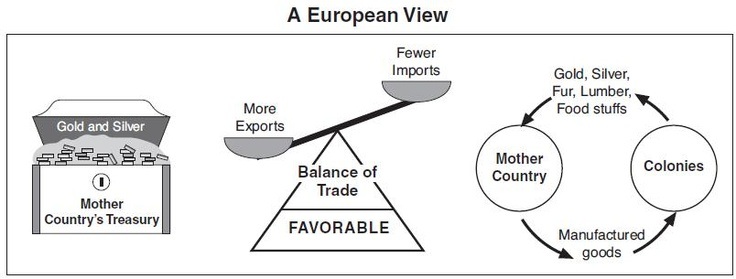
37.

What is mercantilism?

a)

A system where a mother countries gains money and power from natural resources that come from its colonies.

b)

where colonies trade gold and silver with each other.

c)

Wars that start over money.

d)

Plantation colonies trading slaves for money.

38.

What significant outcome of the French and Indian War eventually led to the American Revolution?

a)

Britain placed its colonies under strict control and began taxing them to help pay for the war.

b)

Britain expected colonists to fight the war at their own expense and offered no reimbursement.

c)

The loss of colonial territory to the French made colonists lose faith in the British government.

d)

Britain did not offer aid to colonists during the war but still declared sovereignty over them.

39.

Who was the French and Indian War fought between?

a)

French vs. British

b)

French vs. Native Americans

c)

British vs. Native Americans

d)

British vs. Dutch

40.
The French and Indian War, unfair taxes in the colonies, along with many other events all led to what eventually?
a)
World War I
b)
American Revolution
c)
World War II
d)
Civil War
41.

The French and Indian War as primarily fought over what piece of land?

a)

Ohio Mountain State

b)

Appalachian Mountains

c)

Canada

d)

Ohio River Valley

42.
A snowball fight between the colonists and soldiers in Boston that ended in 5 colonists being killed was called
a)
Boston Tea Party
b)
Boston Massacre
c)
Boston Party
d)
Boston Parliament
43.
A secret organization formed to protest the Stamp Act was called
a)
Congress
b)
Sons of Liberty
c)
Parliament
d)
Loyalists
44.
Great Britain was responsible for making the laws for the colonists, similar to our Congress. What was this group called? 
a)
Senate
b)
House of Representatives
c)
Congress
d)
Parliament
45.
The Sons of Liberty dumped tea into the Boston Harbor. This act of protest is known as 
a)
the Boston Tea Party
b)
the Stamp Act
c)
Committees of Correspondence
d)
Boston Massacre
46.
American colonists were asked to help cover the cost of the French and American War by paying
a)
Patriots
b)
snowballs
c)
taxes
d)
boycott
47.
Many colonists did not want to remain loyal to Great Britain and King George. They wanted to be free from British rule. These colonists were called 
a)
Patriots
b)
Republicans
c)
Democrats
d)
Loyalists
48.
Colonists who supported the Bitish king were called 
a)
Patriots
b)
Republicans
c)
Democrats
d)
Loyalists
49.
The tax on all items in the colonies made of paper was called the
a)
Stamp Act
b)
Sugar Act
c)
Townshend Act
d)
Boston tea Party
50.
Who rode to Lexington from Boston to warn the militia to prepare to fight?
a)
George Washington
b)
Paul Revere
c)
Benedict Arnold
d)
Thomas Jefferson
51.
The 13 colonies were fighting for freedom from England. What is another word for freedom? 
a)
taxes
b)
tariff
c)
liberty
d)
patriot
52.
Why were the colonists angry about "taxation without representation?"
a)
The colonists wanted to pay taxes on stamps and tea
b)
The colonists had no representation in Parliament
c)
The colonists fought to write the Declaration of Independence
d)
The colonists were loyal to the British and wanted to keep them happy
53.

The Quartering Act required _________?

a)

Colonists to be Catholic

b)

Colonists to house and feed soldiers

c)

You to have a stamp on all paper goods

54.

What were the Townshend Acts?

a)

Tax on imported tea, glass, paper, and other items

b)

When Colonists threw tea into the harbor

c)

Says that King George III had full control over 13 colonies

55.

How many Colonists died in the Boston Massacre?

a)

None

b)

5

c)

25

d)

100

56.

Who led the Committees of Correspondence?

a)

John Adams

b)

George Washington

c)

Samuel Adams

57.
Where were the first armed conflicts of the American Revolution?
a)
Yorktown
b)
Saratoga
c)
Lexington and Concord
d)
Bunker Hill
58.
What was the name of the British king during the American Revolution?
a)
Charles III
b)
George III
c)
William III
d)
James III
59.
This American victory was the turning point in the war.
a)
Saratoga
b)
Yorktown
c)
Bunker Hill
d)
Lexington and Concord
60.
Who was the major author of the Declaration of Independence?
a)
Benjamin Franklin
b)
John Adams
c)
Thomas Jefferson
d)
Patrick Henry
61.
Surrounded by French and Continental armies, a large British army surrendered here.
a)
Saratoga
b)
Yorktown
c)
Bunker Hill
d)
Lexington and Concord
62.
This member of the Continental Congress helped gain French support for American independence.
a)
Thomas Jefferson
b)
Benjamin Franklin
c)
Patrick Henry
d)
John Adams
63.
What event is depicted in this image?
a)
Boston Massacre
b)
Boston Tea Party
c)
Battle of Bunker Hill
d)
Lexington and Concord
64.
Of the following events, which happened first? 
a)
Saratoga
b)
Yorktown
c)
Declaration of Independence
d)
Treaty of Paris of 1783
65.
Of the following events, which happened last?
a)
First Continental Congress
b)
Boston Massacre
c)
Boston Tea Party
d)
Stamp Act
66.
Of the following people, who did not help write the Declaration of Independence?
a)
Thomas Jefferson
b)
Patrick Henry
c)
John Adams
d)
Benjamin Franklin
67.
Which one of these is not an advantage that helped the American patriots defeat Great Britain.
a)
defense of their own land, principles and beliefs
b)
support from France
c)
superior numbers of soldiers and greater experience
d)
strong leadership from men like George Washington
68.
What patriot leader is represented by this image?
a)
John Adams
b)
Samuel Adams
c)
Paul Revere
d)
Patrick Henry
69.
The U.S. was founded on July 4, 1776, by the approval of this document.
a)
the Treaty of Paris
b)
the Constitution
c)
the Declaration of Independence
d)
the Virginia Charter
70.
The location of what event is shown on this map?
a)
Lexington and Concord
b)
First Continental Congress
c)
Saratoga
d)
Yorktown
71.
Under the Articles of Confederation, the government consisted of _______________ branch of government.
a)
3
b)
2
c)
1
d)
4
72.
Under the Articles of Confederation Congress could only pass a law if ____________ out 13 states agreed. 
a)
13
b)
8
c)
9
d)
10
73.
One weakness of the Articles of the Confederation was ____________. 
a)
The ability of Congress to tax.
b)
The inability of Congress to tax.
c)
The ability of Congress to declare war.
d)
The ability of Congress to create courts.
74.
In order to change (amend) the Articles of Confederation,  __________ out of 13 states had to agree. 
a)
9
b)
10
c)
13
d)
15
75.
Under the Articles of Confederation, America used a national currency (money)
a)
True
b)
False
76.
Under the Articles of Confederation, Congress could regulate trade between the states.
a)
true
b)
false
77.
The Supreme Court under the Articles of Confederation was made up of 9 Justices.
a)
True
b)
False
78.

Under the AOC representation in Congress was based upon a state's population.

a)

true

b)

false

79.
Under the Articles of Confederation, each state got __________ vote. 
a)
b)
2
c)
1
d)
5
80.
The Articles of Confederation created a _________________ type of government.
a)
strong
b)
average
c)
weak
d)
federal
81.
The Great Compromise solved the problem of both big and small states wanting representation. 
a)
True
b)
False
82.
The Three-Fifths Compromise help settle the debate over whether to count slaves in the population or not.
a)
True
b)
False
83.
Federalist SUPPORT a strong, national government and creating a new constitution.
a)
True
b)
False
84.
Anti-federalists SUPPORTED making a new constitution.
a)
True
b)
False
85.
Which compromise is made up of ideas from the Virginia Plan and the New Jersey plan?
a)
The Great Compromise
b)
The three-fifths compromise
c)
The constitutional compromise
d)
The big compromise
86.
What is the name of the first Constitution?
a)
Articles of Confederation
b)
Articles of Incorporation
c)
The Federalist Papers
d)
The Great Constitution 
87.
Which group of people wanted the Constitution to include a Bill of Rights?
a)
Federalists
b)
Anti-federalists
c)
Democrats
d)
Northerners
88.
Which of the following is NOT a branch of the government?
a)
Legislative
b)
Judicial
c)
Executive
d)
Constitutional
89.
The Federalists papers were written to persuade people to support the new constitution.
a)
True
b)
False
90.
Which one of the following is not a guaranteed freedom found in the First Amendment?
a)
Right to own a gun
b)
Right to freedom of Speech
c)
Right to  petition the government
d)
Right to assemble peacefully
91.
______ is the belief that the government gets its power from the people.
a)
Rule of Law
b)
Popular Sovereignity
c)
Checks and balances
d)
Federalism
92.
The first ten Amendment to the Constitution are called the  _______.
a)
Bill of Rights
b)
Preamble
c)
Articles
d)
Naturalization
93.
The Constitution replaced the ______ as the governing document of the country.
a)
Declaration of Independence
b)
Bill of Rights
c)
Emancipation Proclamation
d)
Articles of Confederation
94.
The _______ is the opening paragraph of the Constitution.
a)
Article 1
b)
Preamble
c)
Bill of Rights
d)
Prelude
95.
Which branch executes the laws?
a)
Executive
b)
Judicial
c)
Appellate
d)
Legislative
96.
Which branch interprets the laws?
a)
Executive
b)
Judicial
c)
Appellate
d)
Legislative
97.
Which branch makes the laws?
a)
Executive
b)
Judicial
c)
Appellate
d)
Legislative
98.
What is the name for a change or addition to the Constitution?
a)
Federalism
b)
Amendment
c)
Ratification
d)
Veto
99.
citizens elect representatives to carry out their will
a)
popular sovereignty
b)
federalism
c)
individual rights
d)
republicanism
100.
Patrick Henry opposed the Constitution because...?
a)
The states would give too much power to the Federal government
b)
The Federal government would give too much power to the states
c)
He was the main author of the Articles of Confederation
d)
He wanted the U.S. to be part of England again
101.
George Mason refused to sign the Constitution because...?
a)
He felt that it did not do a good enough job protecting individual rights
b)
He felt that the executive branch did not have enough power over the military
c)
The legislative branch was weaker then the executive branch
d)
He wanted to be President
102.

What state was George Washington born?

a)

North Carolina

b)

Virginia

c)

South Carolina

d)

South Carolina

103.
The President's cabinet is best described as a:
a)
political party
b)
group of members of Congress
c)
group of the President's advisors
d)
the place where the President keeps his Wheaties
104.
The biggest Domestic policy problem faced by President Washington was:
a)
The National Debt
b)
The Jordhamo Crisis
c)
The war between Britain and France
d)
Attacks on American ships
105.
Washington's Secretary of the Treasury was:
a)
Benjamin Franklin
b)
Thomas Jefferson
c)
John Adams
d)
Alexander Hamilton
106.
In order to get Southerners to agree to pay off Northern state debts, Alexander Hamilton agreed to:
a)
but a tax on whiskey
b)
move the capital to Washington DC
c)
support the British in their war against France
d)
create a National Bank
107.
A tax on imports is called a:
a)
whiskey tax
b)
tariff
c)
cabinet
d)
bond
108.
A tariff can help American industry by:
a)
making foreign goods more expensive
b)
making foreign goods illegal
c)
improving the quality of American goods
d)
All of these
109.
Which of the following was taxed under Hamilton's plan?
a)
corn
b)
tea
c)
cotton
d)
whiskey
110.
The only President without a political party was:
a)
Washington
b)
Adams
c)
Jefferson
d)
Hamilton
111.
The Neutrality Proclamation stated that:
a)
America would not be involved in foreign affairs
b)
America would not be involved in the war between Britain and France
c)
America would not trade with Britain or France
d)
All of these
112.
Jay's treaty stated that:
a)
Britain was sorry for attacking U.S. ships
b)
Britain would pay for U.S. ships it destroyed
c)
The U.S. would not trade with France
d)
The British would stop attacking U.S. ships
113.
The Democratic Republican Party was created by supporters of:
a)
George Washington
b)
John Adams
c)
Thomas Jefferson
d)
Alexander Hamilton
114.
Supporters of Alexander Hamilton created which Political Party?
a)
Federalist
b)
Democratic-Republican
c)
Whig
d)
Tupperware
115.
Who supported the tariff?
a)
Hamilton
b)
Jefferson
116.
Who supported France in foreign policy?
a)
Hamilton
b)
Jefferson
117.
Who opposed the National Bank?
a)
Hamilton
b)
Jefferson
118.
Who wanted the United States to focus on industry and trade?
a)
Hamilton
b)
Jefferson
119.
Who opposed the tariff?
a)
Hamilton
b)
Jefferson
120.
Who supported Britain in foreign policy?
a)
Hamilton
b)
Jefferson
121.
Who is this guy?
a)
Hamilton
b)
Jefferson
c)
Washington
d)
Adams
122.
Who is this guy?
a)
Hamilton
b)
Jefferson
c)
Washington
d)
Adams
