wayground logo

Free Printable Worksheets

NEW

Font size

S
M
L
XL
Worksheets

Chapter 9B review: ions/isotopes/radioactivity

Total questions: 39

Worksheet time: 32mins

Name
Class
Date
1.
What is emitted during Beta Radiation?
a)
A high-energy Electron.
b)
Protons.
c)
Neutrons.
d)
Nuclei
2.
What is emitted during Gamma Radiation?
a)
Particles.
b)
Protons
c)
Beta Rays.
d)
Gamma Rays.
3.
TRUE or FALSE: gamma changes the atomic number.
a)
True
b)
False
4.

If the atomic mass is 200, and alpha radiation is used, what is the atomic mass of the "new" atom?

a)
200
b)
198
c)
196
d)
194
5.
Alpha makes the atomic number decrease by how many? 
a)
1
b)
2
c)
3
d)
5
6.
Isotopes of the same element have different ____________. 
a)
 numbers of protons  
b)
numbers of electrons
c)
 symbols 
d)
numbers of neutrons
7.

In Alpha decay, the atomic number decrease by _________

a)

1

b)

2

c)

3

d)

5

8.
What makes something radioactive?
a)
elements with an atomic number above 81
b)
an unstable nucleus
c)
contaminated sewage
d)
It decays over time
9.

_______________ is when an unstable atoms breaks down emit radiation until they become stable.

a)

Radiation

b)

Chemical Reaction

c)

Radioactive Decay

d)

Isotopes

10.
A beta particle consists of fast moving electron & has a(n) __________ charge.
a)
Positive
b)
Negatuve
c)
Negative
11.
Which particle has a positive charge?
a)
electron
b)
orbital
c)
proton
d)
neutron
12.
Choose the particle that has no charge.
a)
nucleus
b)
neutron
c)
proton
d)
electron
13.
This particle determines what element you have - the elements identity.
a)
electron
b)
proton
c)
neutron
d)
valence shell
14.
Which particles make up the nucleus of an atom?
a)
protons and neutrons
b)
electrons and protons
c)
electrons, protons, and neutrons
d)
electrons and neutrons
15.
What is the number of protons that the element in this image contain?
a)
14
b)
7
c)
15
d)
18
16.
The rate at which a radioactive element decays is its ____.
a)
quarter life
b)
whole life
c)
wonderful life 
d)
half life
17.
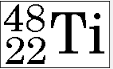
How many protons does this isotope of titanium have?
a)
48
b)
22
c)
26
d)
70
18.
How many neutrons does the isotope of lithium have?
a)
8
b)
3
c)
4
d)
5
19.
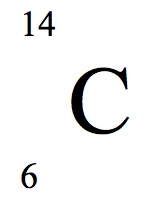
which explanation of this notation is correct?
a)
 12 is proton #
b)
6 tells you there are 6 neutrons
c)
6 tells you there are 6 protons
d)
12 is not a mass # here
20.
How many neutrons in C-14?
a)
6
b)
7
c)
14
d)
8
21.

In what part of an atom can protons be found?

a)

in the electron cloud

b)

inside the neutrons

c)

inside the atomic nucleus

d)

in the area of mostly open space

22.
The photo above shows the isotopic notation for which isotope?
a)
Carbon 12
b)
Carbon 13
c)
Carbon 14
d)
Carbon 15
23.
An atom becomes _________ when it gains electrons.
a)
Positive
b)
Negative
c)
Neutral
d)
Invinsible
24.

Smallest unit of matter, contains subatomic particles

a)

compound

b)

atom

c)

electron

d)

nucleus

25.

Can identify the age of fossils using C-14

a)

radioactive dating

b)

tracer

c)

alpha decay

d)

nucleus

26.

Atom with a charge

a)

neutral

b)

proton

c)

ion

d)

isotope

27.

a use for radioactivity, used in medical field

a)

tracer

b)

C-14

c)

beta decay

d)

gamma decay

28.
What is an ion?
a)
A Charged Atom
b)
A Large Atom
c)
A Small Atom
d)
A Cute Atom
29.
An atom becomes _______ when it loses electrons.
a)
Positive
b)
Negative
c)
Neutral
d)
Invinsible
30.
An atom becomes _________ when it gains electrons.
a)
Positive
b)
Negative
c)
Neutral
d)
Invinsible
31.

When an atom loses an electron, it becomes a(n) _____________ ion.

a)
positive
b)
negative
c)
neutral
d)
polyatomic
32.

Which particles change the charge in atoms when ions are formed?

a)

Protons

b)

Electrons

c)

Neutrons

33.
What is the charge of an atom that has lost one electron?
a)
-1
b)
-2
c)
+1
d)
+2
34.

What is the mass number of this Carbon atom?

a)

8

b)

12

c)

6

d)

15

35.

What is the atomic number of this atom shown in the Bohr model?

a)

11

b)

12

c)

13

d)

can't be determined

36.

What is the mass number of the atom shown in the Bohr model?

a)

11

b)

12

c)

23

d)

Can't be determined

37.

An atom with 2 protons, 3 neutrons, and 4 electrons has a charge of ____.

a)

+2

b)

-2

c)

+3

d)

0

38.

How many protons, neutrons, and electrons?

a)

proton = 6, neutron = 4, electron = 1

b)

proton = 4, neutron = 4, electron = 5

c)

proton = 1, neutron = 6, electron = 10

d)

proton = 4, neutron = 2, electron = 3

39.

How many protons, neutrons, and electrons?

a)

proton = 16, neutron = 8, electron = 10

b)

proton = 8, neutron = 16, electron = 8

c)

proton = 8, neutron = 8, electron = 10

d)

proton = 6, neutron = 2, electron = 6