
 Worksheets
Chemistry 1 test review
Total questions: 38
Worksheet time: 42mins

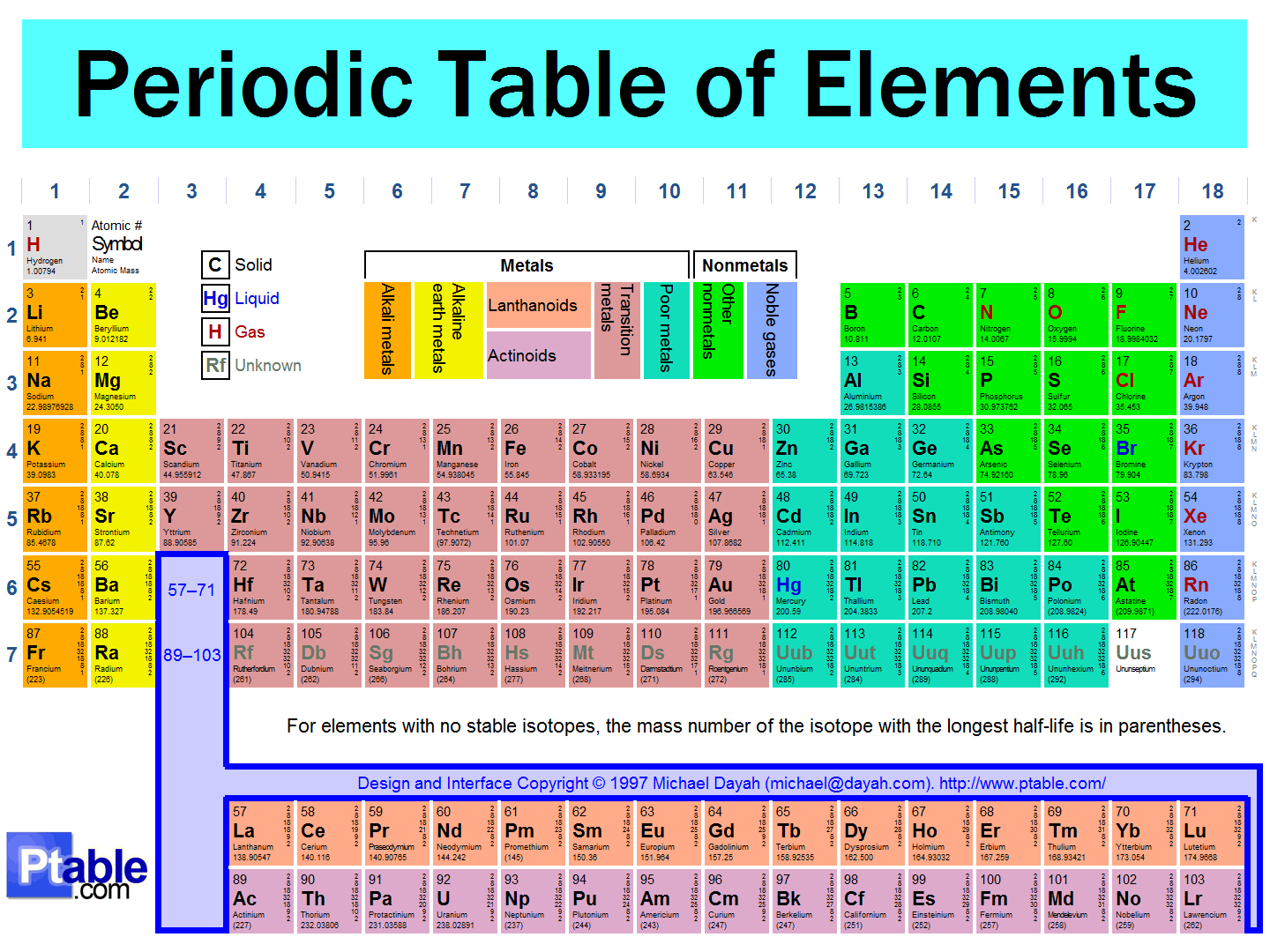
How many electrons does a Copper atom have?
63
29
92
34

How many protons does an Iodine atom have?
53
126
73
179

How many neutrons does a Hydrogen atom have?
1
2
3
0

In an atom, the number of protons is equal to the number of ____________.
energy levels
neutrons
neurons
electrons

At what part of the atom is the arrow pointing?
nucleus
energy level
electron
proton

In a neutral atom,
protons = electrons
protons = neutrons
neutrons = electrons
protons = neutrons = electrons

What is the atomic number of this atom?
2
4
6
8

What is this element?
Beryllium (atomic #4)
Boron (atomic #5)
Carbon (atomic #6)
Nitrogen (atomic #7)

How many valence electrons?
2
3
4
5

How many valence electrons?
2
3
4
5
What is a valence electron?
Electrons in the first energy shell
Electrons in the second energy shell
Electrons in the outer shell
Total number of electrons

What is the mass of this atom?
9
10
19
28


On the periodic table, Periods are
Horizontal rows
Vertical columns

On the periodic table, Groups are
Horizontal rows
Vertical columns

How many energy levels does this element have
7
5
3
2
The period number is equal to
The number of energy levels
The number of electrons
the number of protons
The number of valence electrons
How many electrons can fit on the 1st energy level (orbital) for any Bohr Model?
2
6
8
10
A __________ is a subatomic particle with a positive charge.
proton
neutron
electron
nucleus
A __________ is a subatomic particle with a negative charge.
proton
neutron
electron
nucleus
A __________ is a subatomic particle with a neutral charge.
proton
neutron
electron
nucleus
How many electrons can go in the Second energy level?
2
8
18
32
Elements in a .................. have similar chemical properties.
period
group
row


The elements along zig zag line on the periodic table of elements are:
metals
nonmetals
metalloids

The elements on the right side of the periodic table of elements are mainly:
metals
nonmetals
metalloids

The elements on the left side of the periodic table of elements are mainly:
metals
nonmetals
metalloids

The majority (most) of the elements are:
metals
nonmetals
metalloids

Which element is a noble gas?
Fluorine (F)
Krypton (Kr)
Phosphorus (P)
Aluminum (Al)
How do you find the number of neutrons in an atom?
Atomic Number
Atomic Mass
Atomic Mass - Atomic Number
Atomic Number + Atomic Mass
It's malleable (can be flattened)
Noble gases are..
Stable and gaseous
unstable and gaseous
stable and liquids
unstable and liquids
Which TWO things identify the atom?
protons
neutrons
atomic number
mass
Elements that have similar properties have the same number of
energy levels
Valence electrons
protons
neutrons

