wayground logo

Free Printable Worksheets

NEW

Font size

S
M
L
XL
Worksheets

Mega Quizizz: Cells, Bacteria, and Viruses.

Total questions: 42

Worksheet time: 42mins

Name
Class
Date
1.
Why do doctors suggest that people get a flu vaccine each year?
a)
viruses replicate more rapidly over time
b)
viruses can mutate from year to year
c)
vaccines are absorbed by the body after a year
d)
vaccines get stronger over time
2.

What do viruses need to reproduce?

a)

Genetic material

b)

A host cell

c)

Bacteria

d)

Insulin

3.

Can a virus be cured with antibiotics?

a)

yes

b)

no

4.

Which statement is true about viruses?

a)

Viruses can eat and metabolize food.

b)

Viruses can reproduce only using a host cell.

c)

Viruses can reproduce on their own at any time.

d)

Viruses contain DNA, so they are alive.

5.
How could you describe the size of a virus?
a)
Smaller than bacteria
b)
Larger than a parasite
c)
About the size of a dime
d)
Smaller than a proton
6.

What type of cells contain a nucleus?

a)

bacterial cells

b)

virus cells

c)

prokaryotic cells

d)

eukaryotic cells

7.
Why are viruses considered to be nonliving organism?
a)
they do not have genetic information
b)
they are not able to move on their own
c)
they do not interact with their environment
d)
they are no able to reproduce without a host cell
8.
True or False
The flu is caused by a virus.
a)
true
b)
false
9.
How do viruses reproduce?
a)
They copy their own genetic material inside a protein coat.
b)
They kill a cell and reproduce inside it.
c)
They invade a living cell and use the cell's functions to replicate their genetic material.
d)
They do not reproduce because they are not technically living things.
10.
Which BEST compares bacteria and viruses?
a)
bacteria are smaller than viruses
b)
bacteria cause disease, but viruses do not
c)
bacteria are living organisms, but viruses are not
d)
bacteria have genetic material, but viruses do not
11.

Which is most often used to destroy bacteria?

a)

vaccine

b)

antibiotics

c)

vitamins

d)

water

12.
A group of tissues that perform a similar function is called_____. (Examples include the heart, lungs or stomach)
a)
cells
b)
tissues
c)
organs
d)
organ system
13.
Antibiotics kill viruses
a)
True
b)
False
14.
Which of the following can be helpful in treating bacterial diseases but NOT viral diseases?
a)
vaccines
b)
antibiotics
c)
antiviral drugs
d)
aspirin
15.
Immunity is
a)
an organism's ability to go through gene therapy
b)
the process of getting a vaccine
c)
the use of antibiotics to resist infection
d)
an organism's ability to resist infection using antibodies
16.
The ___ is the basic unit of structure and function of organisms.
a)
atom
b)
cell
c)
matter
d)
all other answers are correct
17.
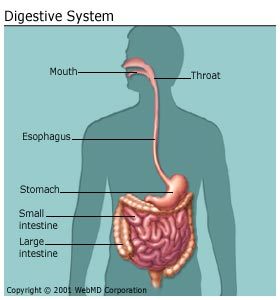
This is a example of........ 
a)
organ system
b)
cells
c)
organ
d)
tissue
18.
Unlike the cells of eukaryotes, the cells of bacteria do not have
a)
a nucleus
b)
cell walls
c)
flagellum
d)
cells
19.
An organism with only one cell is called ________________________________.
a)
multi-celled
b)
duracell
c)
single-celled
d)
slow
20.
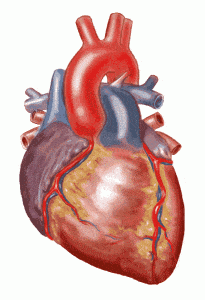
This is a example of ........
a)
cell
b)
organ system
c)
organ
d)
tissue
21.
provides structure and support in plant cells
a)
cytokseleton
b)
cell wall
c)
central vacuole
d)
cytoplasm
22.
What is one way in which all living things on Earth are alike?
a)
All living things have hair.
b)
All living things are made of cells and come from other cells.
c)
The cells of all living things have chloroplast.
d)
All living things can move. 
23.
All cells come from___________ cells.
a)
pregnant
b)
pre-existing
c)
paternal
d)
pin size
24.
Bacteria are prokaryotes.
a)
True
b)
False
25.

Which type of cell has membrane bound organelles?

a)

Prokaryotic Cells

b)

Bacteria Cells

c)

Eukaryotic Cells

d)

E-coli bacterium

26.
jelly like substance in cell
a)
cytokseleton
b)
chloroplast
c)
central vacuole
d)
cytoplasm
27.

Provides structure and support in plant cells

a)

Golgi Body

b)

Cell Wall

c)

Cytoplasm

28.
lets stuff in and out of the cell
a)
cell membrane
b)
cell wall
c)
chloroplast
d)
central vacuole
29.

What does the mitochondria do?

a)

Takes sugar molecules and bakes a cake ;)

b)

Breaks sugar molecules down into Energy, CO2 and water. This process is called Cellular Respiration

c)

Creates sugar out of Energy, CO2 and Water

30.
An organism made of one cell is called
a)
unicellular organism
b)
multicellular organism
31.

The "Brain" of Eukaryotic Cells. Where DNA is stored

a)

cell membrane

b)

nucleus

c)

mitochondria

32.
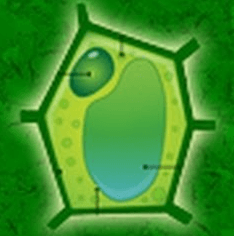
What type of cell is shown below?
a)
Prokaryotic
b)
Eukaryotic
c)
Awesomekaryotic
d)
Lamekaryotic
33.
place of cellular respiration
a)
mitochondria
b)
nucleus
c)
nucleolus
d)
golgi
34.
This organelle takes food and turns it into ENERGY for plant and animal cells.
a)
Chloroplast
b)
Mitochondria
c)
Lysosome
d)
Ribosome
35.
I am the outer most layer of an animal cell. What am I?
a)
cell wall
b)
nucleus
c)
cell membrane 
d)
cell skin
36.
A rigid layer that lies outside the cell's  membrane is...
a)
Cytoskeleton
b)
Cilia
c)
Cell Wall
d)
Flagella
37.
I am only found in a plant cell. What am I?
a)
cell wall
b)
mitochondria
c)
cytoplasm
d)
chloroplast
38.
Stores food and water for the cell.
a)
Cytoplasm
b)
Cell Wall
c)
Vacuole
d)
Nucleus
39.
Controls the cell and contains DNA
a)
Nucleus
b)
Mitochondria
c)
Chloroplast
d)
Cell Wall
40.

Cell division is also known as

a)

interphase

b)

meiosis

c)

mitosis

d)

replication

41.

When a cell goes through mitosis, the daughter cells

a)

are genetically unique from the mother cell

b)

are genetically identical to the mother cell

c)

are used in sexual reproduction

d)

have half the number of chromosomes as the mother cell

42.
The structure of coiled DNA and proteins that forms in the cells nucleus prior to mitosis is 
a)
centromere
b)
centriole
c)
chromosome
d)
chromatid