Worksheets
PreAP Biology: Protein Synthesis
Total questions: 20
Worksheet time: 14mins

Which diagram best represents a segment of a normal DNA molecule?
A
B
C
D
How does DNA in cells determine an organism’s complex traits?
DNA contains codes for proteins, which are necessary for the growth and functioning of an organism.
DNA separates into long single strands that make up each part of an organism
DNA produces the energy an organism needs in order to grow.
DNA folds into the nucleus of each of the cells of an organism

Which of these changes to the DNA triplet 3’ GCT 5’ will affect the protein produced?
GTT
TCT
TCC
GCA

The process represented in the diagram produces a molecule that is complementary to the template strand of DNA. What type of molecule is produced?
new DNA
polypeptide
messenger RNA
carbohydrate

Which of the following is true regarding the process shown?
The process shown above is known as transcription and involves the production of proteins from DNA.
The process shown above is known as replication and involves the production of DNA from RNA.
The process shown above is known as cloning and involves the production of RNA from protein molecules.
The process shown above is known as translation and involves the production of proteins from RNA.
If a DNA strand is TAC-CGC-TAC-GTA What would be the other side of this DNA molecule?
AUG-GCG-AUG-CAU
ATG- GCG- ATG-CAT
AUA-GCG-ACT-ATT
AUU-CGC- ACT-AGC
Protein Synthesis is…
Transcription and translation
The process of duplicating DNA
Where DNA is copied to mRNA in the nucleus
Where mRNA is read to make a protein at the ribosome
Translation is…
Transcription and translation
The process of duplicating DNA
Where DNA is copied to mRNA in the nucleus
Where mRNA is read to make a protein at the ribosome
Transcription is….
Transcription and translation
The process of duplicating DNA
Where DNA is copied to mRNA in the nucleus
Where mRNA is read to make a protein at the ribosome
DNA replication is…
Transcription and translation
The process of duplicating DNA
Where DNA is copied to mRNA in the nucleus
Where mRNA is read to make a protein at the ribosome
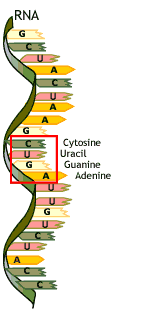
Which of the following describes RNA?
Double stranded and contains thymine
Single stranded and contains uracil
Longer than DNA and uses 5 bases to encode information
Made in the nucleus and stays there to carry out its functions