

wayground logo

Free Printable Worksheets

Font size

S
M
L
XL
Worksheets

1st Semester - Exam Review

Total questions: 150

Worksheet time: 2hrs 7mins

Name
Class
Date
1.
Enlightened thinkers based their philosophical beliefs on what two things?
a)
power and privilege
b)
money and fame
c)
good looks and charm
d)
reason and logic
2.
Natural Rights
a)
Life, Liberty, and the Pursuit of Happiness.
b)
Life, Liberty, and Property
c)
Freedom
d)
Rights to say what we want, when we want to.
3.
___________________ believed that without government, people would fight each other all the time.
a)
A. Locke
b)
B. Hobbes
c)
C. Montesquieu
d)
D. Smith
4.
American's used _________________'s idea of separation of powers to write the US Constitution. 
a)
A. Montesquieu
b)
B. Hobbes
c)
C. Rousseau
d)
D. Voltaire
5.

Who inspired the idea in the Declaration of Independence that all men have natural rights?

a)

Locke

b)

Beccaria

c)

Voltaire

d)

Rousseau

6.
Define "social contract"
a)
an entire society of Imperial Stormtroopers
b)
an entire society of flesh-eating bacteria
c)
an entire society agrees to be governed by its king
d)
an entire society agrees to be governed by its general will
7.

Argued people have a right to overthrow a government that does not protect their natural rights

a)

Hobbes

b)

Diderot

c)

Locke

d)

Wollstonecraft

8.

three branches of government with checks and balances is best was the idea of

a)

Montesquieu

b)

Voltaire

c)

Locke

d)

Wollstonecraft

9.
According to the Declaration of Independence who gives us our rights? 
a)
given by God at birth 
b)
given by our government 
c)
given by our president 
d)
given by our parents 
10.
The Declaration of Independence states the purpose of government is 
a)
to tax and control finances
b)
to provide rules for the people
c)
to regulate trade 
d)
to serve the people
11.
Which statement best describes the role of government according to the Declaration of Independence?
a)
“The main purpose of government is to expand and glorify the state”
b)
“The main purpose of government is to protect the unalienable rights of individuals”
c)
“The main purpose of government is to protect the rights and privileges of His Majesty, the King”
d)
“The main purpose of government is to promote the general welfare of the community by taking steps toward social equality”
12.
When Thomas Jefferson copied John Locke's ideas about the social contract, what did he say the people had the right to do to a government who was not protecting the people's rights?
a)
Write a letter
b)
Suggest how it could be better
c)
Wait until they started to respect the people's rights
d)
Abolish it
13.
What are the three inalienable rights that all people have?
a)
Food, Shelter, and Clothing
b)
Life, Liberty and Death
c)
Life, Liberty and the Pursuit of Happiness
14.
According to the Declaration,  what causes a government to be just? 
a)
powerful institutions
b)
a Bill of Rights 
c)
ease of altering 
d)
Consent of the people being governed
15.

Why was the Declaration of Independence written?

a)

to start the American Revolution

b)

to offer a peace settlement to Great Britain

c)

to instruct how a country wins its freedom

d)

to explain why the colonies were separating from Great Britain
16.
Congress never had any money because under the Articles they did NOT have the power to ____.
a)
print money
b)
sell items to other countries
c)
tax
d)
spend money
17.
Because of the Articles the government could NOT regulate ______ among the states.
a)
food quality
b)
laws
c)
travel
d)
commerce (trade)
18.
Because of the Articles, each state got __ vote(s).
a)
1
b)
2
c)
10
d)
more votes if more people live in that state
19.
The Articles created a _____ national government.
a)
strong
b)
weak
c)
nope
d)
nope
20.
Which of the following was a weakness of the Articles?
a)
national government taxed the states a lot
b)
created a very strong president
c)
all states used the same money
d)
could not regulate commerce (trade) among the states
21.
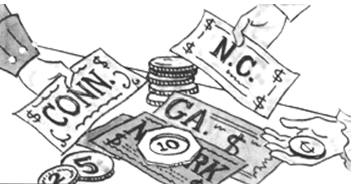
This picture shows which weakness of the Articles?
a)
no common currency
b)
no executive branch
c)
no power to tax
d)
one vote for each state
22.
This picture shows which weakness of the Articles?
a)
no common currency
b)
no executive branch
c)
no power to tax
d)
one vote for each state
23.
Under the Articles of Confederation, the government consisted of _______________ branch of government.
a)
3
b)
2
c)
1
d)
4
24.
Under the Articles of Confederation Congress could only pass a law if ____________ out 13 states agreed. 
a)
13
b)
8
c)
9
d)
10
25.
In order to change (amend) the Articles of Confederation,  __________ out of 13 states had to agree. 
a)
9
b)
10
c)
13
d)
15
26.
One weakness of the Articles Of Confederation was that it lacked which 2 branches of government?
a)
Legislative & Executive
b)
Executive & Judicial
c)
Judicial & Legislative
d)
Executive & Oak
27.

Which strong feature of the Articles of Confederation created a method for western territories to become states?

a)

The ability to sign peace treaties

b)

Shays' Rebellion

c)

Northwest Ordinance

d)

60,000 Ordinance

28.
In the Articles of Confederation, where was most of the government power placed?
a)
The States
b)
The National Government
c)
The Continental Congress
d)
The Legislative Branch
29.
Why was the U.S. Army so weak under the Articles of Confederation?
a)
There was only 1 branch of government
b)
States could refuse to provide soldiers
c)
The nation had no common currency
d)
All of the above
30.
What did Shays' Rebellion help Americans realize they needed?
a)
A strong national government
b)
A stronger militia
c)
A common currency
d)
The ability to sign peace treaties
31.
How many states needed to agree to revise the Articles of Confederation?
a)
3/4
b)
13
c)
2/3
d)
12
32.
Which of the following BEST describes the Articles of Confederation?
a)
A Constitution established after the American Revolution
b)
A Declaration of Independence
c)
The 1st Constitution of the U.S.
d)
A strong form of government
33.
The McCullough v. Maryland decision by the Supreme Court upheld the principle that...
a)
Congress only has powers specifically enumerated in the Constitution
b)
Congress has the power to make laws to carry out its constitutional duties
c)
the federal gov't and state governments are equal
d)
the federal government alone may levy taxes
34.
Which is a result of the Necessary and Proper Clause?
a)
defeated American pluralism
b)
expanded the powers of the central gov't
c)
checked the powers of the legislative branch
d)
defended U.S. republicanism
35.
The practical effect of the Necessary and Proper Clause has been to...
a)
allow the national government to extend its powers beyond those expressed in the Constitution
b)
make the legislative branch the most powerful branch of gov't
c)
allow states to nullify federal laws withing their borders
d)
give the President uncontested power in the area of foreign policy
36.
Which of the following is an example of an implied power?
a)
The power to declare war
b)
The power to impeach the president
c)
The power to coin money
d)
The power to build the 42,000 mile interstate highway system
37.
Congressional override of a presidential veto is an example of which of the following?
a)
checks and balances
b)
federalism
c)
judicial review
d)
reserved powers
38.
Which of the following powers are reserved powers?
a)
make laws
b)
establish local governments
c)
declare war
d)
regulate interstate commerce
39.
Concurrent powers are
a)
powers shared by different branches of government
b)
powers that the Constitution gives to both national and state governments
c)
those powers that are mentioned explicitly in the Constitution
d)
the powers shared by two or more states when they enter into compacts
40.
The Connecticut Compromise resolved the controversy at the Constitutional Convention involving
a)
the method of choosing the president
b)
the regulation of interstate and foreign trade
c)
representation in Congress
d)
ratification of the Constitution
41.
Judicial Review gives the Supreme Court the power to
a)
kick bad judges off the federal bench
b)
declare legislative acts unconstitutional
c)
hold office for life
d)
create new federal judicial posts
42.
Which of the following arguments did the Anti-Federalists make against ratifying the
Constitution?
a)
It entrusted too much power in the king of England
b)
It prohibited political parties
c)
It made the states too powerful
d)
It neglected to protect important liberties
43.
What was James Madison trying to avoid by creating a system of checks & balances?
a)
Federalism
b)
The Connecticut Compromise
c)
A tyrannical government
d)
The Bill of rights
44.
In the organization of government, the principle of federalism is illustrated best by the
a)
separation of powers between the United States Supreme Court and Congress
b)
qualifications for the office of president
c)
president’s power as commander in chief
d)
representation system for electing senators
45.
What is the difference between block grants and categorical grants?
a)
Block grants are given by the federal government to the states. Categorical grants are given by the states to the
federal government
b)
States have greater flexibility over how to use block grants
c)
Block grants are always smaller than categorical grants
d)
States prefer categorical grants to block grants because they come with fewer strings attached
46.
Which of the following is an example of a block grant?
a)
A grant from the federal government to be administered by the states with few strings attached
b)
The free and reduced lunch program run by the federal government in
c)
The Americans with Disabilities Act
d)
A grant with strict control exercised by the federal government
47.
The commerce clause has been instrumental in
a)
developing a more vigorous alliance between government and business
b)
enabling Congress to impose regulations upon the judicial branch
c)
enforcing civil rights and fighting discrimination
d)
undermining judicial review
48.
In Marbury v Madison (1803), the Supreme Court assumed the power to
a)
advise Congress on the constitutionality of a proposed law
b)
regulate slavery
c)
decide on the constitutionality of a law or an executive action
d)
approve executive agreements
49.
Which of the following is the most directly democratic?
a)
Representative democracy
b)
Executive privilege
c)
The process of amending the Constitution
d)
A referendum
50.
In writing about the social contract, John Locke argues that
a)
in the state of nature no one has any natural rights
b)
in society citizens trade their natural liberties for the preservation of their property
c)
anyone willing to give up their liberty for security deserves neither
d)
absolute liberty is far more important than security
51.
What was the main point of disagreement between supporters of the Virginia and New Jersey plans?
a)
whether or not they should keep the Articles of Confederation
b)
how the States should be represented in Congress
c)
whether or not there should be an executive branch
d)
how they would present the completed Constitution to the States
52.
What is a bicameral legislature?
a)
a legislature with one house
b)
a legislature with two houses
c)
a legislature that is run by the Crown
d)
a legislature that is appointed by the governor
53.
Under the Articles of Confederation, most power rested with the 
a)
British Parliament
b)
the president
c)
Continental Congress
d)
state legislatures
54.
The Federalist Papers were
a)
essays in support of ratification of the constitution. 
b)
essays written that were critical of the constitution. 
c)
newspapers which backed the Federalist party in early United States elections. 
d)
the original name of the constitution written by the Constitutional Convention.
55.
The Madisonian requirement that each branch of government acquire the consent of   the others for many of its actions created a system of 
a)
confederated government
b)
checks and balances
c)
constitutional republic
d)
separation of powers
56.
As originally established by the Constitution, the House of Representatives had how many members from each state?
a)
7
b)
1
c)
2
d)
depended on population of state
57.
The framers of the Constitution gave the chief economic policymaking role to
a)
the courts
b)
the states
c)
the president
d)
Congress
58.
To propose a formal amendment to the Constitution, one needs to have a
a)
three-quarters vote in Congress. 
b)
national convention requested by half of the states. 
c)
majority vote of the Supreme Court. 
d)
two-thirds vote in Congress.
59.
Constitutional amendments are usually ratified by
a)
state conventions called by two-thirds vote in Congress. 
b)
a national convention. 
c)
legislatures of three-fourths of the states.
d)
a two-thirds vote in each house of Congress.
60.
Federal law taking precedence over state laws when there is a conflict refers to which constitutional clause?
a)
Commerce Clause
b)
Supremacy Clause
c)
Full Faith and Credit Clause
d)
Privileges and Immunities Clause
61.
States honoring each other's laws and records refers to which constitutional clause?
a)
Commerce Clause
b)
Supremacy Clause
c)
Privileges and Immunities Clause
d)
Full Faith and Credit Clause
62.
Powers that are not given to the Federal government are 
a)
implied powers
b)
expressed powers
c)
reserved powers
d)
super powers
63.
The power to tax is a(n)
a)
implied power
b)
concurrent power
c)
reserved power
d)
abused power
64.
The power to print money is a(n)
a)
reserved power
b)
concurrent power
c)
implied
d)
expressed power
65.
The power to run public schools is a(n)
a)
concurrent power
b)
expressed power
c)
reserved power
d)
implied power
66.
The Supremacy Clause states that 
a)
state laws are superior to federal laws
b)
federal laws are superior to state laws
c)
expressed powers are superior to implied powers
d)
Alabama is superior to Auburn
67.
Powers of Congress that are stated in the Constitution
a)
expressed
b)
reserved
c)
implied
d)
concurrent
68.
The branch of government that makes laws
a)
Legislative
b)
Executive
c)
Judicial
d)
Supreme Court
69.
The branch of government that interprets laws
a)
Congress
b)
Executive
c)
Legislative
d)
Judicial
70.
In the Constitution, the implied powers of Congress come from the 
a)
Necessary and Proper Clause
b)
Supremacy Clause
c)
Relative Clause
d)
Santa Clause
71.
Which amendment reserves the powers of the states? 
a)
14th
b)
12th
c)
9th
d)
10th
72.

Which constitutional principle do the 15,19, & 26th Amendments deal with?

a)

Federalism

b)

Limited Government

c)

Popular Sovereignty

d)

Checks & Balances

73.

Which best summarizes the main idea behind the 4,5, & 6th Amendments?

a)

People accused of crimes enjoy certain basic rights.

b)

Criminals must be fully prosecuted.

c)

Criminal acts should lead to the loss of personal liberty.

d)

Accused people are usually guilt of committing some crime.

74.
Which principle was the focus of the U.S Supreme Court decision in Miranda v. Arizona?
a)
Freedom of expression
b)
Freedom of Speech
c)
Self-Incrimination
d)
Right to Counsel
75.
The principle of Judicial Review was established by which US Supreme Court case?
a)
Marbury v. Madison
b)
DC v. Heller
c)
Gideon v. Wainwright
d)
Beecroft v. Civics 
76.
Voted against public prayer and Bible readings in school
a)
Board of Ed. v. Earls
b)
Engel v. Vitale
c)
Brown v. Board of Education
d)
Plessy v. Ferguson
77.
Upheld the constitutionality of state laws requiring racial segregation in public facilities under the doctrine of "separate but equal".
a)
Brown v. Board of Education
b)
Plessy v. Ferguson
c)
Gideon v. Wainwright
78.
Ruled that courts are required to provide counsel in criminal cases to represent defendants who are unable to afford their own attorneys.
a)
United States v. Nixon
b)
Marbury v. Madison
c)
Gideon v. Wainwright
79.
This court case defined freedom of speech in schools for studnets
a)
Hazelwood v. Kuhlmeier
b)
Brown v. Board of Education
c)
Tinker v. Des Moines
d)
Plessy v. Ferguson
80.
Slaves were considered property; therefore, you may bring your slave anywhere-Chief Justice Roger Taney
a)
Dred Scott vs. Sandford
b)
McCulloch vs Maryland
c)
Worcester vs. Georgia
d)
Marbury vs. Madison
81.

This case established a special test that prevented "excessive entanglement" between gov't and religion

a)

Oregon v. Smith

b)

Baker v. Carr

c)

Texas v. Johnson

d)

Lemon v Kurtzman

82.

This case protected free speech in that the ruling said that public officials cannot win in a defamation suit unless there is "ACTUAL MALICE"

a)

Gitlow v. New York

b)

Wesberry v. Sanders

c)

New York Times v. Sullivan

d)

Grutter v. Bollinger

83.

This case made sure that suspects must be informed of their criminal rights before they are questioned.

a)

Gitlow v. New York

b)

Miranda v. Arizona

c)

Korematsu v. United States

d)

Roe v. Wade

84.

This case said the Bill of Rights cannot be applied to the states

a)

Weeks v. United States

b)

Barron v. Baltimore

c)

Roth v. United States

d)

Mapp v. Ohio

85.

Selective Incorporation is best associated with this case:

a)

Gitlow v. New York

b)

New York Times v. Sullivan

c)

Griswold v. Connecticut

d)

Gibbons v. Ogden

86.

Case that est. precedent that speech could be limited if there is a "clear and present danger"

a)

Griswold v. Connecticut

b)

Roth v. United States

c)

Schneck v. United States

d)

Gitlow v. New York

87.

According to this case one could spend their own money on their campaign

a)

Buckley v. Valeo

b)

Dred Scott v. Stanford

c)

United States v. Nixon

d)

Baker v. Carr

88.

This case said that race could be used as one factor among others when competing for available places in college

a)

Grutter v. Bollinger

b)

Roe v. Wade

c)

Korematsu V. United States

d)

Regents of the University of California v. Bakke

89.

This Supreme Court cases ruled that a person's Sixth Amendment right-to-counsel applies to those accused of major crimes under state laws.

a)

Baker v. Carr

b)

Gideon v. Wainwright

c)

Miranda v. Arizona

d)

Griswold v. Connecticut

90.

This case said that laws that made contraception illegal violated people's rights to marital privacy

a)

Roe v. Wade

b)

Grutter v. Bollinger

c)

Griswold v. Connecticut

d)

Gideon v. Wainwright

91.

This case extended exclusionary rule to the states.

a)

Weeks v. United States

b)

Mapp v. Ohio

c)

Texas v. Johnson

d)

Gibbons v. Ogden

92.

SCOTUS said that burning the American flag is protected symbolic speech in...

a)

Korematsu v. United States

b)

Texas v. Johnson

c)

Weeks. v. United States

d)

Lemon v. Kurtzman

93.
What are linkage institutions?
a)
sects
b)
political party leadership groups
c)
groups of people qualified to vote
d)
organizations that help connect people to the government
94.
What does an open primary mean?
a)
Even minors can vote
b)
Only people registered with a given party can vote
c)
Secret ballots are not used
d)
All voters can participate
95.
Which term refers to a paid representative for an interest group?
a)
bureaucrat
b)
lobbyist
c)
civil servant
d)
congressional page
96.
Where are presidential candidates formally nominated?
a)
at a national convention
b)
at a local caucus
c)
at a district convention
d)
at a state convention
97.
Which term is used for a loose alliance of political groups?
a)
arrangement
b)
coalition
c)
front
d)
lobby
98.
Which term is used for the moment when the groups that make up political parties are rearranged?
a)
coalition
b)
musical chairs
c)
realignment
d)
rearranging
99.
How did the Democratic Party gain power in the 1930s
a)
by providing economic help during the Great Depression
b)
by promising voting rights for all white males
c)
by gaining the support of the Progressive Party
d)
by gaining the support of the Anti-Federalist Party
100.
A new party is formed whose main concern is the environment. What kind of party would this be? 
a)
An ideological party
b)
an economic protest party
c)
a single-issue party
d)
a splinter party
101.
What is one way minor parties affect American politics?
a)
they get voters to vote for major party candidates
b)
they get the attention of newspapers, television, and radio
c)
they win state and local elections
d)
they influence the outcomes of elections
102.
The 26th Amendment says that states have to allow the right to vote in which case?
a)
if the voter has no income
b)
if the voter is 18 or over
c)
if the voter is female
d)
if the voter pays taxes
103.
Which federal law passed in 1993 was intended to make voter registration easier?
a)
24th Amendment 
b)
Civil Rights Act
c)
Motor Voter Law
d)
Voting Rights Act
104.
The Voting Rights Act of 1965
a)
applied to State and Local, but not Federal elections
b)
It gave the Federal Government power regarding all elections, held anywhere in the country.
c)
granted the States complete control over State and Local elections
d)
Applied to Federal, but not State and Local elections 
105.
Which of the following is the MOST ACCURATE statement about voters aged 18-20?
a)
The number of young voters has gone steadily down in every presidential election since 1972
b)
Members of this age group consistently vote in higher numbers than Americans 65 and older.
c)
Turnout for this age group has consistently been the highest of all age groups.
d)
Members of this age group have shown themselves to be less likely to vote than any other age group
106.
What is the effect of aging on political participation?
a)
Aging has no discernible effect on political participation.
b)
Aging increases political participation.
c)
Aging decreases political participation
d)
Aging decreases political participation among women, but not men.
107.
What changed in the demographics of the New Deal coalition after nearly four decades of political control?
a)
Catholics and Jews began to defect from the Republicans to the Democrats.
b)
Evangelicals began to defect from the Republicans to the Democrats.
c)
African Americans began to defect from the Republicans to the Democrats
d)
Southern whites began to defect from the Democrats to the Republicans.
108.
Why are Super PACs so powerful? 
a)
They may raise UNLIMITED sums of money 
b)
They have super powers
c)
PAC stands for "Powerful American Club"
d)
None of the above
109.
Which was a result of the Federal Elections Campaign Act?
a)
Limited individual and PAC donations
b)
Banned soft money
c)
Limited candidates to only public funding
d)
led to rise of SuperPACs
110.
Banned "soft money", restricted so-called issue ads, increased the contribution limits.
a)
Federal Election Campaign Act
b)
Buckley v. Valeo
c)
McCain Feingold
d)
McConnell v. FEC
111.
A system in which there are too many groups that the government is trying to 'please', the groups than are 'too strong', thus, the government is weakened by its attempts...
a)
Elitism
b)
Pluralism
c)
HyperPluralism
d)
Shenaniganism
112.
Increasing public attention to specific problems is a core feature of the media’s __________ power.
a)
gate-keeping
b)
agenda-setting
c)
investigative
d)
watchdog
113.
Which of the following helped create the soft money loophole of campaign donations?
a)
Buckley v. Valeo
b)
Baker v. Carr
c)
Citizens United v. FEC
d)
U.S. v Nixon
114.
America's earliest party system developed over political differences between
a)
Hamilton and Washington
b)
Jefferson and Hamilton
c)
Madison and Hamilton
d)
Madison and Monroe
115.
Pressure legislators & public-policy-making; Seek to influence on an issue

Think $$$
a)
Lobbying
b)
Public Opinion Polls
c)
Mass Media
d)
Interest Groups
116.
Private organizers who share certain views & work to shape public policy

Example = NRA or MADD
a)
Interest Group
b)
Mass Media
c)
Political Party
d)
Interest Factions
117.
People who seek to control Gov't through winning elections

Example = Democrats & Republicans
a)
Political Party
b)
Interest Group
c)
Political Lobbying
d)
Political Agenda
118.
Voters who vote based on a party's past performance in office are called
a)
Prospective Voters
b)
Retrospective Voters
119.
We are in a period of _____, where one party control the White House and another party controls Congress.
a)
Dealignment
b)
Divided government
c)
Realignment
d)
Unified government
120.
The belief that competition among all affected interests shapes public policy
a)
Pluralist view
b)
Class view
c)
Power elite view
d)
Bureaucratic View
121.
When voters choose candidates from both parties, it is called
a)
Ticket-splitting
b)
Closed primary
c)
Party alliance
d)
Open primary
122.
Your attitude and beliefs about politics are primarily influenced by
a)
family
b)
religion
c)
school
d)
the President
123.
Which of the following events signaled the beginning of the Republican Party's rise to power?
a)
Mexican-American War
b)
Civil War
c)
Reconstruction
d)
Prohibition
124.
Which interest group would MOST LIKELY oppose eliminating the social security system?
a)
American Association of Retired Persons
b)
Mothers Against Drunk Driving
c)
National Rifle Association
d)
American Federation of Labor
125.
What was the warning that many of our founding fathers gave about political parties?
a)
They would be ineffective at running the nation 
b)
It would be too expensive 
c)
There would be too many political parties 
d)
They would divide the country 
126.
The MAIN purpose of lobbying is to
a)
ensure that free and honest elections are held
b)
Represent Interest groups and attempt to influence government 
c)
meet constitutional requirements for choosing the President
d)
protect the American public from corrupt public officials
127.
Which of these groups is most likely to be conservative?
a)
Whites
b)
African Americans
c)
Hispanics
d)
Jews
128.
Which of these groups has the highest voter turnout
a)
18-24 year olds
b)
65 and over voters
c)
African American voters
d)
High school dropouts
129.
Which of these groups has the lowest voter turnout rate?
a)
Hispanics
b)
African Americans
c)
High school dropouts
d)
Those with a Masters Degree
130.
The term “gender gap” refers to the idea that
a)
women tend to be more educated than men
b)
women tend to be more liberal than men
c)
women tend to be proportionally over represented in the US Congress
d)
women tend to be less religious than men
131.
Trust in government has generally _______________ since the 1950s.
a)
decreased
b)
stayed the same
c)
increased
d)
fluctuated with public mood
132.
What technique is the key to the accuracy of public opinion polls?
a)
indexing
b)
question format
c)
random sampling
d)
sample size
133.
Political culture refers to:
a)
a set of beliefs about the role of the government in society.
b)
how truly American someone is
c)
an overall set of values widely shared within a society.
d)
a high degree of homogeneity in political opinions.
134.
"friend of the court"; legal brief submitted by interest groups to inform the court of their position on a case
a)
litigation
b)
amicus curiae brief
c)
going public
d)
class action suit
135.
helping a sympathetic candidate to get into office
a)
lobbying
b)
electioneering
c)
litigating
d)
going public
136.
argues that interest group activities provide additional representation and compete against each to acheive political outcomes
a)
elite theory
b)
pluralist theory
c)
Olson's Theory
d)
hyperpluralist theory
137.
Increasing public attention to specific problems is a core feature of the media’s __________ power.
a)
gate-keeping
b)
agenda-setting
c)
investigative
d)
watchdog
138.
An intentional news leak for the purpose of assessing the political reaction to that news is called a(n) __________.
a)
press conference
b)
trial balloon
c)
talking head
d)
media event
139.
The Democratic and Republican candidates for president are formally nominated by the __________.
a)
national party conventions
b)
presidential caucuses
c)
national committees
d)
Electoral College
140.

The Framers saw no need for a bill of rights because

a)

in their view, civil liberties were a matter for the states, not for the federal government.

b)

they were convinced that in a democratic republic, public opinion was a sufficient protection.

c)

no one bothered to even bring up the topic at the Convention.

d)

they assumed that the federal government could not do things that it was not explicitly authorized to do.

141.
the person who already holds elected office
a)
incumbent
b)
candidate
c)
sophomore
d)
important
142.
Which of the following individuals would be most likely to vote in a Republican primary? 
a)
A 25-year-old white male with some high school education who is employed as a laborer in Florida 
b)
A 55-year-old African American saleswoman from Georgia who has a master’s degree 
c)
 A 35-year-old female secretary from New York with an associate’s degree who is a devout Catholic 
d)
A45-year-old white business man from South Carolina who attends church weekly 
143.
In the United States political system, the term Federalism refers to 
a)
limits on the powers of the state governments 
b)
the division of powers between the levels of government
c)
the fundamental basis of law
d)
limits on the powers of the national government
144.
Which of the following constitutional provisions broadened the power of Congress? 
a)
The necessary and proper clause 
b)
The equal protection clause
c)
The Tenth Amendment
d)
The Ninth Amendment 
145.
Single-member districts
a)
tend to be consistently dominated by one party
b)
favor the two-party system
c)
are rare in American politics
d)
increase the influence of interest groups
146.
The term “horse-race journalism” refers to the tendency of the media to:
a)
Cover Congress by focusing on committee chairs rather than on the work of the committees
b)
Cover campaigns by emphasizing the relative standings of the candidates in the polls rather than the issues they discuss
c)
Cover politics by concentrating on scandal and corruption rather than on instances of integrity and honorable action
d)
Compete for access to sources rather than to cooperate in gathering news
147.
A "layer cake" analogy is often used to describe
a)
sovereignty of the states
b)
dual federalism
c)
cooperative federalism
d)
block grants
148.
State and localities have the most discretion in establishing policy when federal funding is derived from
a)
categorical grants
b)
block grants
c)
project grants
d)
grants-in-aid
149.
The "Devolution Revolution" is a movement to devolve more responsibilities and powers to the 
a)
House of Representatives
b)
Senate
c)
President
d)
States
150.
Which decision below gave the federal government exclusive power to regulate interstate commerce?
a)
McCulloch v. Maryland
b)
Gibbons v. Ogden
c)
Dred Scott v. Sandford
d)
Plessy v. Ferguson