wayground logo

Free Printable Worksheets

Font size

S
M
L
XL
Worksheets

Fall 2018 Final Review

Total questions: 170

Worksheet time: 35hrs 50mins

Name
Class
Date
1.
Two atoms of different elements will definitely have different numbers_____
a)
Nuclei
b)
Protons
c)
Neutrons
d)
Electrons
2.
Which particle is NOT made up of quarks?
a)
Protons
b)
Neutron
c)
Electron
3.
Although carbon's three isotopes are carbon-12, carbon-13, and carbon-14, its average atomic mass is 12.01 because
a)
Carbon-12 is the heaviest isotope
b)
Carbon-12 is the most useful to humans
c)
Carbon-12 is the most common isotope
4.
An ion forms when an atom gains or loses
a)
Protons
b)
Neutrons
c)
Electrons
5.
A neutral atom would become an ion that has a charge of 2+ by 
a)
Losing two protons
b)
Losing two neutrons
c)
Losing two electrons
6.
Isotopes are atoms that have different
a)
Mass numbers
b)
Element names
c)
Atomic Numbers
7.
A positively charged ion is formed when
a)
A neutron is lost
b)
An electron is lost
c)
A neutron is gained
d)
An electron is gained
8.
Two atoms that have different numbers of protons are 
a)
Different ions
b)
Different isotopes
c)
Different elements
9.
If neutral copper atom (atomic number 29) becomes an ion that has a charge of 2+, how many electrons does the resulting ion have?
a)
27
b)
28
c)
29
d)
31
10.
Two neutral atoms that have the same atomic number and different mass numbers are
a)
Ions
b)
Isotopes
c)
Alpha particles
d)
Different elements
11.
Which phrase describes two atoms that are isotopes
a)
Same mass number, same atomic number
b)
Same mass number, different atomic number
c)
Different mass number, same atomic number
d)
Different mass number, different atomic number
12.
An ion that has a negative charge is formed when an atom 
a)
Loses neutrons
b)
Loses electrons
c)
Gains neutrons
d)
Gains electrons
13.
What information would allow you to determine whether two atoms are of the same or different elements
a)
The charge on each atom
b)
The number of neutrons each has
c)
The number of protons in their nuclei
d)
The location of the electrons in their electron clouds
14.
Define Atom
a)
It is the smallest piece of an element that still represents that element
b)
Is an element has the electrons in their electron cloud
c)
A positively charged isotope
15.
How are Protons and Neutrons similar
a)
Both are in the nucleus of the atom and they both have the relative mass of 1
b)
They both have alpha particles and have the relative mass of 2
c)
They both have 1 high-energy electron and different elements
16.
Two atoms of different elements will definitely have different numbers_____
a)
Nuclei
b)
Protons
c)
Neutrons
d)
Electrons
17.
Which particles are found in the nucleus of an atom?
a)
electrons and protons
b)
electrons and neutrons
c)
neutrons and protons
d)
electrons and protons
18.
Which subatomic particles are important in the formation of bonds?
a)
electrons
b)
protons
c)
neutrons
19.
What charge do electrons have?
a)
positive
b)
negative
c)
neutral
20.
Where are the reactive electrons in an atom?
a)
In the inner rings
b)
In the outer rings
21.
How many protons does the following element have?
a)
11
b)
23
c)
12
22.
How many electrons does the following element have?
a)
11
b)
12
c)
23
23.
How many neutrons does the sodium have?
a)
11
b)
12
c)
23
24.
How many electrons can be in the first energy level (shell) in a Bohr-Rutherford diagram
a)
2
b)
6
c)
8
25.
How many electrons can the second energy level (shell) of a Bohr-Rutherford diagram have?
a)
2
b)
6
c)
8
26.
How many electrons will the element Si have in a Lewis dot diagram?
a)
2
b)
4
c)
6
d)
8
27.
How many bonds can the following element form?
a)
1
b)
2
c)
3
d)
4
28.
How many bonds can the following element form?
a)
1
b)
2
c)
3
d)
4
29.
What is the formula for the following molecule?
a)
CH4
b)
C2H2
c)
C2H4
30.
What type of elements are generally found in covalent drawings?
a)
non-metals
b)
metals
c)
metals and non-metals
31.
This particle is found in the nucleus and has no charge
a)
Neutron
b)
Proton
c)
Electron
32.
This particle is found in the nucleus and has a positive charge
a)
Electron
b)
Proton
c)
Neutron
33.
This is a negatively charged particle found outside the nucleus
a)
Electron
b)
Proton
c)
Neutron
34.
This contains most of the mass of an atom
a)
Electron Cloud
b)
Nucleus
c)
Electron
35.
This is the simplest of all atoms and contains only one proton and one electron
a)
Oxygen
b)
Hydrogen
c)
Water
36.
The first person to ever talk about an atom was
a)
Democritus
b)
Rutherford
c)
Dalton
37.
All matter is made of what?
a)
energy 
b)
atoms 
c)
electrons 
d)
compounds 
38.
How did Rutherford discover the proton?
a)
Cathode tube ray experiment
b)
Gold Foil Experiment
c)
Planetary Model
d)
Plum Pudding Model
39.
Who stated that all atoms of the same element are excacty alike?
a)
Democritus
b)
Dalton
c)
Thomson
d)
Borh
40.
What scientist is best known for his "Plum Pudding" model of the atom?
a)
J.J. Tomson
b)
Ernest Rutherford
c)
John Dalton
d)
Democritus
41.
What contribution did John Dalton make to atomic theory? 
a)
He discovered that every atom was positively charged. 
b)
He discovered that every element consisted of one type of atom.  
c)
He discovered that atoms had nuclei. 
d)
He discovered that atoms could be divided into smaller parts. 
42.
Place the following scientists in order, from earliest to latest: 
A) Ernest Rutherford
B) J.J. Thomson
C) John Dalton
a)
B,C,A
b)
C,A,B
c)
A,C,B
d)
C,B,A
43.
J.J. Thomson provided evidence that an atom...
a)
is the smallest particle of matter
b)
contains negatively charged particles
c)
has an overall negative charge
d)
has an overall positive charge
44.
Rutherford's gold foil experiment provided evidence that...
a)
negative and positive charges are spread evenly throughout the atom.
b)
alpha particles have a positive charge.
c)
gold is not a dense as previously thought.
d)
there is a dense positively charged nucleus at the center of an atom.
45.
People have always agreed that matter is made of atoms.
a)
True
b)
False
46.
An atom's overall charge is ________.
a)
positive 
b)
depends
c)
neutral 
d)
negative 
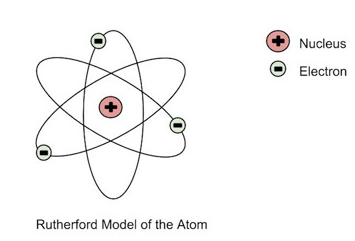
47.
Who came up with this model of an atom?
a)
J.J. Thompson
b)
Ernest Rutherford
c)
Neils Bohr
d)
James Chadwick
48.
True or False: The majority of an atom is made up of empty space
a)
True
b)
False
49.
Contributes basically no mass to an atom.
a)
protons
b)
neutrons
c)
electrons
d)
protons and neutrons
50.
The majority of an atom's mass exists where?
a)
In the nucleus
b)
In the electron cloud
c)
In the space between the nucleus and the electrons
d)
In the neutrons
51.
Which particle is responsible for the chemical properties of an atom?
a)
Neutron
b)
Protons
c)
Valence Electrons
d)
Nucleus
52.
Neon has an atomic number of 10 and an atomic mass of 20.180.  How many protons, electrons, and neutrons will it have?
a)
P=10 E=10 N=11
b)
P=5  E=5  N=10
c)
P=10  E=10  N=10
d)
P=10  E=5  N=5
53.
What element is pictured?
a)
Hydorgen
b)
Boron
c)
Beryllium
d)
Arsenic
54.
The atomic number for Oxygen is 8, so
a)
there are 8 protons in the atom
b)
the atomic mass is less than 8
c)
the mass of the atom is 8
d)
the atom is decaying
55.
What is the mass of 2.50 mol of oxygen gas O2?
a)
40.0 g
b)
80.0 g
c)
16.0 g
d)
32.0 g
56.
If I have 6.02 x10²³ molecules of CO2, what is the mass?
a)
44.0 g
b)
2.65 x10²³ g
c)
1.37 x10²² g
d)
96.0 g
57.
How many molecules are in 32.4 grams of phosphorous pentoxide?
a)
1.76 x 10²³ molecules
b)
0.29 moles
c)
1.76 x 10²² molecules
d)
0.29 molecules
58.
What is the percent by mass of sodium in NaCl?
a)
39%
b)
61%
c)
35%
d)
65%
59.
What is the percent composition by mass of magnesium in the compound MgSO4 (gram formula mass = 120 g/mol)?
a)
20%
b)
27%
c)
46%
d)
53%
60.
In which compound is the percent composition by mass of Cl equal to 42%?
a)
HClO (gram formula mass = 52 g/mol)
b)
HClO2 (gram formula mass = 68 g/mol)
c)
HClO3 (gram formula mass = 84 g/mol)
d)
HClO4 (gram formula mass = 100 g/mol)
61.
What is the molar mass of AuCl3?
a)
96 g
b)
130 g
c)
232.5 g
d)
303.3 g
62.
Fluorine is diatomic.  What is the molar mass of fluorine gas?
a)
18.998 g/mol
b)
37.996 g/mol
c)
9 g/mol
d)
18 g/mol
63.
How many moles of copper (II) chlorate contain 1.45x10²¹ formula units?
a)
8.73x1044
b)
1.20x1024
c)
0.00241
d)
1.45
64.
How many atoms would be contained in 454 grams of iron (Fe)?
a)
6.02x10²³ atoms
b)
8.14 atoms
c)
4.90x1024 atoms
d)
55.85x10²³ atoms
65.
How many grams are in 3.3 mol of Potassium Sulfide?
a)
360 g
b)
454 g
c)
238 g
d)
132 g
66.
calcium phosphate
a)
CaPO4
b)
Ca2(PO4)3
c)
Ca3PO4
d)
Ca3(PO4)2
67.
magnesium carbonate
a)
Mg2C
b)
Mg2CO4
c)
Mg2(CO3)2
d)
MgCO3
68.
Name the following ionic compound: Cr(NO2)3
a)
chromium nitrite
b)
chromium nitride
c)
chromium III nitride
d)
chromium III nitrite
69.
Which conversion factor would you use to calculate correctly the mass of 2 moles of the element titanium?
a)
1 g Ti / 47.84 mol Ti
b)
1 mol Ti / 47.84 g Ti
c)
47.84 mol / 1 g Ti
d)
47.87 g Ti / 1 mol Ti
70.
Which compound has the smallest molar mass?
a)
CO
b)
CO2
c)
H2O
d)
H2O2
71.
Which has a greater mass: 1 mole of scandium or 2 moles of boron?
a)
scandium
b)
boron
c)
neither
d)
more information is needed.
72.
What is the mass in grams of 6.25 mol of copper (II) nitrate?
a)
126 g
b)
785 g
c)
625 g
d)
1172 g
73.
What is the mass of 2.50 mol of oxygen gas O2?
a)
40 g
b)
80 g
c)
16 g
d)
32 g
74.
Avogadro's number of representative particles is equal to one_____.
a)
kilogram
b)
gram
c)
kelvin
d)
mole
75.
What is the molar mass of AuCl3?
a)
96 g
b)
130 g
c)
232.5 g
d)
303.3 g
76.
What is the mass in grams of 5.90 mol C8H18?
a)
.0512 g
b)
19.4 g
c)
673 g
d)
389 g
77.
Fluorine is diatomic (2).  What is the molar mass of fluorine gas?
a)
18.998 g/mol
b)
37.996 g/mol
c)
9 g/mol
d)
18 g/mol
78.
What is the mass of one mole of aluminum?
a)
26.982 g
b)
13 g
c)
53.985 g
d)
14 g
79.
How many molecules are in 32.4 grams of phosphorous pentoxide?
a)
1.76 x 10²³ molecules
b)
0.29 moles
c)
1.76 x 10²² molecules
d)
0.29 molecules
80.

A measure of the size of an atom, and is generally defined as the distance from the nucleus to the outermost electron orbit

a)

chemical reactivity

b)

atomic radius

c)

energy levels

d)

orbit

81.
The minimum energy required to remove an electron from the ground state of an atom
a)
electron configuration
b)
energy levels
c)
ionization energy
d)
ionic bond
82.
A negatively charged subatomic particle that exists in various energy levels outside the nucleus of an atom
a)
neutron
b)
electron
c)
proton
d)
subatomic particle
83.
The chart scientists use to organize and classify all the known elements
a)
elements chart
b)
the chart
c)
Periodic Table of the Elements
d)
Period table
84.
The tendency of an atom to attract electrons and acquire a negative charge
a)
electronegativity
b)
charge
c)
bonding ability
d)
electron configuration
85.
The energies of electrons as they orbit the nucleus of an atom
a)
energy levels
b)
orbits
c)
shells
d)
electron area
86.
Vertical columns of elements (families) on the periodic table with similar valence electron configurations and similar properties
a)
groups
b)
periods
c)
quadrants
d)
rows
87.
An electron that resides in the outermost shell, or principal quantum level, of an atom
a)
periodic trend
b)
electron shell
c)
ionic radius
d)
valence electron
88.
Which has the greater EN: 
Cl or Al?
a)
Cl
b)
Al
89.
Which has the greater EN: 
N or C?
a)
C
b)
N
90.
Which has the greater EN: 
H or F?
a)
H
b)
F
91.
Which of the following will have a larger radius than Zinc?
a)
Gallium
b)
Aluminum
c)
Magnesium
d)
Strontium
92.
Which of the following will have a higher electronegativity than arsenic (As)?
a)
Carbon (C)
b)
Neon (Ne)
c)
Antimony (Sb)
d)
Germanium (Ge)
93.
As atoms of elements in group 16 are considered in order from top to bottom, the electronegativity of each successive element....
a)
decreases
b)
increases
c)
remains the same
d)
none of the above
94.
Which atom has the largest atomic radius?
a)
potassium
b)
rubidium 
c)
francium
d)
cesium
95.
As you move down the periodic table atoms get bigger.  This is because ____________.
a)
The atoms have more mass.
b)
The atoms have more protons.
c)
The atoms have more energy levels
d)
The atoms have more nuetrons
96.
As you move across the periodic table atoms tend to get smaller because, ______________.
a)
the atoms have more mass.
b)
the atoms have less mass
c)
the atoms have more protons.
d)
the atoms have less electrons.
97.
Electronegativity is...
a)
how good an atom is at attracting electrons
b)
the ability of an atom to lose electrons
c)
the energy required to remove an electron from a specific atom
d)
how easy it is to make friends. 
98.
The atom with the largest atomic radius in Group 18 is - 
a)
Ar
b)
He
c)
Kr
d)
Rn
99.
The element with the largest electronegativity in the halogens is - 
a)
At
b)
F
c)
Cl
d)
Br
100.
The element with the lowest electronegativity in Period 3 is - 
a)
Na
b)
Cl
c)
Ar
d)
Mg
101.
Which periodic group has the smallest atomic radius?
a)
Alkali metals
b)
Halogens
c)
Noble Gases
d)
Transition metals
102.
Which orbital block corresponds to transition metals in the periodic table?
a)
s
b)
p
c)
d
d)
f
103.
Which of the following atoms would you expect  to have the largest atomic radius?
a)
Li
b)
K
c)
Ca
d)
Br
104.
A group of elements that includes the most active of the elements is the -
a)
halogens.
b)
noble gases.
c)
nitrogen group.
d)
alkaline earth metals.
105.
Put the following elements in order of decreasing ionization energy:
O, Te, Po, S.
a)
O, S, Po, Te
b)
O, S, Te, Po
c)
O, Te, Po, S
d)
O, Po, Te, S
106.
Which is larger:
Ca or Ca+2
a)
Ca
b)
Ca+2
c)
both are same size
107.
Which is larger:
P or P-3
a)
P
b)
P-3
c)
both are same size
108.
The atoms along the staircase are called 
a)
metals
b)
nonmetals
c)
metalloids
d)
noble gases
109.
The major difference between a 1s orbital and a 2 s orbital is that
a)
the 2 s orbital is at a higher energy level.
b)
the 2s orbital has a slightly different shape.
c)
the 1 s orbital can have only one electron.
d)
the 2s orbital can hold more electrons.
110.
The p orbitals are shaped like
a)
circles.
b)
dumbbells.
c)
spheres.
d)
electrons.
111.
A spherical electron cloud surrounding an atomic nucleus would best represent
a)
a px orbital.
b)
a combination of an s and a px orbital.
c)
an s orbital.
d)
a combination of px and py orbitals.
112.
The element with electron configuration 1s22s22p63s23p2
a)
Si
b)
Mg
c)
S
d)
C
113.
The Pauli exclusion principle states that no two electrons in the same orbital can 
a)
have the same set of quantum numbers.
b)
be at the same main energy level.
c)
have the same spin.
d)
occupy the same orbital.
114.
The electron configuration for the carbon atom (C)is 1s22s22p2. The atomic number of carbon is 
a)
3.
b)
11.
c)
12.
d)
6.
115.
The atomic sublevel with the next hightest energy after 4p is
a)
5s
b)
4f
c)
5p
d)
4d
116.
The part of the atom where the electrons CANNOT be fond is the 
a)
orbitals.
b)
nucleus.
c)
electron cloud.
d)
area surrounding the nucleus
117.
With the quantum model of the atom, scientists have come to believe that determining an electron's exact location around the nucleus.
a)
can be done before 2005.
b)
can be done only with specialized equipment.
c)
is impossible.
d)
can be done easily.
118.
The statement that an electron occupies the lowest available energy orbital is 
a)
the Pauli exclusion principle.
b)
Hund's rule.
c)
the Aufbau principle.
d)
Bohr's law.
119.
A single orbital in the 3d level can hold ______ electrons.
a)
6
b)
2
c)
3
d)
10
120.
What is the electron configuration for nitrogen?
a)
1s22s22p23s1
b)
1s22s32p1
c)
1s22s32p2
d)
1s22s22p3
121.
The electron notation for aluminum is 
a)
1s22s22p63s22d1
b)
1s22s22p33s23d1
c)
1s22s22p63s23p1
d)
1s22s22p9
122.
Which of the following rules requires that each of the p orbitals at a particular energy level receive one electron before any of them can have two electrons?
a)
the Pauli exclusion principle
b)
Hund's rule.
c)
the Aufbau principle.
d)
the quantum rule.
123.
The main energy levels of an atom are indicated by the 
a)
magnetic quantum numbers.
b)
principal quantum numbers.
c)
orbital quantum numbers.
d)
spin quantum numbers.
124.
The region outside the nucleus where an electron can most probably be found is the
a)
s sublevel.
b)
electron cloud.
c)
quantum.
d)
electron configuration
125.
What element's orbital diagram is shown in the figure?
a)
stontium
b)
chromium
c)
antimony
d)
fluorine
126.
Which element has the following noble gas notation [Ar]4s23d104p5?
a)
bromine
b)
calcium
c)
helium
d)
boron
127.
A 3-D region around a nucleus where electrons may be found is called a(n)
a)
spectral line.
b)
electron path.
c)
orbital
d)
Pauli exclusion.
128.
The total number of orbitals that can exist in a p sublevel is 
a)
5
b)
3
c)
1
d)
7
129.

How much C12H22O11 solute is saturated at 40 degrees?

a)

240

b)

220

c)

230

d)

250

130.

How much KNO3 solute is saturated at 40 degrees?

a)

75

b)

55

c)

65

d)

85

131.

How much Ce2(SO4)3 solute is saturated at 80 degrees?

a)

20

b)

15

c)

30

d)

2

132.

How much NaBr solute is saturated at 70 degrees?

a)

110

b)

120

c)

130

d)

140

133.

At what temperature can you fully dissolve 140g of NaNO3?

a)

62

b)

73

c)

81

d)

You cannot determine this

134.

At what temperature can you fully dissolve 60g of KNO3?

a)

27

b)

30

c)

37

d)

You cannot determine this

135.

At what temperature can you fully dissolve 120g of NaBr?

a)

70

b)

20

c)

100

d)

You cannot determine this

136.

What type of a solution is 60g NaNO3 at 40ºC in 100g H2O?

a)

Saturated

b)

Unsaturated

c)

Supersaturated

137.

What type of a solution is 100g KNO3 at 40ºC in 100g H2O?

a)

Saturated

b)

Unsaturated

c)

Supersaturated

138.

What type of a solution is 260g sugar at 50ºC in 100g H2O?

a)

Saturated

b)

Unsaturated

c)

Supersaturated

139.

What type of a solution is 25g NaCl at 70ºC in 100g H2O?

a)

Saturated

b)

Unsaturated

c)

Supersaturated

140.
CH4 + 2O2 --> 2H2O + CO2
What is the mass of CO2 produced when 35g of O2 reacts? 
a)
1.09 g
b)
24.1 g
c)
28.2 g
d)
44.0 g
141.

N2 + 3 H2 → 2 NH3

How many moles of NH3 will be formed from 1 mole of H2?

a)

4 moles

b)

2/3 moles

c)

3/2 moles

d)

6 moles

142.
1 Cheese + 2 Bread --> 1 Grilled cheese
How many grilled cheeses can you make with 26 slices of bread and 14 pieces of cheese?
a)
14
b)
13
c)
26
d)
7
143.
N2 +  3H2 → 2NH3 
How many moles of hydrogen are needed to react with 2 moles of nitrogen?
a)
6
b)
2
c)
3
d)
1
144.

Given the equation:

2NaClO3 (s) → 2NaCl (s) + 3O2 (g)

2.00 moles of NaClO3 will produce how many grams of O2? (mass of O2 = 32g/mol)

a)

56 g of O2

b)

96 g of O2

c)

64 g O2

d)

32 g O2

145.

2 NaClO3 (s) --> 2NaCl (s) +3 O2 (g)

12.00 moles of NaClO3 will produce how many grams of O2?

a)

256 g of O2

b)

576 g of O2

c)

288 g O2

d)

32 g O2

146.
Fe2O3 + 3H2 → 2Fe + 3H2O
About how many grams of H2O will be produced from 150 grams of Fe2O3
a)
50 grams H2O
b)
60 grams H2O
c)
5000 grams H2O
d)
6000 grams H2O
147.
CH4 + 2 O2 → CO2 + 2 H2O
How many moles of carbon dioxide are produced from the combustion of 110 g of CH4?
a)
13.7 mol
b)
2.75 mol
c)
6.11 mol
d)
6.85 mol
148.
How many elements are in C6H12O6?
a)
1
b)
2
c)
3
d)
4
149.
How many atoms of carbon (C) are in C6H12O6?
a)
3
b)
6
c)
12
d)
24
150.
Element or compound?
H2O
a)
element
b)
compound
151.
Element or compound?
O2
a)
Element
b)
Compound
152.
Which of the following is a compound?
a)
Co
b)
O2
c)
C
d)
CO2
153.
Which is the correct formula for:
 three hydrogen (H)
one sulfur (S)
four oxygen (O)
a)
H3SO4
b)
HSO4
c)
H4S3O
d)
H2O
154.
The red numbers in the image below represent ________
a)
subscripts
b)
coefficients
c)
I don't know, and don't want to try
d)
None of the answers are correct
155.
The substances at the beginning of a chemical equation are called the ____
a)
product
b)
yield
c)
chemical symbol
d)
reactants
156.
In the equation,          2Mg + O2 ---> 2MgO, which are the reactants?
a)
Mg and O
b)
MgO
c)
Mg and MgO
d)
O and MgO
157.
How many atoms of aluminum are on each side of the following equation: 4Al + 3O--> 2AlO3
a)
2
b)
6
c)
1
d)
4
158.
Number of H in 3(NH₄)₂CrO₄
a)
4
b)
2
c)
8
d)
24
159.
Evidence of a chemical reactions is anything that shows - 
a)
a new substance has formed
b)
a solid dissolved in a liquid
c)
interaction between 2 gases
d)
a change in the state of matter
160.
One of the signs of a chemical reaction taking place is:
a)
Bubbles are produced 
b)
Reactants are not combining
c)
Products are not forming
d)
Color is not changing
161.
Which is NOT an indication of a chemical change?
a)
temperature change
b)
formation of a precipitate
c)
shape change
d)
production of light
162.
What is the Law of Conservation of Mass?
a)
It states that no matter can be created or destroyed.
b)
It states that no energy can be created or destroyed.
c)
It states that matter can be created or destroyed.
d)
It states that no sound can be created or destroyed.
163.
Is the equation balanced?: 2H2O + O2 --> 4MgO + 3Fe
a)
Yes
b)
No
164.
Balance this equation.
_CF+ _Br-- _CBr+ _F2
a)
2,1,2,1
b)
1,2,2,1
c)
1,2,1,2
d)
2,2,2,2
165.
When balancing equations a ____ can be placed to the left of a formula of a substance to make the equations balanced
a)
charge
b)
subscript
c)
random number
d)
coefficient
166.

2NaCl + CaO --> ___Na2O + CaCl2

a)

1

b)

2

c)

3

d)

4

167.
Which of the following is an example of an exothermic reaction?
a)
Freezing
b)
Melting
c)
Evaporating
d)
Subliming
168.
Which of the following symbols is not a correct indication of the phase of a substance in a reaction? 
a)
(s)=solid
b)
(g)=grams
c)
(l)=liquid
d)
(aq)= aqueous
169.
Which of the following shows the correct way to balance the chemical equation?
Fe + O2 -> Fe2O3
a)
4Fe + 3O2 -> 2Fe2O3
b)
2 Fe + 3O2 -> Fe2O6
c)
4 Fe + O6 -> 2Fe2O3
d)
None of the options are correctly balanced.
170.
Balance this equation...
H2 + Cl2 --> HCl
a)
It is balanced 
b)
3H2 + Cl2 --> 6H2Cl
c)
H2 + Cl2 --> 2HCl
d)
I don't know! Oh well.