wayground logo

Free Printable Worksheets

Font size

S
M
L
XL
Worksheets

Elements & Principles of Design

Total questions: 70

Worksheet time: 5hrs 53mins

Name
Class
Date
1.

The Elements of Art are:

a)

The rules of art

b)

The building blocks of art

c)

The materials used to make art

d)

The place you go to look at art

2.

Line is

a)

the lightness or darkness of a color or shade

b)

something that goes straight in either direction forever

c)

a moving point

d)

a Principle of Design

3.

The Principles of Design are:

a)

The building blocks of Art

b)

The rules of art

c)

The materials used to make art

d)

The place you go to look at art

4.

Shape is:

a)

the lightness or darkness of a color or shade

b)

a moving point

c)

an area enclosed by a line

d)

the area between objects in an artwork

5.

Complementary colors are:

a)

colors that look good together

b)

opposites on the color wheel

c)

side by side on the color wheel

d)

one color plus black and white

6.

Analogous colors are

a)

colors that look good together

b)

colors that are side by side on the color wheel

c)

colors that are opposites on the color wheel

d)

one color plus black and white

7.

Brown, black, grey, and white are______________ colors

a)

primary

b)

secondary

c)

tertiary

d)

neutral

8.

Primary colors are

a)

blue, black, red

b)

blue, black, purple

c)

blue, green, purple

d)

blue, red, yellow

9.

Secondary colors are:

a)

red, blue, black

b)

blue, green, purple

c)

purple, orange, green

d)

purple, blue, red

10.

How do you make a secondary color?

a)

mix two tertiary colors together in equal amounts

b)

mix two primary colors together in equal amounts

c)

mix a primary and a tertiary color together in equal amounts

d)

mix one color with black or white

11.

Tertiary colors are:

a)

red-orange, yellow-orange, yellow-green, blue-green, blue-violet, and red-violet

b)

red, red-orange, orange, yellow-orange, yellow, yellow-green, green, and blue-green

c)

red, orange, yellow, green, blue, indigo, violet

d)

black, dark red, red, light red, white

12.

You make a tertiary color by

a)

mixing two primary colors

b)

mixing one primary color and one tertiary color

c)

mixing one primary color with one secondary color

d)

mixing one primary color with black and white

13.

What is an example of a monochromatic color scheme?

a)

red, yellow, blue

b)

red, red-orange, orange, yellow-orange, yellow

c)

red, orange, yellow, blue, indigo, violet

d)

black, dark red, red, light red, white

14.

How do you create value in an artwork?

a)

by adding complementary colors

b)

by adding dark and light

c)

by adding patterns

d)

by adding shapes

15.

Texture can be ______________ if you can feel it, or _______________ if it's 2-D

a)

factual, imagined

b)

real, pretend

c)

positive, negative

d)

actual, implied

16.

Shapes can be either _______ or _________

a)

geometric, abstract

b)

geometric, neutral

c)

geometric, radial

d)

geometric, organic

17.
What you see when you look at an artwork is called the:
a)
theme
b)
subject
c)
background
d)
picture
18.
Shapes are
a)
the form of an object
b)
two-dimensional
c)
three-dimensional
d)
open spaces
19.
A three-dimensional object is called:
a)
a square
b)
a mold
c)
a form
d)
a circle
20.
Which color is an example of a warm color?
a)
Red
b)
Yellow
c)
Orange
d)
All of These!
21.
Which color is an example of a cool color?
a)
Purple
b)
Yellow
c)
Secondary Color
d)
Flurple
22.
Blue + Yellow =
a)
Flurple
b)
Green
c)
Light Blue
d)
Orange
23.

This scheme uses different values of a single hue

a)

Color

b)

Intensity

c)

Analogous

d)

Monochromatic

24.
What element of art is best represented in this picture?
a)
Line
b)
Form
c)
Value
25.
What element of art is defined as the lightness or darkness of a color?
a)
Value
b)
Hue
c)
Intensity
26.
What is created when light is reflected off a surface?
a)
Sparkles
b)
Lines
c)
Color
27.
The area in and around objects.
a)
Space
b)
Shape
c)
Line
28.
The surface quality or ______________ is how things are seen or felt. 
a)
Shape
b)
fuzzy
c)
Texture
29.
A ______________ can be long, short, diagonal, vertical, squiggly, thick or thin.
a)
Line
b)
Space
c)
Value
30.
What element of art is best represented in this picture?
a)
Color
b)
Line
c)
Texture
d)
Shape
31.
What element of art is best represented in this picture?
a)
Shape
b)
Line
c)
Texture
d)
Color
32.
An element of art that refers to the lightness and darkness of a color.
a)
hue
b)
value
c)
movement
d)
contrast
33.
A mark with length and direction, created by a point that moves across a surface.
a)
line
b)
value
c)
contrast
d)
form
34.
The empty or open area between, around, above below and within objects.
a)
form
b)
balance
c)
color
d)
space
35.
Any three dimensional object that can be measured by height, width and depth.
a)
emphasis
b)
space
c)
form
d)
shape
36.
The element of art that refers to the surface quality of an object or the way something feels such as rough-smooth
a)
shape
b)
texture
c)
color
d)
line
37.
A flat figure created when actual or implied lines surround a space-can be geometric or organic
a)
line
b)
form
c)
shape
d)
space
38.
Element of art produced when a wavelength of light strikes an object and reflects back to the eyes.
a)
primary
b)
secondary
c)
teriary
d)
color
39.
________________ can be recognizable like squares, triangles, or circles, or they can be organic.
a)
Lines
b)
Value
c)
Shape
40.
What element of art is best represented in this picture?
a)
Color
b)
Line
c)
Shape
d)
Form
41.
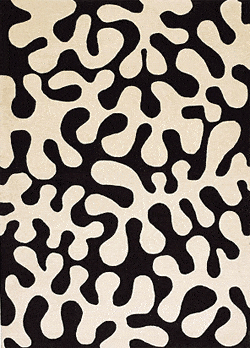
What phrase best describes this image?
a)
geometric forms
b)
geometric shapes
c)
organic shapes
d)
organic forms
42.
Which letter shows an example of negative space?
a)
S
b)
H
c)
I
d)
F
43.
What three colors are called "Primary" colors?
a)
Red, orange, yellow
b)
Blue, Green, Purple
c)
Red, red-orange, red-yellow
d)
Red, blue, yellow
44.
What three colors are the Secondary Colors?
a)
Red, Yellow, Blue
b)
Blue, Green, Violet
c)
Orange, Green, Violet
d)
Red, Orange, Yellow
45.
Which of the following colors can be described as "Warm" colors?
a)
Red, Orange, Yellow
b)
Blue, Green, Violet
c)
Blue, Yellow, Red
d)
Green, Orange, Violet
46.
Which of the following colors are "cool colors?"
a)
Black, grey, white
b)
Green, blue, violet
c)
Red, yellow, orange
d)
Green, orange, violet
47.
What element allows you to "feel" a subject?
a)
Texture
b)
Shape
c)
Line
d)
Balance
48.
What is the three-dimensional version of a shape?
a)
Line
b)
Space
Space
c)
Value
d)
Form
49.
The attached picture is known as a ________ __________
a)
chart graph
b)
color wheel
c)
value scale
d)
graph chart
50.
All the shapes in the picture are what kind of shape? 
a)
geometric
b)
organic
51.
There are 2 types of space, they are __________ and ____________. 
a)
Right and Wrong
b)
Positive and Negative
c)
Dark and Light
d)
Black and white
52.
Shape is _____ where as Form is ______. 
a)
2d, 3d
b)
4d, 5d
c)
flat, round
d)
1d, 2d
53.
All the shapes in the picture are characterized as...
a)
organic
b)
geometric
c)
wavy
d)
straight
54.

Principle of art which refers to the decoration of the surface of art with repeated units.

a)

contrast

b)

pattern

c)

rhythm

d)

balance

e)

movement

55.
The principle defined as the difference between elements in an artwork.
a)
Unity
b)
Balance
c)
Texture
d)
Contrast
56.
The principle of design that creates a focal area in a work of art?
a)
Emphasis
b)
Color
c)
Rhythm
d)
Movement
57.
This principle directs the viewers eye around the artwork.
a)
Mosaic
b)
Harmony
c)
Movement
d)
Rhythm
58.
This principle is typically decorative and consists of planned and repeated units.
a)
Rhythm
b)
Shape
c)
Pattern
d)
Repetition
59.
The principle that means all is in harmony.  Variety adds visual interest.
a)
Unity
b)
Balance
c)
Harmony
d)
Pattern
60.
This principle of design includes:  symmetrical, asymmetrical, radial, and approximate symmetry.
a)
Movement
b)
Balance
c)
Elements of Art
d)
Pattern
61.
Comparing parts of a whole is called:
a)
Scale
b)
Proportion
c)
Contrast
d)
Balance
62.
Using many different elements to create interest or contrast in an artwork is called:
a)
Variety
b)
Unity
c)
Balance
d)
Value
63.
The way an artwork is arranged is called:
a)
design
b)
composition
c)
frame
d)
photo
64.
Using similar elements to create a single theme
a)
unity
b)
variety
c)
emphasis
d)
space
65.
The focal point of an artwork is also called:
a)
background
b)
rhythm
c)
emphasis
d)
pattern
66.
The appearance of motion is called:
a)
calibration
b)
animation
c)
design
d)
movement
67.
A repeated design is called a:
a)
principle
b)
pattern
c)
element
d)
shape
68.
The amount of difference between things is called:
a)
contrast
b)
value
c)
variety
d)
unity
69.
The "rules" that  govern how artists organize the elements of art.
a)
Elements of Art
b)
Principles of Design
c)
Project Rubric
d)
Interactive Notebook
70.

It is a concept in visual arts in which the frame is divided into nine imaginary sections as reference points which act as guides for framing the image.

a)

ruler

b)

thumbnail

c)

rule of thirds

d)

frame grids