
 Worksheets
AP Biology First Semester Final Review
Total questions: 250
Worksheet time: 9hrs 37mins
Name
Class
Date
1.
An experiment is performed on plants to see how different liquids affect plant growth. Each plant in the experiment is given a different liquid; water, apple juice, or milk. Each plant has the same amount of soil, sunlight, and listens to the same music. In this investigation, the independent variable is ...
a)
The type of plant
b)
The amount of sunlight
c)
The type of music
d)
The type of liquid
2.
A student is planning an experiment to find out how the height from which he drops a ball affects how high the ball bounces. The dependent variable is the _____.
a)
Diameter of the ball
b)
Force acting on the ball
c)
Height that the ball bounces
d)
Height from which the ball is dropped
3.
Lauren is convinced that book/movie combinations are better if you have read the book before watching the movie. Lauren's friend, Alyssa, thinks that movies are just as good even if you don't read the book. They got 40 of their classmates to help them solve their debate. 20 classmates read the book Divergent and 20 more classmates viewed the movie without reading the book. All participants went to see the movie on Friday at 6 p.m. They had their classmates do a survey (1-4 stars). Then, Alyssa and Lauren averaged the number of stars for both groups.
What is the dependent variable?
What is the dependent variable?
a)
The length of the movie
b)
The time the movie starts
c)
The # of stars the movie gets
4.
Mr. S set up an experiment to see how the mass of a ball affects the distance it rolls off a ramp. Identify the independent variable.
a)
Distance traveled by the ball
b)
Height of the ramp
c)
Mass of the ball
5.
Mr. S set up an experiment to see how the mass of a ball affects the distance it rolls off a ramp. What is the dependent variable?
a)
Distance traveled by the ball
b)
Height of the ramp
c)
Mass of the ball
6.
Jessie is concerned about how tired his classmates seem. He created a drink that he thinks will boost their energy. He recruits 100 classmates with a history of tiredness. He has 50 of them drink his new special energy drink. The other 50 drink a beverage that looks like the special energy drink, but is just water and food coloring. Both groups were told that they were getting the special drink that would boost energy. After 2 hours, 30 classmates in the first group reported having more energy and 8 classmates in the second group reported having more energy.
What is the dependent variable?
What is the dependent variable?
a)
Amount of energy
b)
100 classmates
c)
Special energy drink
7.
Maria wants to know if birds prefer to eat in one place over another. She makes three feeders out of 2-liter bottles and paints all of them red. She fills each of the feeders with the same amount of mixed birdseed, and plans to keep the feeders out for 10 days before measuring how much seed is eaten from each feeder. She puts each of the feeders in her back yard: one feeder in a large dead tree, another feeder she sits on the dog house, and the last she sits in a small bushy tree.
What is the independent variable?
What is the independent variable?
a)
Red birdfeeders
b)
Placement of birdfeeders
c)
Amount of seed
8.
Maria wants to know if birds prefer to eat in one place over another. She makes three feeders out of 2-liter bottles and paints all of them red. She fills each of the feeders with the same amount of mixed birdseed, and plans to keep the feeders out for 10 days before measuring how much seed is eaten from each feeder. She puts each of the feeders in her back yard: one feeder in a large dead tree, another feeder she sits on the dog house, and the last she sits in a small bushy tree.
What is the dependent variable?
What is the dependent variable?
a)
Length of the birdfeeders
b)
Amount of time feeders are outside
c)
Amount of seed eaten
9.
Scientific Question: Does being tardy impact test scores?
What is the dependent variable?
What is the dependent variable?
a)
test scores
b)
the time a study arrives to class
c)
amount of time to complete test
10.
the variable that is changed by the scientist at the beginning of the experiment
a)
independent variable
b)
dependent variable
c)
control variable
11.
the variable that is observed at the end of the experiment
a)
independent variable
b)
dependent variable
c)
control variable
12.
There are two types of data. Which type of data involves numbers that are obtained by counting or measuring?
a)
quantitative
b)
qualitative
13.
There are two types of data. Which type of data involves descriptions that cannot be counted or measured?
a)
qualitative
b)
quantitative
14.
In a controlled experiment, how many variables can be worked with at a time?
a)
one
b)
none
c)
two or more
d)
how ever many makes sense.
15.

What is this?
a)
Balance
b)
Beaker
c)
Flask
d)
Graduated cylinder
16.

What is this?
a)
flask
b)
beaker
c)
graduated cylinder
d)
cup
17.
Which one of the following is NOT an example of quantitative data?
a)
number of flowers on a plant
b)
size of a flower
c)
height of a flower
d)
color of a flower
18.

What is an observation for this picture?
a)
The man is scared
b)
The man is going to get eaten
c)
There is a man in a kayak
d)
The man is paddling fast
19.
Dolphins have smooth skin.
a)
quantitative observation
b)
qualitative observation
20.

What type of graph is this?
a)
Bar Graph
b)
Line Plot
c)
Pictograph
d)
Tally Chart
21.
What do we put at the top of a graph?
a)
X axis
b)
data table
c)
title
d)
nothing
22.
What is the name of the vertical (up and down) axis of the graph?
a)
X axis
b)
Y axis
23.
What is the name of the horizontal (side to side) axis of the graph?
a)
X axis
b)
Y axis
24.
Jeff is 6 feet 2 inches is a ___________ observation.
a)
Qualitative
b)
Quantitative
25.

The weather is cold.
a)
inference
b)
observation
c)
prediction
26.

The tree branch is broken.
a)
inference
b)
observation
c)
prediction
27.

The boy is in the water.
a)
inference
b)
observation
c)
prediction
28.
What is the part of the experiment that is left alone or “natural", and is used to compare back to?
a)
Independent Variable
b)
Dependent Variable
c)
Control Group
d)
Experimental Group
29.
What skill is a scientist using when she listens to the sounds that an elephant makes?
a)
drawing conclusions
b)
making observations
c)
interpreting data
d)
making a hypothesis
30.
How many millimeters are in 1,064 cm?
a)
10,640
b)
106.4
c)
10.64
d)
106,400
31.
There are ___ meters in 25 kilometers (km)
a)
250 m
b)
2500 m
c)
25000 m
d)
.025 m
32.
There are ___ millimeters(mm) in 2.7 centimeters (cm)
a)
270 mm
b)
.27 mm
c)
27 mm
d)
.027 mm
33.
Convert 0.25 m to mm
a)
25
b)
2.5
c)
250
d)
0.025
34.
convert 30 cm to m
a)
300
b)
3
c)
0.03
d)
0.3 m
35.
convert 9 km to mm
a)
900,000
b)
9,000,000
c)
9,000
d)
90,000
36.
convert 0.7 cm to m
a)
70
b)
0.07
c)
0.007
d)
7
37.
Which is more 4 kg or 3,000 g?
a)
4 kg
b)
3,000 g
38.
Convert 65 mg to g
a)
65 g
b)
.65 g
c)
.065 g
d)
.0065 g
39.
How many dag are in 4.6 kg?
a)
.046
b)
46
c)
.00046
d)
460
40.
0.57 mL = ___________ L
a)
5.7
b)
0.057
c)
0.0057
d)
0.00057
41.
1234 mg = ___________ kg
a)
0.0001234
b)
0.001234
c)
0.01234
d)
0.1234
42.
Should experiments be repeated over and over to see if the results are the same each time?
a)
yes
b)
no
43.

What piece of lab equipment is this?
a)
Erlenmeyer Flask
b)
Graduated cylinder
c)
Beaker
d)
Round flask
44.
Find the median of these numbers:
4, 2, 7, 4, 3
4, 2, 7, 4, 3
a)
2
b)
5
c)
7
d)
4
45.
Find the mean of these numbers:
5,11,2,12,4,2
5,11,2,12,4,2
a)
4.1
b)
6
c)
4.5
d)
4
46.
Roger bowled 7 games last weekend. His scores are: 155, 165, 138, 172, 127, 193, 142. What is the range of Roger's scores?
a)
193
b)
127
c)
60
d)
66
47.
What is the mean?
a)
# happening the most
b)
the number in the middle
c)
biggest-smallest
d)
the average
48.
What is the median?
a)
biggest- smallest
b)
average
c)
the middle #
d)
# that happens the most
49.
What is the range?
a)
average
b)
biggest-smallest
c)
the middle #
d)
# happening the most
50.
Find the mean of these numbers:
4,2,5,6,3
4,2,5,6,3
a)
2
b)
5
c)
4
d)
6
51.
Find the median of these numbers:
4,2,7,4,3
4,2,7,4,3
a)
2
b)
5
c)
7
d)
4
52.
Find the mode of these numbers:
4,3,6,4,3,6,6,3,2,1,3
a)
3
b)
6
c)
4
d)
2
53.
Find the range of these numbers:
15,2,3,7,8,4,3,2,16,2,4
15,2,3,7,8,4,3,2,16,2,4
a)
2
b)
13
c)
14
d)
7
54.
Find the mode of these numbers:
4,4,6,6,2,2,6,2,4,2
4,4,6,6,2,2,6,2,4,2
a)
2
b)
4
c)
6
d)
2.4
55.
Find the median, mode and range:
3, 5, 7, 9, 11, 8, 3
3, 5, 7, 9, 11, 8, 3
a)
mean : 6.9 median: 11 mode:3 range:6
b)
mean: 7.2 median: 6 mode:3 range:2
c)
mean: 6.5 median: 7 mode:3 range:8
56.
Tigers, Jellyfish, Gorillas and Sponges are all part of kingdom _______.
a)
Animalia
b)
Plantae
c)
Fungi
d)
Bacteria
57.
Which kingdom is autotrophic AND has a cell wall?
a)
Bacteria
b)
Fungi
c)
Plantae
d)
Protista
58.

You would find mushrooms in which kingdom?
a)
Plantae
b)
Protists
c)
Fungi
d)
Animalia
59.
The scientific name for an organism is made from the:
a)
class and family name
b)
genus and species name
c)
domain and kingdom name
d)
kingdom and phylum name
60.
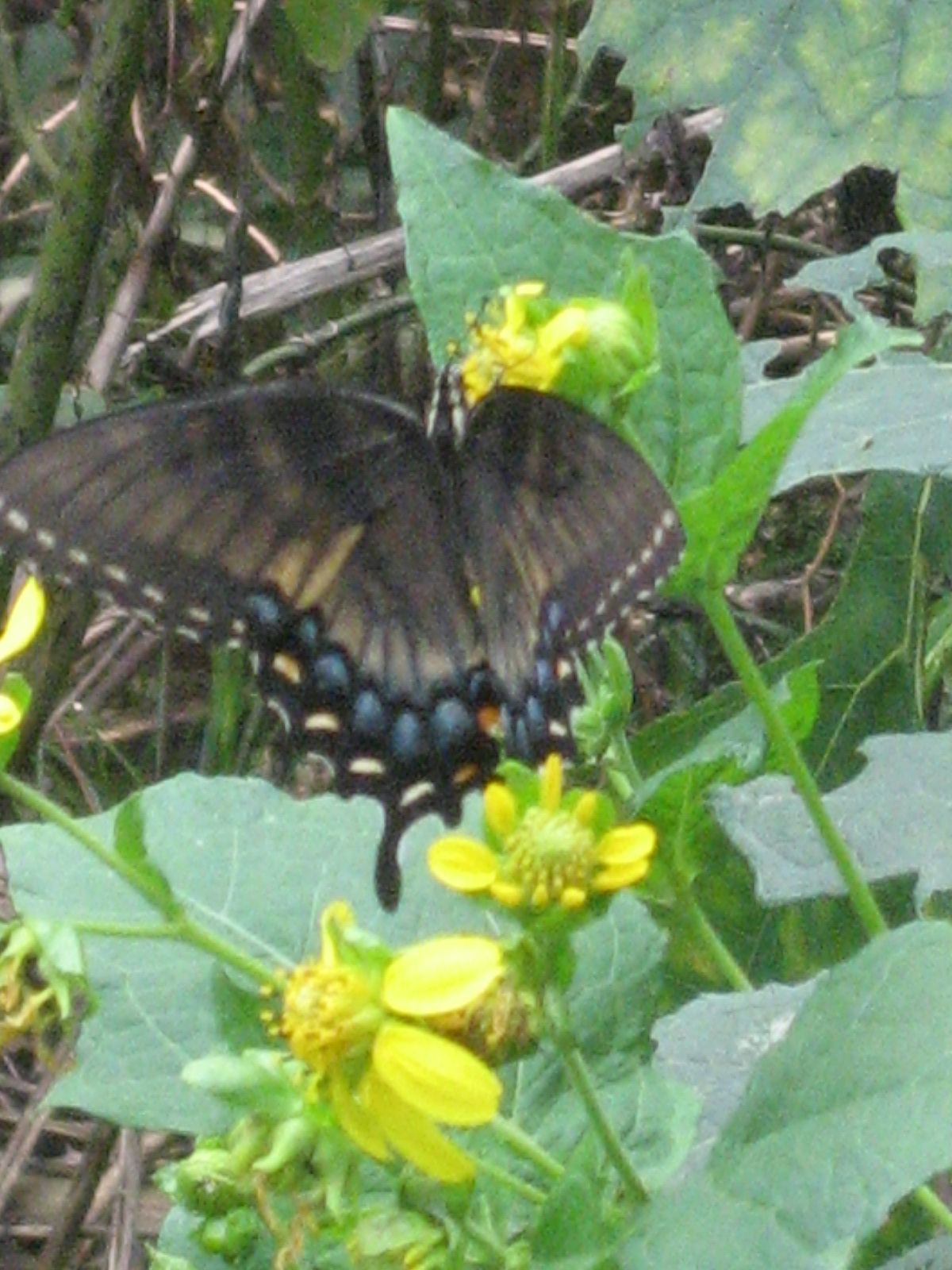
The 8 levels of classification, most broad to most specific.
a)
Domain, Genus, Family, Order, Class, Phylum, Kingdom, Species
b)
Domain, Species, Kingdom, Genus, Phylum, Family, Class, Order
c)
Domain, Kingdom, Phylum, Class, Order, Family, Genus, Species
d)
Order, Kingdom, Species, Domain, Phylum, Family, Class, Genus
61.

An illustration and a dichotomous key are given. What is the correct classification for this organism?
a)
Class Insecta
b)
Order Amblygygi
c)
Order Araneae
d)
Order Scorpiones
62.

A dichotomous key for trees is provided. Hikers found a tree that has large brown cones and single sharp needles. What species of tree have the hikers found?
a)
Juniper
b)
Pine
c)
Spruce
d)
Fir
63.
Which of the following organisms are MOST closely related?
a)
organisms that share a domain
b)
organisms that share a family
c)
organisms that share a genus
d)
organisms that share an order
64.
Which of the following characteristics will most likely be helpful in identifying a butterfly using a dichotomous key?
a)
Migrates north every spring
b)
hangs on branches
c)
flutters wings fast on hot days
d)
Wings have long extensions
65.
What is the most specific level of classification?
a)
Family
b)
Domain
c)
Species
d)
Carolus Linnaeus
66.

Which domain includes all animals and plants?
a)
Archaea
b)
Eukarya
c)
Bacteria
67.

Which two kingdoms are entirely multicellular?
a)
Animalia and Plantae
b)
Animalia and Protista
c)
Protista and Plantae
68.
To say that an organism is heterotrophic means...
a)
it cannot reproduce asexually
b)
it cannot make its own food
c)
it cannot breathe oxygen gas
69.
Organisms whose cells have NO nucleus are classified as...
a)
Eukaryotic
b)
Prokaryotic
c)
Dead
70.
True or False: All living things are made of one or more cells.
a)
True
b)
False
71.
What is the genus name here:
Canis lupus
Canis lupus
a)
Canis
b)
lupus
72.
In which kingdom do I belong if I am unicellular, autotrophic, and eukaryotic?
a)
Archaebacteria
b)
Protista
c)
Animalia
d)
Plantae
73.
What are the three domains?
a)
Archaea, Bacteria, and Eubacteria
b)
Archaea, Protista, and Eubacteria
c)
Archaea, Bacteria, and Eukarya
d)
Archaea, Fungi, Animalia
74.

A student discovers an arachnid with a segmented abdomen, long legs, and a tail with no stinger. The student uses the dichotomous key below to identify it. Which arachnid has the student found?
a)
Whip Scorpion
b)
Wind Scorpion
c)
Daddy long legs
d)
Scorpion
75.
Which of the following organisms are LEAST closely related?
a)
organisms that share a domain
b)
organisms that share a family
c)
organisms that share a genus
d)
organisms that share a species
76.
Organisms are the same ___________ when they can have offspring, then those have more offspring.
a)
Class
b)
Family
c)
Species
d)
Phylum
77.
An organism made up of more than one cell would be called:
a)
multicellular
b)
unicellular
c)
heterotroph
d)
autotroph
78.
Which of the following is NOT an example of natural selection?
a)
People selectively breeding hamsters.
b)
Insect populations developing resistance to certain pesticides.
c)
Bacteria becoming resistant to antibiotics.
d)
Male birds of certain species developing colorful feathers to attract female mates.
79.
What characteristic did Darwin observe about the finches on the Galapagos Islands?
a)
Their feathers
b)
Genotypes
c)
Their beaks
d)
Their body sizes
80.
Which term refers to the process by which individuals that are better suited to the environment survive and reproduce therefore passing down their genes to their offspring?
a)
Evolution
b)
Variation
c)
Adaptation
d)
Natural Selection
81.

Which species’ DNA is most similar to the DNA of the toothed whale?
a)
Hippopotamus
b)
Baleen Whale
c)
Grazing Mammals
d)
Camels
82.
When an organism completely dies out, it is called.....
a)
Adaption
b)
Extinction
c)
Fossilization
d)
Mutation
83.

Change over time...
a)
Evolution
b)
Nucleotide
84.
Who is the father of evolution?
a)
Darwin
b)
Mendel
c)
Newton
d)
Einstein
85.
What is another name for natural selection?
a)
survival of the smartest
b)
survival of the fastest
c)
survival of the biggest
d)
survival of the fittest
86.
What is a change in an organism that allows for it to survive in its environment?
a)
homologous
b)
vestigial
c)
variation
d)
adaptation
87.
What is an organism that has similar characteristics and can reproduce?
a)
species
b)
organism
c)
embryology
d)
vestigial
88.

What is this an example of?
a)
diversity of species
b)
variation
c)
vestigial structures
d)
DNA studies
89.
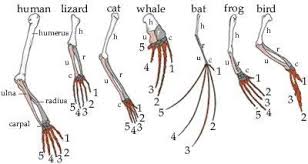
What is this an example of?
a)
vestigial structures
b)
embryology
c)
homologous structures
d)
fossil record
90.
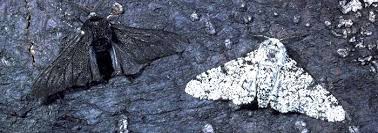
Predict which moth would increase in population
a)
light
b)
dark
91.
Why are advantageous traits more likely to be passed onto offspring?
a)
Because they are more likely to survive and reproduce.
b)
Because they come from dominant alleles.
c)
Because they come from recessive alleles.
d)
Because the trait is an acquired phenotype.
92.
The ability of an organism to survive and reproduce in its specific environment
a)
diversity.
b)
evolution
c)
adaptation
d)
fitness
93.
The white feathers of a snowy owl allow it to blend in with its environment during the winter months (snow). This is an example of ________________
a)
Species
b)
Environmental Change
c)
Adaptation
d)
Variation
94.
What is the advantage of having different shaped beaks?
a)
To look different from other species.
b)
To be able to eat the food readily available in the environment.
c)
To protect itself against predators.
d)
To protect itself against prey.
95.
Remains of ancient organisms are called
a)
Extinctions
b)
Fossils
c)
Mutations
d)
Variations
96.

what did Charles Darwin observe in finch populations of the Galapagos Islands off the coast of South America?
a)
different species on different islands
b)
all species on one of the islands
c)
identical species on all the islands
d)
the same species as North America
97.
What is suggested by the anatomical similarity of different species of vertebrates?
a)
no evolutionary relationships between the groups
b)
recent common ancestry
c)
similar environments in the past
d)
evolution from a distant common ancestor
98.

Some organisms that share a common ancestor have features that have different functions, but similar structures. These are known as
a)
vestigial structures
b)
analogous structures
c)
homologous structures
d)
fossil structures
99.

If an organism has a vestigial structure, that structure likely once had a function in a(n)
a)
close relative
b)
early ancestor
c)
unrelated organism
d)
embryological stage
100.
What is speciation?
a)
combining of tow species to form one with different traits
b)
isolation that affects mating behaviors
c)
timing of mating that prevents normal sexual selection
d)
divergence of two or more species from an existing one
101.

An earthquake causes an ocean channel top open and separate an island into two. the species on each section are now in
a)
geographic isoliation
b)
behavioral isolation
c)
disruptive selection
d)
temporal isolation
102.

What kid of isolation occurs when two populations of birds have different courtship dances?
a)
geographic
b)
sexual
c)
temporal
d)
behavioral
103.

the hind leg bones in a whale are examples of
a)
homologous structures
b)
analogous structures
c)
fossils
d)
vestigals
104.
Natural selection results in change over time by acting on traits that are
a)
heritable
b)
new
c)
mutated
d)
better than the best
105.

Which two species are most related?
a)
B&C
b)
A&B
c)
A&C
d)
C&B
106.
Similar DNA sequences between organisms illustrate
a)
natural selection
b)
common ancestry
c)
population bottlenecks
107.

Study of embryos of various organisms to show a common ancestor because of similarities in development
a)
natural selection
b)
embryology
c)
speciation
d)
evolution
108.
What does Darwin's theory of evolution suggest?
a)
species change over time
b)
extinct species are not related to living species
c)
different species can interbreed
d)
animals that look alike are most closely related
109.
Whales are aquatic mammals that contain a pelvis bone. Even though it does not aid in its movement, the function must have been used by a common ancestor of the whale. Thus, the pelvis is referred to as a(n)
a)
vestigial structure
b)
analogous structure
c)
homologous structure
110.
If species A and B have very similar genes and proteins, what is probably TRUE?
a)
species A and B share a relatively recent common ancestor
b)
species A evolved independently of species B for a long period
c)
species A is younger than species B
d)
species A is older than species B
111.
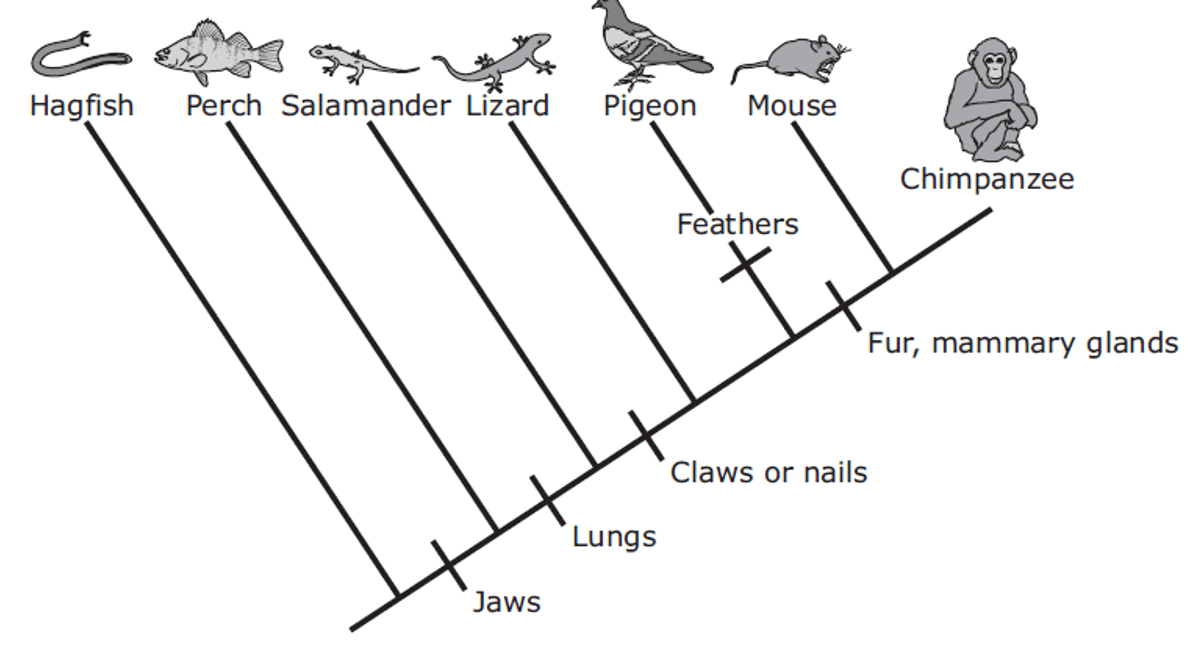
All the animals to the right of the hagfish would have the common characteristic of -
a)
Fur
b)
Claws or nails
c)
Lungs
d)
Jaws
112.

According to this cladogram, birds are LEAST related to -
a)
Amphibians
b)
Sharks
c)
Ray Finned Fish
d)
Crocodiles
113.
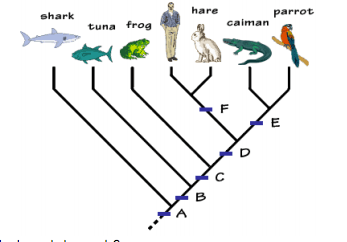
On the cladogram, which organism is the closest relative of the human?
a)
Frog
b)
Hare
c)
Caiman
d)
Parrot
114.

Which trait do only humans have, according to the cladogram?
a)
jaws
b)
mammary glands & hair
c)
terrestrial during all life stages
d)
opposable thumbs
115.

According to the cladogram, which organism is most distantly related to the human?
a)
crayfish
b)
rat
c)
perch
d)
frog
116.
Genetic differences between organisms of the same species
a)
Variation
b)
Adaptation
c)
Behavior
d)
Environment
117.
What is a diagram that shows characteristic relationships among organisms called?
a)
Cladogram
b)
Karyotype chart
c)
Punnet square
d)
Biogeography
118.
Which of the following must occur for speciation to happen?
a)
geographic isolation
b)
reproductive isolation
c)
temporal isolation
d)
behavioral isolation
119.
Which of the following is an example of reproductive isolation?
a)
two populations of finches that cannot produce viable offspring
b)
two populations of finches that have different feather colors
c)
two populations of salamanders that live in different lakes
d)
two populations of salamanders that have different tail lengths
120.
Which is an example of temporal isolation?
a)
flowers that bloom in different months
b)
birds that have different mating calls
c)
fruit flies that mate in different locations
d)
squirrels that have different fur colors
121.
Gentoo penguins will present a mate with a pebble that they find to attract a mate. Emperor penguins have a specific call and movement that they make to attract a mate. Which type of isolation do these penguins demonstrate?
a)
temporal isolation
b)
behavioral isolation
c)
geographical isolation
d)
anatomical isolation
122.
Does genetic drift decrease genetic diversity?
a)
No, because you are gaining alleles
b)
No, because new traits are formed
c)
Yes, because you lose alleles
d)
Yes, because you gain alleles
123.
What type of speciation involves geographic isolation?
a)
Allopatric
b)
Sympatric
c)
Both
124.
What type of speciation involves isolation due to behavior such as sexual selection or habitat differentiation?
a)
Allopatric
b)
Sympatric
c)
Both
125.
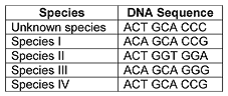
According to this data, the unknown bacterial species is most closely related to:
a)
Species I
b)
Species II
c)
Species III
d)
Species IV
126.

The hypothesis that evolution of a species occurs in periods of rapid change separated by periods of little or no change is called
a)
divergence
b)
gradualism
c)
punctuated equilibrium
d)
isolation
127.

The hypothesis that evolution of a species occurs gradually over time as a slow and constant process is known as
a)
speciation
b)
punctuated equilibrium
c)
gradualism
d)
microevolution
128.
Which Hardy-Weinberg factor represents the frequency of heterozygous individuals in a population?
a)
p2
b)
2pq
c)
q2
d)
p2 + 2pq
129.
Which Hardy-Weinberg equation represents the genotype frequencies in a population?
a)
p + q = 1
b)
p2 + 2pq + q2 = 1
c)
p2 + pq2 + q2 = 1
d)
p + 2pq + q3 = 1
130.
If a population has the following genotype frequencies: AA = 0.42, Aa = 0.46, and aa = 0.12, what are the allele frequencies?
a)
A = 0.42, a = 0.12
b)
A = 0.6, a = 0.4
c)
A = 0.65, a = 0.35
d)
A = 0.84, a = 0.24
131.
Genetic drift is likely to be seen in a population
a)
That has a low mutation rate
b)
In which natural selection is occurring
c)
That is very small
d)
For which environmental conditions are changing
132.
What does the Hardy-Weinberg equilibrium measure?
a)
changes in allele frequencies
b)
numbers of mutations
c)
goodness of fit
d)
genetic diversity
133.
If a population is not evolving, it is in genetic equilibrium.
a)
True
b)
False
134.
Which of the following is not an assumption required for Hardy-Weinberg equilibrium?
a)
Random mating
b)
No mutations
c)
Population size must fluctate
d)
No gene flow
135.
In the Hardy-Weinberg theorem, p refers to what?
a)
The frequency of the dominant allele.
b)
The frequency of the homozygous genotype.
c)
The frequency of the recessive allele.
d)
The frequency of the homozygous dominant.
136.
What does the variable q represent?
a)
Frequency of the heterozygote genotype
b)
Frequency of the homozygous recessive genotype
c)
The frequency of the recessive allele
d)
The frequency of the dominant allele
137.

Which of the three graphs shows stabilizing selection?
a)
A
b)
B
c)
C
138.

Which of the three graphs shows disruptive selection?
a)
A
b)
B
c)
C
139.

What type of selection?
a)
Directional
b)
Stabilizing
c)
Disruptive
140.
If finches with large beaks and finches with small beaks increase in a population while finches with average sized beaks decreases, which pattern of natural selection has occurred?
a)
Directional selection
b)
Disruptive selection
c)
Stabilizing selection
141.
An isotope is defined as having the same number of protons, but different number of ____________.
a)
Electrons
b)
Neutrons
c)
Protons
d)
Quarks
142.
The atomic number is equal to the number of _____________ in an atom.
a)
Neutrons
b)
Protons
c)
Isotope
d)
Mass Number
143.
An element that has lost or gained electrons is called an?
a)
Isotope
b)
Ion
c)
Allotrope
d)
Octet
144.
The dense, positively charged mass located in the center of the atom.
a)
nucleus
b)
proton
c)
isotope
d)
molecule
145.
Atoms of the same element must always have the same number of _________
a)
electrons
b)
neutrons
c)
isotopes
d)
protons
146.

How many protons are in this element?
a)
79
b)
196
c)
117
d)
Cannot be determined
147.
How many protons are in an atom with an atomic number of 20, an atomic mass of 45, and a charge of +2?
a)
20
b)
10
c)
2
d)
18
148.
How many neutrons are in an atom with an atomic number of 20, an atomic mass of 45, and a charge of +2?
a)
20
b)
25
c)
2
d)
18
149.

How many neutrons does the isotope of lithium have?
a)
8
b)
3
c)
4
d)
5
150.
How many electrons are in an atom that has an atomic number of 34, an atomic mass of 74 and a charge of -2?
a)
34
b)
36
c)
2
d)
40
151.

What do these isotopes of carbon all have in common?
a)
neutrons & mass number
b)
atomic number and neutrons
c)
atomic number and electrons
d)
protons, atomic number, and mass number
152.

What element is this? What is the mass number of this atom?
a)
sodium, 23
b)
magnesium, 23
c)
magnesium, 12
d)
sodium, 11
153.
I have an atom with 3 protons and 3 neutrons... what is this atom?
a)
Helium - 6
b)
Carbon - 7
c)
Lithium - 6
d)
Beryllium - 2
154.
What does Sodium do to become an ion?
a)
It doesn't.
b)
Gain 1 electron
c)
Gain 7 electrons
d)
Lose 1 electron
155.
In covalent bonds, atoms _____ electrons
a)
Give/Take
b)
Share
c)
Leave alone
d)
You never know.
156.
Covalent bonds are formed between...
a)
two metals
b)
two non-metals
c)
metal and a non-metal
d)
none of these
157.
What type of bond would Hydrogen and Oxygen make?
a)
Ionic
b)
Covalent
158.

How many electrons does potassium K contain? (click to see image)
a)
19
b)
39
c)
20
d)
40
159.

?
a)
Lithium
b)
Boron
c)
Carbon
d)
Neon
160.

?
a)
Helium
b)
Hydrogen
c)
Argon
d)
Silver
161.

What is the atomic number of this atom?
a)
2
b)
4
c)
6
d)
none of the above
162.
Coffee
a)
Heterogeneous
b)
Homogeneous
c)
A compound
163.
Lucky Charms
a)
Heterogeneous
b)
Homogeneous
c)
A compound
164.
DNA and RNA are examples of
a)
Carbohydrates
b)
Lipids
c)
Proteins
d)
Nucleic Acids
165.
Monosaccharides are monomers of
a)
Carbohydrates
b)
Lipids
c)
Proteins
d)
Nucleic Acids
166.
Nucleotides are monomers of
a)
Carbohydrates
b)
Lipids
c)
Proteins
d)
Nucleic Acids
167.
Glycerol and fatty acids are the monomers of
a)
Carbohydrates
b)
Lipids
c)
Proteins
d)
Nucleic Acids
168.
The organic compounds that have many structural purposes and are used in many processes within the
cell are called ____________________.
cell are called ____________________.
a)
Carbohydrates
b)
Lipids
c)
Proteins
d)
Nucleic Acids
169.

Which macromolecule is shown?
View Figure 1 (if not visible)
View Figure 1 (if not visible)
a)
lipid
b)
protein
c)
nucleic acid
d)
carbohydrate
170.
What are the four macromolecules?
a)
proteins, nucleic acids, carbohydrates, and lipids
b)
monosaccharides, lipids, polysaccaharides, and proteins
c)
RNA, DNA, proteins, and carbohydrates
d)
proteins, DNA, RNA, and steroids
171.
What is the function of carbohydrates?
a)
store genetic information
b)
store energy (long-term)
c)
store energy (short-term)
d)
build skin, hair, nails, muscles
172.
Define Dehydration Synthesis
a)
The use of H2O to break a bond between molecules
b)
the process of becoming thirsty
c)
the bonding of two molecules by the addition of H2O
d)
The bonding of two molecules by the removal of H2O
173.

What type of molecule is represented in the image?
a)
poly
sacch
aride
sacch
aride
b)
un
saturated fat
saturated fat
c)
saturated fat
d)
mono
sacch
aride
sacch
aride
174.

What molecule is represented in the image?
a)
amino acid
b)
carbs
c)
lipid
d)
mono
sacch
aride
sacch
aride
175.

What molecule is represented in the image?
a)
Protein
b)
Carbo
hydrate
hydrate
c)
lipid
d)
mono
sacc
aride
sacc
aride
176.
A(n) ______ is a substance with a pH less than 7
a)
Acid
b)
Alkaline
c)
Base
d)
Buffer
177.
A(n) _______ is a substance with a pH greater than 7.
a)
Base
b)
Acid
c)
Buffer
d)
Water
178.
The pH scale is based off of the concentration of _________ ions.
a)
Oxygen
b)
Hydronium (H+)
c)
Nitrogen
d)
None of the others
179.
Which of the following is NOT a product of the light reactions?
a)
ATP
b)
NADPH
c)
Oxygen
d)
Glucose
180.
What does ATP synthase do?
a)
Create ATP in chemiosmosis.
b)
Break down ATP in chemiosmosis.
c)
Break down NADPH.
d)
Create NADPH.
181.
Where is chlorophyll found in the chloroplast?
a)
in the stroma
b)
within photosystems
c)
in the ATP synthase
d)
in the electron carrier molecule
182.

What supplies the electrons that are lost in photosystem I (PSI)?
a)
the electrons from PS II
b)
water
c)
glucose
d)
oxygen
183.
What is the function of NADP+?
a)
It absorbs light
b)
It is an electron carrier
c)
It is a light-reflecting pigment
d)
It acts as long-term energy storage
184.
Which substance from the light-dependent reactions of photosynthesis is a source of energy for the light-independent reactions?
a)
ADP
b)
H2O
c)
NADPH
d)
pyruvic acid
185.
Which substance from the light-dependent reactions of photosynthesis is a source of energy for the light-independent reactions?
a)
ADP
b)
H2O
c)
NADPH
d)
pyruvic acid
186.
What is the ultimate source of energy for life on Earth?
a)
glucose
b)
sunlight
c)
ATP
d)
H2O
187.
What is the purpose of splitting water in PS2 of the light dependent reaction?
a)
Provides e- for PS2 and H+ for the thylakoid space
b)
To produce Oxygen for animals
c)
There is no purpose
188.
It is important to create a concentration of H+ in the thylakoid space so that the H+ can diffuse through_________ to create ______.
a)
ATP synthase, ATP
b)
NADH, NADPH
c)
proton pump, protons
189.

Where do the light reactions happen?
a)
mitochondria membrane
b)
thylakoid membrane
c)
stroma
d)
central vacuole
190.

Where are photosystems located?
a)
thylakoid space
b)
thylakoid membrane
c)
central vacuole
d)
stroma
191.

What supplies the electron that is lost in PS II?
a)
oxygen
b)
water
c)
glucose
d)
rubisco
192.

What are the two products of the light reactions that are needed for the calvin cycle?
a)
NAD and NADPH
b)
NADP + and Glucose
c)
NADPH and ATP
d)
Oxygen and NADPH
193.
What is the pigment in chloroplasts that performs photosynthesis?
a)
Chlorosynthesis
b)
Chlorophyll
c)
ADP
d)
Electron Transport
194.
What gas does the process of photosynthesis release into the atmosphere?
a)
oxygen
b)
carbon dioxide
c)
water
d)
nitrogen
195.
What is the function of NADP+?
a)
It absorbs light
b)
It is an electron carrier
c)
It is a light-reflecting pigment
d)
It acts as long-term energy storage
196.
Which of the following formulas represents photosynthesis?
a)
6 H2O + 6 O2 = C6H12O6 + 6 CO2
b)
6 H2O + 6 CO2 = C6H12O6 + 6 O2
c)
C6H12O6 + + 6 O2 = 6 H2O + 6 CO2
197.
Energy is released from ATP when
a)
a phosphate group is added
b)
a phosphate group is removed
c)
adenine binds to ribose
d)
ATP is exposed to sun
198.
Protons move into the thylakoid due to the
a)
concentration gradient in the stroma
b)
Brownian motion of the protons.
c)
peer pressure of the cool electrons in the stroma.
d)
movement of electrons through the electron transport chain
199.
Which of the following move through the electron transport chain?
a)
Protons
b)
Electrons
c)
Water
d)
Carbon Dioxide
200.
Which substance from the light-dependent reactions of photosynthesis is a source of energy for the light-independent reactions?
a)
ADP
b)
H2O
c)
NADPH
d)
pyruvic acid
201.

What is the name of the enzyme that fixes carbon in photosynthesis?
a)
Rubisco
b)
NADPH reductase
c)
Carbon Fixase
d)
Calvinase
202.

What is the product of the Calvin Cycle?
a)
Rubisco
b)
Glyceraldehyde 3-Phosphate (G3P)
c)
Oxygen
d)
Starch
203.

How many carbons does G3P have?
a)
1
b)
2
c)
3
d)
6
204.

18 is referring to a stack of these disc-shaped structures. What is this stack known as?
a)
lumen
b)
thylakoid
c)
granum
d)
stroma
205.
When carbon first enters the Calvin cycle, what molecule does it combine with?
a)
PGA
b)
G3P
c)
RuBP
d)
ATP
206.
Gel-like material that fills the space of the chloroplast is the
a)
stroma
b)
thylakoids
c)
cytoplasm
d)
mitochondria
207.
What is the name of the simple sugar that is produced in photosynthesis?
a)
Sucrose
b)
Dextrose
c)
Glucose
d)
Lactose
208.

Which is not a phase of the Calvin Cycle?
a)
Carbon Fixation
b)
Reduction
c)
Regeneration of RuBP
d)
Regeneration of Oxaloacetate
209.
The important gases, carbon dioxide and oxygen, enter and leave the leaf through the
a)
upper epidermis
b)
phloem
c)
stomata
d)
guard cells
210.

a)
Grana
b)
Thylakoid
c)
Stroma
d)
Jelly Filling
211.
Glycolysis results in the net gain of:
a)
2 ATP
b)
4 ATP
c)
4 NADH
d)
2 Acetyl CoA
212.
Which of the following is not a product of glycolysis?
a)
FADH2
b)
NADH
c)
ATP
d)
Pyruvate
213.
NADH is produced by the oxidation of:
a)
G3P
b)
DHAP
c)
PEP
d)
1,3 BPG
214.
Where does glycolysis take place in cells?
a)
Cytoplasm
b)
Mitochondrion
c)
Endoplasmic Reticulum
d)
Ribosomes
215.

What is the correct order of cellular respiration?
a)
ETC, Krebs Cycle, Acetyl coA Formation, Glycolysis
b)
ETC, Acetyl coA Formation, Glycolysis, Krebs Cycle
c)
Glycolysis, ETC, Acetyl coA Formation, Krebs Cycle
d)
Glycolysis, Acetyl coA Formation, Krebs Cycle, ETC
216.
Where does the Krebs Cycle take place?
a)
Matrix
b)
cristae
c)
cytoplasm
d)
nucleus
217.
How many CO2 molecules are produced by the Krebs Cycle for a molecule of glucose?
a)
2
b)
4
c)
6
d)
3
218.
Krebs Cycle is part of_______________ respiration.
a)
Aerobic
b)
Anaerobic
219.
What is the correct equation for cellular respiration?
a)
6O2 + C6H12O6 -> 6CO2 + 6H2O + Energy
b)
6O2 + C6H12O6 + Energy -> 6CO2 + 6H2O
c)
6CO2 + 6H2O -> 6O2 + C6H12O6 + Energy
d)
6CO2 + 6H2O + Energy -> 6O2 + C6H12O6
220.
Before entering Krebs Cycle, pyruvate is:
a)
Oxidized
b)
Reduced
c)
Isomerized to Acetyl-CoA
d)
Phosphorylated
221.
Prior to entering the Krebs Cycle, each pyruvate molecule loses electrons, hydrogen ions, and a carbon, forming an energy-rich molecule of
a)
Acetyl-CoA
b)
Citrate
c)
Oxaloacetate
d)
Malate
222.
The "regenerator" of the Krebs Cycle is:
a)
Oxaloacetate
b)
Acetyl-CoA
c)
Citrate
d)
α-Ketoglutarate
223.
Which molecule(s) go into the Kreb's cycle?
a)
glucose
b)
2 pyruvate
c)
2 acetyl CoA
d)
NADH and FADH2
224.
What job does NADH and FADH2 do?
a)
they carry ATP
b)
they carry electrons
c)
they carry neutrons
d)
they carry H2O
225.
Which organelle is called the "powerhouse" of the cell because it makes most ATP?
a)
nucleus
b)
chloroplast
c)
mitochondrion
d)
ribosome
226.
What are the total products in glycolysis + pyruvate conversion + Kreb's cycle?
a)
2 NADH, 2 FADH2, 6 CO2, 4 ATP
b)
10 NADH, 2 FADH2, 6 CO2, 4 ATP
c)
6 NADH, 10 FADH2, 2 CO2, 2 ATP
d)
2 NADH, 6 FADH2, 3 CO2, 2 ATP
227.
Where does the electron transport chain take place in cells?
a)
cytoplasm
b)
mitochondria matrix
c)
mitochondria inner membrane
d)
chloroplast
228.
In animal cells, what are the 3 products of anaerobic respiration?
a)
2 ATP, 2 NAD and lactic acid
b)
4 ATP, 2 NADH and ethanol
c)
2 ATP, 2 CO2 and lactic acid
d)
32 ATP, 6 H2O and ethanol
229.
Which of the following is TRUE regarding anaerobic respiration/fermentation?
a)
it produces more ATP than aerobic respiration and doesn't require oxygen
b)
it produces far less ATP than aerobic respiration and doesn't require oxygen
c)
it produces more ATP than aerobic respiration and requires oxygen
d)
it produces far less ATP than aerobic respiration and requires oxygen
230.
In the electron transport chain of respiration, the energy of the electrons is used to___________________.
a)
pumpt H+ ions outside of the inner membrane forming a concentration gradient
b)
make glucose
c)
break down glucose
d)
form NADH and FADH2
231.
packages proteins for delivery
a)
Endoplasmic reticulum
b)
ribosomes
c)
golgi apparatus
d)
lysosomes
232.
collect sunlight which it converts to sugars
a)
chloroplasts
b)
cytoplasm
c)
cell wall
d)
mitochondria
233.
hold/store water, mainly found in plant cells
a)
nuclolus
b)
ribosomes
c)
golgi bodies
d)
vacuoles
234.
break down (digest) worn out cell parts, mostly in animal cells
a)
cytoplasm
b)
lysosomes
c)
mitochondria
d)
vacuoles
235.
Transportation network for the cell, moves materials around in the cell
a)
Lysosome
b)
Nuclear Membrane
c)
Endoplasmic Reticulum
d)
Centriole
236.

What am I?
a)
vacuole
b)
ribosome
c)
endoplasmic reticulum
d)
golgi apparatus
237.
In what organelle is the genetic material found inside?
a)
Endoplasmic Reticulum
b)
Golgi Complex
c)
Nucleolus
d)
Nucleus
238.

I make proteins for the cell. What am I?
a)
ribosome
b)
mitochondria
c)
chloroplast
d)
lysosome
239.
cells can communicate by Direct Contact. Which of the following is NOT an example of direct contact?
a)
Direct intracellular Signalling (buy cell junctions)
b)
Contact Dependent Signaling (cell to cell recognition)
c)
Intracellular Contact (using lysosomes)
d)
None of the above are examples of Direct Contact
240.
Messenger molecules are divided into two types, which are:
a)
Local and Long
b)
Fast and Slow
c)
Green and Blue
d)
Square and Circle
241.
Synaptic Signaling occurs in which type of cell?
a)
Muscle cell
b)
Nervous System cell
c)
White Blood Cell
d)
Red Blood
242.
paracrine signals affect
a)
the cell that sent the signal
b)
the cell that sent the signal and the surrounding cells
c)
only the surrounding cells but not itself
d)
no cells
243.
How many stages are there to cell conversation?
a)
4
b)
6
c)
3
d)
87
244.
The three stages of cell signalling are
a)
paracrine, local, and synaptic
b)
reception, transduction, and response
c)
transcription, translation, and folding
d)
alpha, beta, and gamma
245.
1. Each of the following numbered processes are involved in signal transduction pathways:
I. Response
II. Amplification
III. Reception
IV. Transduction
Which of the following represents the sequence of events in a typical signal transduction pathway?
I. Response
II. Amplification
III. Reception
IV. Transduction
Which of the following represents the sequence of events in a typical signal transduction pathway?
a)
I, II, III, IV
b)
III, I, IV, II
c)
II, IV, I, III
d)
III, IV, II, I
246.
Testosterone does not affect all cells of the body because __________.
a)
testosterone cannot cross the plasma membrane
b)
not all cells have cytoplasmic receptors for testosterone
c)
not all cells in the body have membrane receptors for testosterone
d)
it is a local regulator
e)
it affects only cells that have ion-channel receptors
247.
What determines whether a cell is a target cell for a particular signal molecule?
a)
phosphorylation cascade
b)
cAMP
c)
signal receptors
d)
phosphatase
248.
A cell is known to respond to a particular signaling molecule. Which of the following must be true of this cell?
a)
It is in the heart muscle
b)
it is also the site of production for the signaling molecule
c)
It contains the receptor for the signaling molecule
d)
It is incapable of signal transduction
249.
For cells to stay alive they require what type of SA:V?
a)
Large SA, Large V
b)
Small SA, Large V
c)
Large SA, Small V
d)
Small SA, Small V
250.

Microvilli are tiny projections that extend off the cell to increase the Surface Area. What purpose might that serve?
a)
Increased absorption
b)
Better communication among cells
c)
Maintain homeostasis
d)
Decreased oxygen use
100 %

