
 Worksheets
Energy Unit Test
Total questions: 51
Worksheet time: 38mins
Name
Class
Date
1.
A girl turned the light off and went to bed. She remembered she had accidentally left her glass of ice water on the counter. When she got up the next morning, the ice had melted. What form of energy caused the ice to melt?
a)
Sound energy
b)
Light energy
c)
Thermal energy
d)
Mechanical energy
2.

A student created an electrical circuit, shown.
Which of the following statements is true about the circuit?
Which of the following statements is true about the circuit?
a)
The electrical circuit is working.
b)
The electrical circuit is open.
c)
The electrical circuit is complete.
d)
The electrical circuit is closed.
3.
Which form of energy is produced when a guitar string vibrates?
a)
Sound energy
b)
Electrical energy
c)
Chemical energy
d)
Light energy
4.
Which form of energy is produced when a lamp is switched on?
a)
Sound energy
b)
Electrical energy
c)
Chemical energy
d)
Light energy
5.
Biomass, petroleum, natural gas, propane, and coal are examples.
a)
Chemical Energy
b)
Radiant Energy
c)
Stored Mechanical Energy
d)
Gravitational Energy
6.
Stored energy
a)
Thermal Energy
b)
Stored Mechanical Energy
c)
Kinetic Energy
d)
Potential Energy
7.
Energy stored in the nucleus of an atom-the energy that holds the nucleus together. The energy in the nucleus of a uranium atom is an example.
a)
Electrical Energy
b)
Nuclear Energy
c)
Radiant Energy
d)
Potential Energy
8.
Energy of place or position.
a)
Gravitational Energy
b)
Mechanical Energy
c)
Thermal Energy
d)
Chemical Energy
9.
Motion Energy
a)
Stored Mechanical Energy
b)
Potential Energy
c)
Electrical Energy
d)
Kinetic Energy
10.
Solar energy is an example.
a)
Sound Energy
b)
Thermal Energy
c)
Radiant Energy
d)
Gravitational Energy
11.
Wind and hydropower are examples.
a)
Chemical Energy
b)
Gravitational Energy
c)
Mechanical Energy
d)
Sound Energy
12.
Movement of electrons.
a)
Nuclear Energy
b)
Radiant Energy
c)
Mechanical Energy
d)
Electrical Energy
13.
All energy transformations end in
a)
electricity.
b)
thermal.
c)
mechanical.
d)
chemical.
14.
Which of the following energy transformations occur when a lamp that is plugged into a wall socket is functioning correctly?
a)
Chemical to light
b)
Electrical to chemical
c)
Electrical to light
d)
Chemical to electrical
15.
What energy transformations take place when a battery-operated radio is in use?
a)
Electrical to chemical to light
b)
Sound to chemical to mechanical
c)
Chemical to electrical to sound
d)
Light to electrical to thermal
16.
People get energy from the food that they eat and transform that energy as they move. Which energy transformations occur as a student rapidly rubs the palms of his hands together?
a)
mechanical to thermal to electrical
b)
chemical to mechanical to thermal
c)
mechanical to chemical to sound
d)
chemical to sound to electrical
17.

The diagram shows a complete circuit with a battery and a buzzer making noise. This circuit works by transforming -
a)
chemical energy to electrical to sound.
b)
electrical energy to thermal to light.
c)
sound energy to electrical to chemical.
d)
mechanical energy to electrical to sound.
18.

Which of the following best describes the energy transformations that occur when a flashlight that runs on batteries is turned on?
a)
chemical to mechanical to electrical to radiant
b)
radiant to electrical to sound
c)
chemical to radiant to mechanical to electrical
d)
electric to radiant to chemical
19.
Which of the following shows the correct order of the energy transformations that occur when green plants produce their food from the Sun’s energy?
a)
chemical to thermal
b)
light to chemical
c)
thermal to light
d)
chemical to electrical
20.
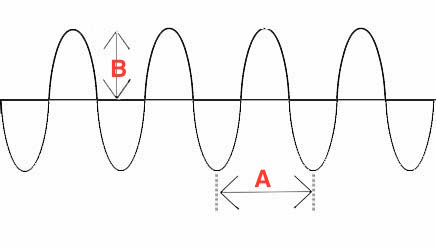
What property of this wave is represented by the letter "A"
a)
amplitude
b)
crest
c)
trough
d)
wavelength
21.
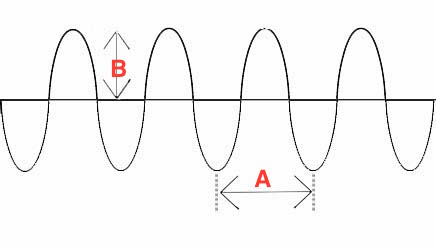
What property of the wave is represented by the letter "B"?
a)
amplitude
b)
crest
c)
trough
d)
wavelength
22.
The highest point on a wave is:
a)
the crest
b)
the trough
c)
the top
d)
the coast
23.
The lowest point on a wave is the:
a)
Amplitude
b)
Crest
c)
Trough
d)
Wavelength
24.
The number of wavelengths that pass a point each per second is:
a)
frequency
b)
period
c)
longitudinal
d)
transverse wave
25.
The type of waves that require medium to pass:
a)
Mechanical Waves
b)
Electromagnetic Waves
26.

Which vocabulary term is used to identify the distance between points C & G?
a)
Amplitude
b)
Crest
c)
Frequency
d)
Wavelength
27.
When the frequency of a wave increases, what happens to the wavelength?
a)
The wavelength is not directly affected by the frequency of a wave.
b)
The wavelength increases.
c)
The wavelength decreases.
d)
More specific information is needed to form a conclusion about the wavelength.
28.
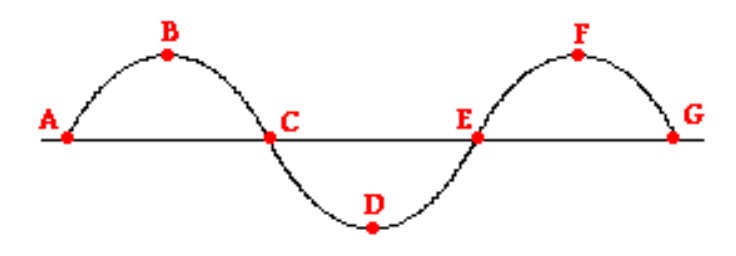
Which letter(s) represent the trough of the wave?
a)
A
b)
B & D
c)
D
d)
C & G
29.
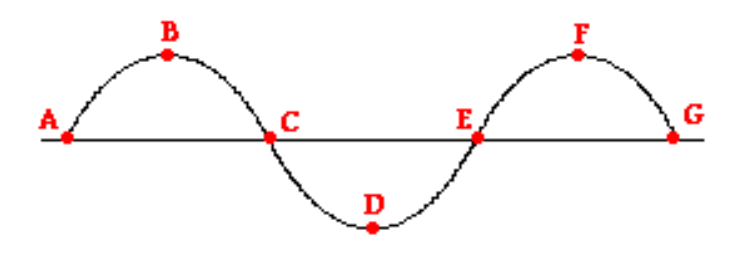
Which letter(s) represent the crest of the wave?
a)
A
b)
B & D
c)
B & F
d)
F
30.
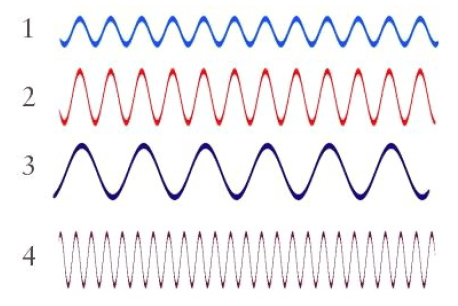
Which wave in the diagram has the greatest frequency?
a)
1
b)
2
c)
3
d)
4
31.
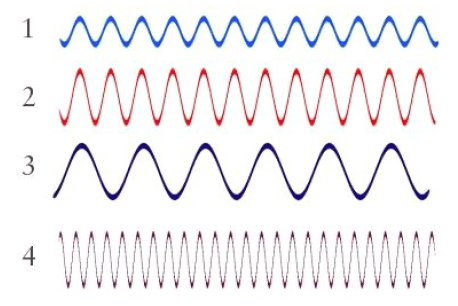
Which wave in the diagram has the greatest wavelength?
a)
1
b)
2
c)
3
d)
4
32.
crest to crest or trough to trough
a)
crest
b)
trough
c)
amplitude
d)
wavelength
33.
In a longitudinal wave, the particles move...?
a)
back and forth
b)
up and down
c)
not at all
d)
at a 90 degree angle
34.
What do we call the part of a compressional wave that is when the waves are squeezed together?
a)
compression
b)
rarefaction
c)
crest
d)
trough
35.
What do we call the part of a compressional wave that is spread a part?
a)
compression
b)
rarefaction
c)
crest
d)
trough
36.
Conduction is heat transfer by -
a)
Touch
b)
Circles
c)
Waves
37.
Convection is heat transfer by-
a)
Touch an object
b)
The heating and cooling of a fluid
c)
Electromagnetic Waves
38.

When the 2nd story of a house is warmer than the 1st floor of a house is heat transfer through
a)
conduction
b)
convection
c)
radiation
d)
thermal equilibrium
39.

The sun warming your skin is an example of heat transfer through
a)
conduction
b)
convection
c)
radiation
d)
thermal electricity
40.

If you replace the paper clip with a plastic spoon, what happens?
a)
The bulb doesn't light
b)
The bulb is dimmer
c)
The wires get hot
d)
There is no change
41.
A series circuit has ____ path(s) that the electric current can take.
a)
One
b)
Two
c)
Three
d)
Four
42.
In a parallel circuit, if one connection is broken, all of the connections stop working.
a)
True
b)
False
43.

What kind of circuit is this?
a)
series
b)
parallel
44.
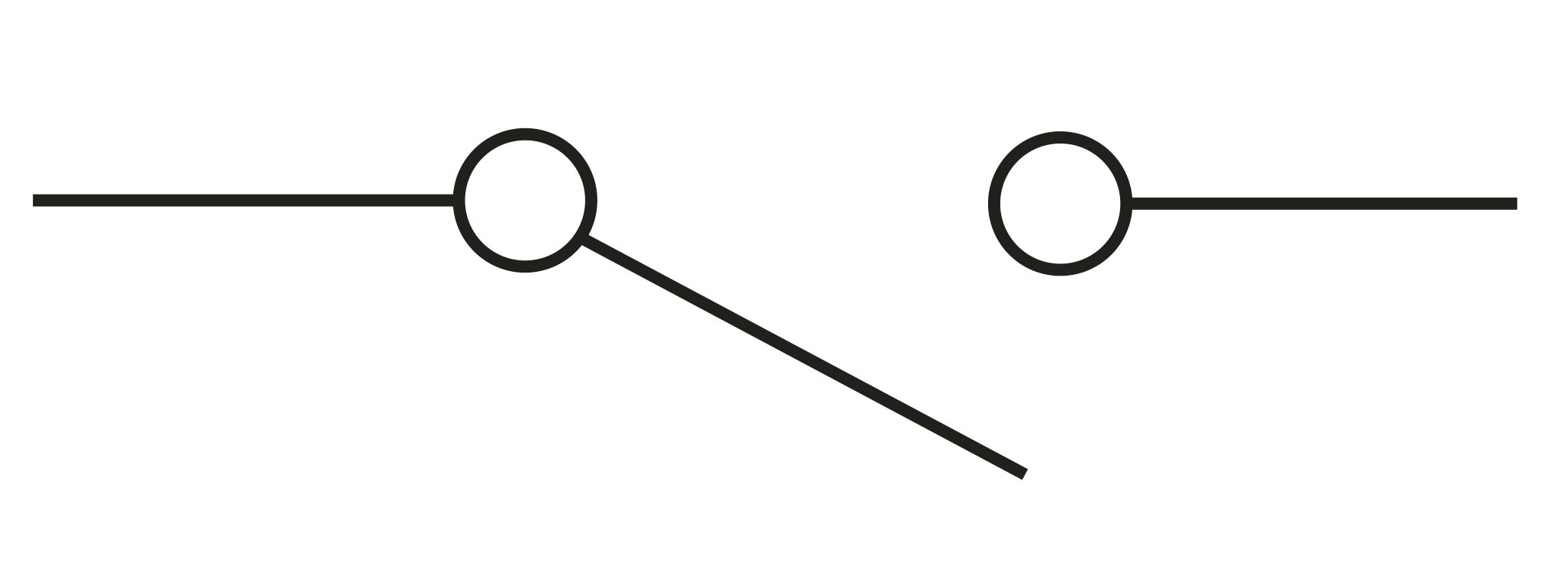
this is the symbol for a _____?
a)
switch
b)
light
c)
battery
d)
wires
45.

What kind of circuit is this?
a)
Series
b)
Consecutive
c)
Parallel
d)
Training
46.
In a parallel circuit if one light bulb goes OUT; then they ALL go out. TRUE OR FALSE?
a)
TRUE
b)
FALSE
47.
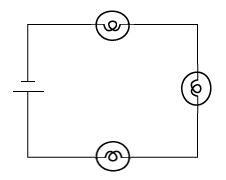
The picture shows an electrical circuit. This circuit is a series circuit because:
a)
It has 3 light bulbs.
b)
The same current flows through all three light bulbs.
c)
It uses a single battery.
d)
The electrical current has more than one path to flow through
48.
In a Series circuit the more lightbulbs you add the brighter they get
a)
False
b)
True
49.
What is a Parallel circuit?
a)
Has only one path
b)
Has more than one path
c)
Allows energy to travel through easily
d)
Has only one light bulb
50.
This circuit has more than one loop. When one light goes out, the others stay on.
a)
closed circuit
b)
series circuit
c)
parallel circuit
d)
open circuit
51.
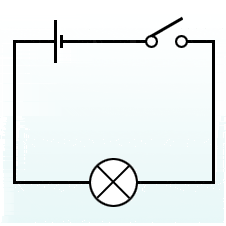
this circuit is .....?
a)
open
b)
parallel
c)
closed
d)
The cutest little circuit evah!
100 %

