Worksheets
PBS - Unit 4 Review
Total questions: 40
Worksheet time: 37mins
A measure of cardiac activity usually expressed as the number of beats per minute.
heart rate
carotid pulse
blood pressure
radial pulse
The rhythmic expansion and recoil of arteries resulting from heart contraction; can be felt from the outside of the body.
blood pressure
pulse
hypertension
systolic pressure
Blood pressure that remains between heart contractions
Diastolic pressure
Systolic Pressure
Hypertension
Hypotension
An acute episode of heart disease marked by death or damage of heart muscle due to insufficient blood supply to the heart muscle
carotid pulse
myocardial infarction
hypertension
stroke
A small mass of tissue made up of Purkinje fibers and other nerve cells that is embedded in the right atrium and that originates the impulses stimulating the heartbeat.
Bundle branches
Sinoatrial (SA) node
Atrioventricular (AV) Node
Purkinje fibers
Which lipoprotein decreases your chances of heart disease?
HDL
DLD
Triglycerides
PDL
What is the genotype for someone who is homozygous for familial hypercholesterolemia?
ff
Ff
FF
Familial hypercholesterolemia is not a genetic disorder
What process is used to analyze and compare DNA?
Micropipetting
Transcription
Gel Electrophoresis
Protein Synthesis
Can someone be a carrier of the FH allele without having FH?
Yes, because it is a recessive allele
Yes, because it is a dominant allele
No, because it is a recessive allele
No, because it is a dominant allele
If both parents are heterozygous for FH, what are the chances that their offspring will NOT have the disorder.
100%
75%
50%
25%
What is atherosclerosis?
Plaque build up in the inner walls of arteries
Plaque build up in the heart chambers
Irregular contraction of the ventricles
Irregular contraction of the atria
The largest vein in the human body; it returns blood to the right atrium from the lower body.
Carotid artery
Superior Vena Cava
Inferior Vena Cava
Pulmonary Vein

The t-wave correlates with which event?
atrial contraction/signals moving from the SA node to the AV node
ventricular contraction
ventricle repolarization
both atrial and ventricular contraction

The AV node is located at....
A
B
C
D
How do statins work to lower cholesterol?
Inhibit an enzyme in the liver from producing cholesterol
Inhibit the receptor for HDL on cells
Inhibit the receptor for LDL on cells

The p-wave correlates with which event?
atrium contraction/signals moving from SA node to AV node
ventricle contraction
ventricle repolarization
both atrial and ventricular contraction
Which of the following is NOT a direct indicator of a person's cardiac health?
Heart Rate
Blood Pressure
EKG
Temperature

Lane 1 is normal DNA. Lane 2 is the FH mutation. What is the genotype of the patient in lane 5?
homozygous for the FH mutation
heterozygous for the FH muation
does not have the FH mutation
A(n) _____________ is an imaging test that uses dye and x-rays to view your body's blood vessels
angioplasty
angiogram
MRI
stent
Compared to arteries, veins generally
carry faster moving blood
are thinner walled
have more smooth muscle
experience more hydrostatic pressure
An abnormal T wave of an EKG could represent problems with
ventricular depolarization
ventricular repolarization
atrial depolarization
atrial repolarization
This structure of the heart is responsible for preventing blood from flowing in the wrong direction
auricle
ventricle
artery
valve
The right side of the heart contains ____________ blood and the left side contains ____________ blood.
oxygenated, deoxygenated
deoxygenated, oxygenated
both deoxygenated
both oxygenated
What is tachycardia?
abnormally fast heartbeat
abnormally slow heartbeat
abnormally powerful heart contractions
abnormally weak heart contractions
A valve in the heart that guards the opening between the left atrium and the left ventricle; it's alternative name is the bicuspid valve
Tricuspid valve
Aortic valve
Pulmonary valve
Mitral Valve
A valve that is situated at the opening of the right atrium; it consist of three triangular membranous flaps.
Tricuspid valve
Mitral valve
Bicuspid valve
Aortic valve
What is the name of the "bands" seen when analyzeing the results of gel electrophoresis
restriction enzyme
double helicase
restriction fragment length polymorphism
gels
Which choice shows a diagnostic procedure?
stent inisertion
angiogram
angioplasty
coronary artery bypass graft
How do the respiratory and circulatory systems work together?
The circulatory system takes in oxygen, while the respiratory system delivers oxygen to the cells.
The respiratory system takes in carbon dioxide while the circulatory system delivers carbon dioxide to the cells.
The respiratory system takes in oxygen while the circulatory system delivers oxygen to the cells.
The circulatory system takes in carbon dioxide, while the respiratory system delivers carbon dioxide to the cells.
The pacemaker of the heart is the
SA node
AV node
SV node
All of them
The purpose of PCR (polymerase chain reaction) is to
amplify the amount of DNA in a sample
amplify the amount of HDL in the liver
amplify the amount of statins in the blood
amplify the amount of restriction enzymes
In an EKG the p-wave is completely absent. What is not happening in the heart?
the ventricles are not contracting
the SA node is not firing
the atria are not contracting
the ventricles are not contracting
Which of the following is NOT true of cholesterol?
it is a protein that helps produce bile
it is necessary to support learning and memory
it is an essential component of the cell membrane
it is a precursor to biologically important steroid hormones
Cholesterol is synthesized in the _________ and absorbed from the food we eat in the
small intestines; gall bladder
liver; stomach
liver; small intestines
none of the answer choices are correct

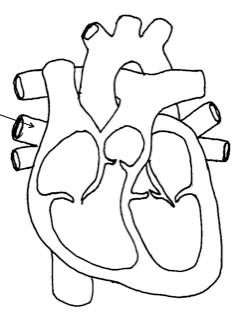
Label 8
right atrium
left atrium
right ventricle
left ventricle
Label 5
aortic valve
mitral valve
tricuspid valve
pulmonary valve